The Jakarta Post
Please Update your browser
Your browser is out of date, and may not be compatible with our website. A list of the most popular web browsers can be found below.
Just click on the icons to get to the download page.


Popular Reads
Top Results
No results found. Please check your search term and try again
Can't find what you're looking for?
View all search results
Popular Reads
Top Results
No results found. Please check your search term and try again
Can't find what you're looking for?
View all search resultsNot just numbers
When human lives are reduced to statistical "error rates," our social contract fails the very people it was built to protect, from a child lacking a notebook to a patient denied life-saving care by a spreadsheet.
Change text size
Gift Premium Articles
to Anyone
Share the best of The Jakarta Post with friends, family, or colleagues. As a subscriber, you can gift 3 to 5 articles each month that anyone can read—no subscription needed!
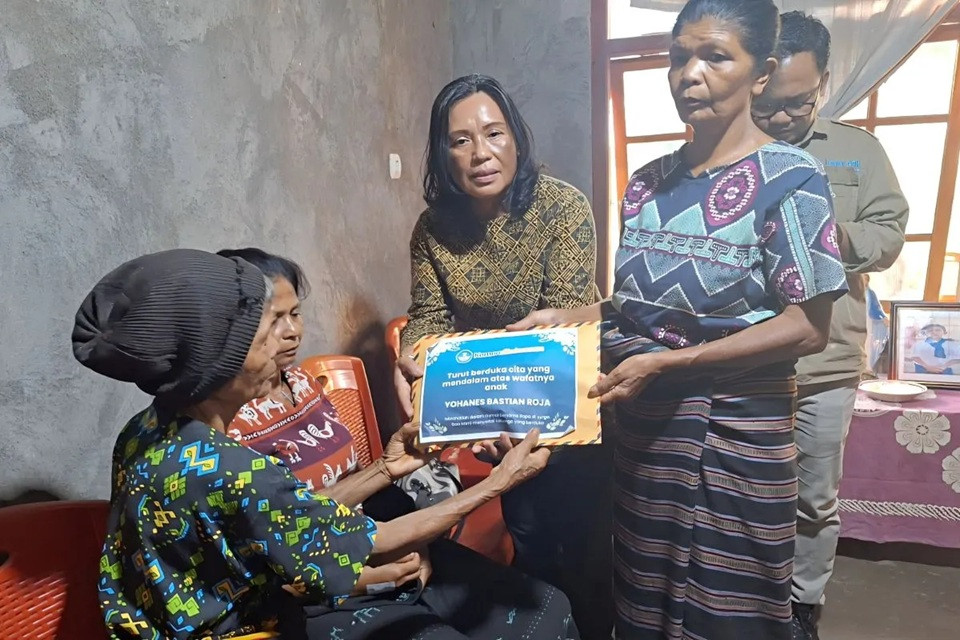 Family members of an elementary school pupil who committed suicide display a package of assistance from the Elementary and Secondary Education Ministry at their home in Ngada regency, East Nusa Tenggara on Feb. 5, 2026. (Antara/Public Relations Bureau of Primary and Secondary Education Ministry)
T
he tragedy in Ngada, East Nusa Tenggara, where a 10-year-old elementary school pupil reportedly took his own life because his family could not afford basic school supplies, should have stopped us cold in our tracks.
So should the separate, quieter emergency in clinics and hospitals nationwide. There, thousands of chronically ill Indonesians have found themselves turned away from subsidized care because they fell through the cracks of a technical eligibility check in the national health insurance system.
These are not the same story. One is a single death; the other is a bureaucratic gate that endangers many lives. Yet they rhyme in a way that ought to worry any policymaker who claims to put people first: Both point to a governing instinct that prizes neat categories, targets and “success rates” over the messy, human realities that public services exist to protect.
The state has no shortage of slogans about inclusive development. It also has no shortage of programs that look impressive on paper. We see goals of nutrition treated as markers of growth and legacy, while the rapid construction of schools and subsidized housing outstrips the supply of quality teachers or the ability of residents to maintain homeownership. But when a child’s dignity collapses under the weight of a notebook and a pen, or when a patient with a chronic condition is told to come back later because their status is "inactive," it is hard to argue that our basic social contract is working as intended.
Observers may be tempted to frame both episodes simply as “budget misallocation”, arguing that a large, constitutionally mandated education budget is unable to serve even a single child in desperate poverty. While that critique is warranted, it is incomplete. The deeper issue is how decisions are being made and defended: by aggregating citizens into statistics, then using those aggregates as moral cover when the outliers suffer.
We have seen this logic before. When President Prabowo Subianto defended the free nutritious meal program amid reports of mass food poisoning, the public message was that the affected cases represented a tiny fraction of the total meals distributed. Even if the percentage is mathematically small, the governing lesson should have been the opposite: A program that feeds children must be held to a higher standard precisely because the harm is borne by the most vulnerable.

In public services, the “error rate” is a warning light.