The Jakarta Post
Please Update your browser
Your browser is out of date, and may not be compatible with our website. A list of the most popular web browsers can be found below.
Just click on the icons to get to the download page.


Popular Reads
Top Results
No results found. Please check your search term and try again
Can't find what you're looking for?
View all search results
Popular Reads
Top Results
No results found. Please check your search term and try again
Can't find what you're looking for?
View all search resultsSix shades of leadership: A Davos barometer
As the traditional global order fractures, Davos 2026 reveals a new reality: The future no longer belongs to those with the most eloquent rhetoric, but to the leaders combining technical competence with the quiet confidence of actual delivery.
Change text size
Gift Premium Articles
to Anyone
Share the best of The Jakarta Post with friends, family, or colleagues. As a subscriber, you can gift 3 to 5 articles each month that anyone can read—no subscription needed!
 Set as preferred source
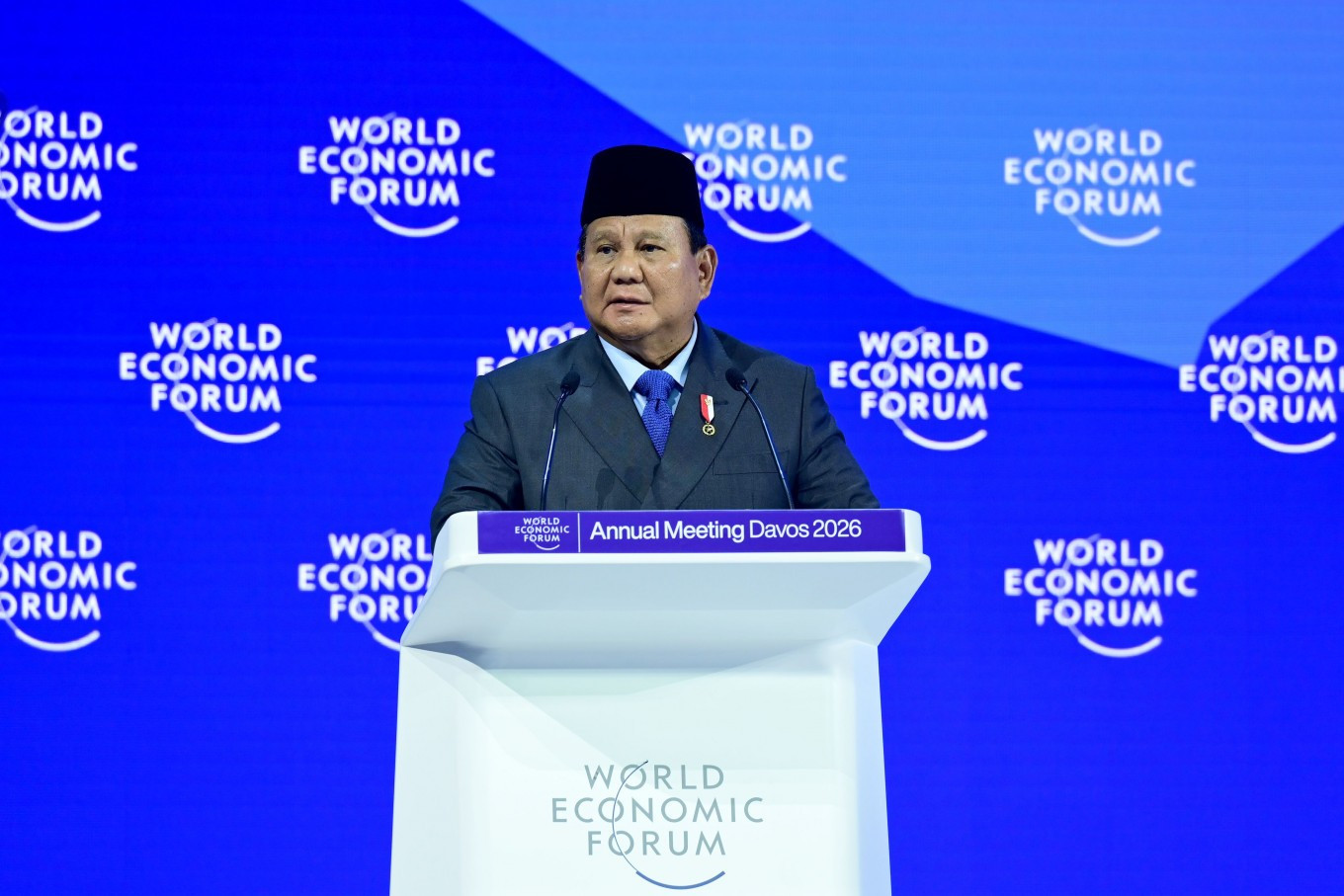 President Prabowo Subianto delivers his keynote speech on Jan. 22, 2026, during his debut at the World Economic Forum (WEF) in Davos, Switzerland. (Presidential Secretariat/Muchlis Jr)
T
he World Economic Forum (WEF) in Davos, Switzerland, is not merely an assemblage of elites; it is a barometer of the zeitgeist. Each year, it reveals how leaders interpret power, responsibility and risk in a changing world. This year’s interventions presented six distinct shades of leadership, conveyed through four key perspectives and embodied by two central actors. Together, they present not consensus, but a sharp study in contrast.
The first shade was managerial stewardship, articulated by Canadian Prime Minister Mark Carney. His address pointed to a moment of "rupture." He argued that intensifying great-power rivalry has led countries to seek "greater strategic autonomy," creating a "world of fortresses."
Carney’s speech was rooted in institutional confidence. He framed the strengthening of domestic economies and collective investment in resilience as twin objectives, arguing for a world order that respects human rights, sustainable development and sovereignty. His Davos was a call to be "principled and pragmatic" rather than to re-architect the global order. This was leadership that trusts existing institutions and believes the world still has the patience to let them work.
The second shade was transactional disruption, communicated by United States President Donald Trump. His rhetoric rejected multilateral restraint in favor of bilateral leverage, presenting economic gain as an overriding priority and alliances as instruments rather than obligations. The message was clear: prosperity follows power, not process. As Trump put it, "We're a great power [...] I think they found that out." With a focus on tariffs and trade deficits, his Davos was interested only in outcomes, not rules, in immediacy, not institution-building.
The third shade was a desire for normative leadership, expressed by European Commission President Ursula von der Leyen. She sought to reaffirm Europe’s belief that values can still anchor power, citing climate leadership, rules-based trade and responsible digital cooperation as sources of strategic strength.
Yet, there lay an unresolved tension: Europe’s influence rests on standards, but its ability to enforce them is being tested by a world that respects speed, scale and leverage more than value-based persuasion. Von der Leyen’s was a Davos of aspiration, eloquent and principled, but also one of wistfulness: "The cooperative world order we imagined 25 years ago has not turned into reality."

The fourth shade was a return to the principle of inclusion, articulated by Indonesian President Prabowo Subianto. The conviction that "there will be no prosperity without peace" framed his speech. Prabowo highlighted Indonesia’s recognition as a "global bright spot," a result of a legacy of "unity over fragmentation and collaboration over confrontation," alongside a consistently unblemished record of debt repayment. His Davos was one of excellence at home and cooperation with the world on mutually beneficial terms, proving that sound domestic investment creates international gravity.