TheJakartaPost
Please Update your browser
Your browser is out of date, and may not be compatible with our website. A list of the most popular web browsers can be found below.
Just click on the icons to get to the download page.


Popular Reads
Top Results
No results found. Please check your search term and try again
Can't find what you're looking for?
View all search results
Popular Reads
Top Results
No results found. Please check your search term and try again
Can't find what you're looking for?
View all search resultsIndonesia, BRICS and the rise of the Global South
BRICS expansion reflects a deeper shift toward a Global South-driven framework for cooperation, representation and influence.
Change text size
Gift Premium Articles
to Anyone
Share the best of The Jakarta Post with friends, family, or colleagues. As a subscriber, you can gift 3 to 5 articles each month that anyone can read—no subscription needed!
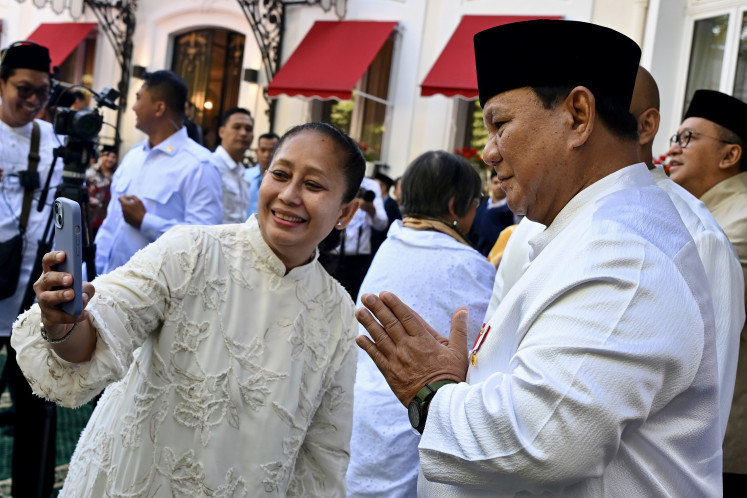
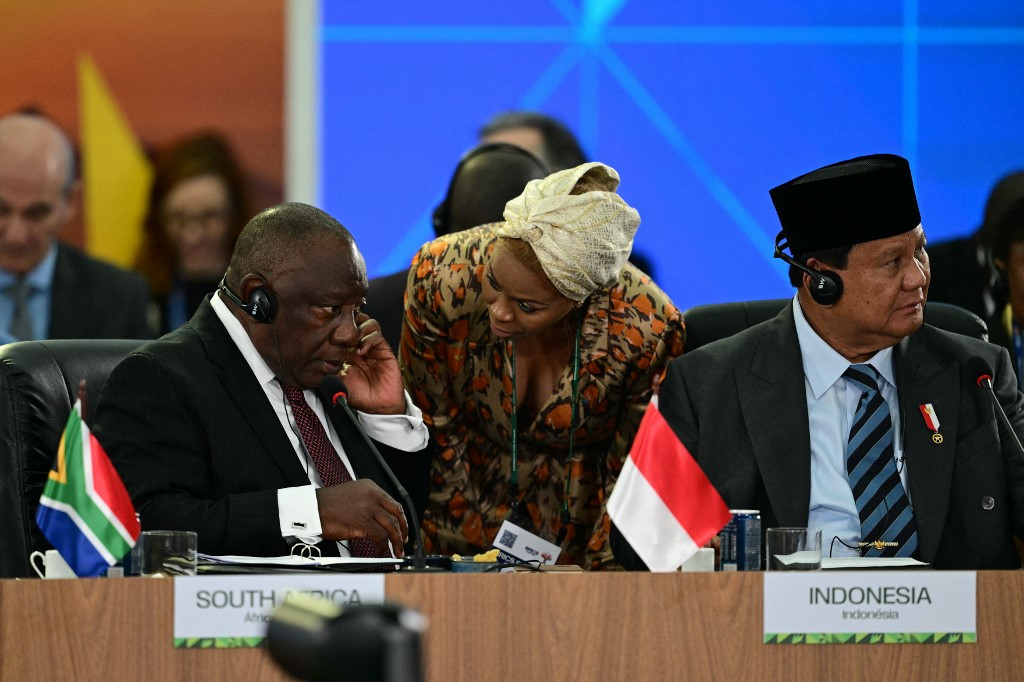 South Africa's President Cyril Ramaphosa (left) talks with an advisor next to President Prabowo Subianto during a July 7, 2025, plenary session of the BRICS summit in Rio de Janeiro, Brazil. (AFP/Pablo Porciuncula)
T
he global order is undergoing a profound transformation. The Western-centric system that dominated the post-Cold War era is gradually giving way to a more complex and multipolar landscape, one that is less predictable, but also richer in opportunity for emerging powers. In this context, the expanding role of BRICS has become one of the most significant developments in contemporary international politics.
Originally formed by Brazil, Russia, India, China and South Africa, BRICS has evolved from an economic grouping into a strategic platform seeking to reform global governance and challenge the dominance of Western-led institutions. Its recent expansion, bringing in countries such as Indonesia, Egypt, Ethiopia, the United Arab Emirates and Iran, signals more than numerical growth. It reflects a deeper shift toward a Global South-driven framework for cooperation, representation and influence.
Indonesia’s inclusion is particularly consequential. As Southeast Asia’s largest economy, the world’s third-largest democracy, and an active member of ASEAN, the G20 and the Organisation of Islamic Cooperation, Indonesia brings both legitimacy and strategic weight to BRICS. Its membership expands the group’s geographical reach into Southeast Asia, and strengthens its claim to represent a broader spectrum of the developing world.
From a strategic perspective, Indonesia’s engagement with BRICS offers several opportunities. Economically, it opens access to alternative financial mechanisms and trade networks beyond traditional Western-dominated institutions. Politically, it enhances Indonesia’s voice in South-South cooperation and strengthens its bargaining position in an increasingly polarized international system.
At the same time, membership is not without challenges. Internal policy coordination and institutional preparedness will be critical if Indonesia is to fully benefit from BRICS participation. More importantly, Jakarta must ensure that its BRICS engagement complements, rather than contradicts, its existing international commitments. The central challenge would be: maintaining constructive relations with Western partners while embracing new avenues of cooperation through BRICS.
This approach is consistent with Indonesia’s long-standing bebas aktif (independent and active) foreign policy tradition. Under President Prabowo Subianto, Indonesia has signaled a clearer willingness to play a more assertive and confident role on the global stage. Early moves to deepen engagement with BRICS reflect an effort to diversify partnerships rather than realign allegiances, an approach well suited to the realities of multipolar competition.

Geostrategically, Indonesia is well positioned to act as a bridge between regions. Situated between the Indian and Pacific Oceans, and anchored within ASEAN, Indonesia can serve as a key connector between BRICS and Southeast Asia. Its role could help institutionalize dialogue and cooperation between BRICS and ASEAN, two groupings that will increasingly shape the future of the Global South.