TheJakartaPost
Please Update your browser
Your browser is out of date, and may not be compatible with our website. A list of the most popular web browsers can be found below.
Just click on the icons to get to the download page.


Popular Reads
Top Results
No results found. Please check your search term and try again
Can't find what you're looking for?
View all search results
Popular Reads
Top Results
No results found. Please check your search term and try again
Can't find what you're looking for?
View all search resultsFinancing the Global South's infrastructure boom
Too often, emerging markets have relied on models proselytized by global development finance institutions without paying adequate attention to local institutional constraints.
Change text size
Gift Premium Articles
to Anyone
Share the best of The Jakarta Post with friends, family, or colleagues. As a subscriber, you can gift 3 to 5 articles each month that anyone can read—no subscription needed!
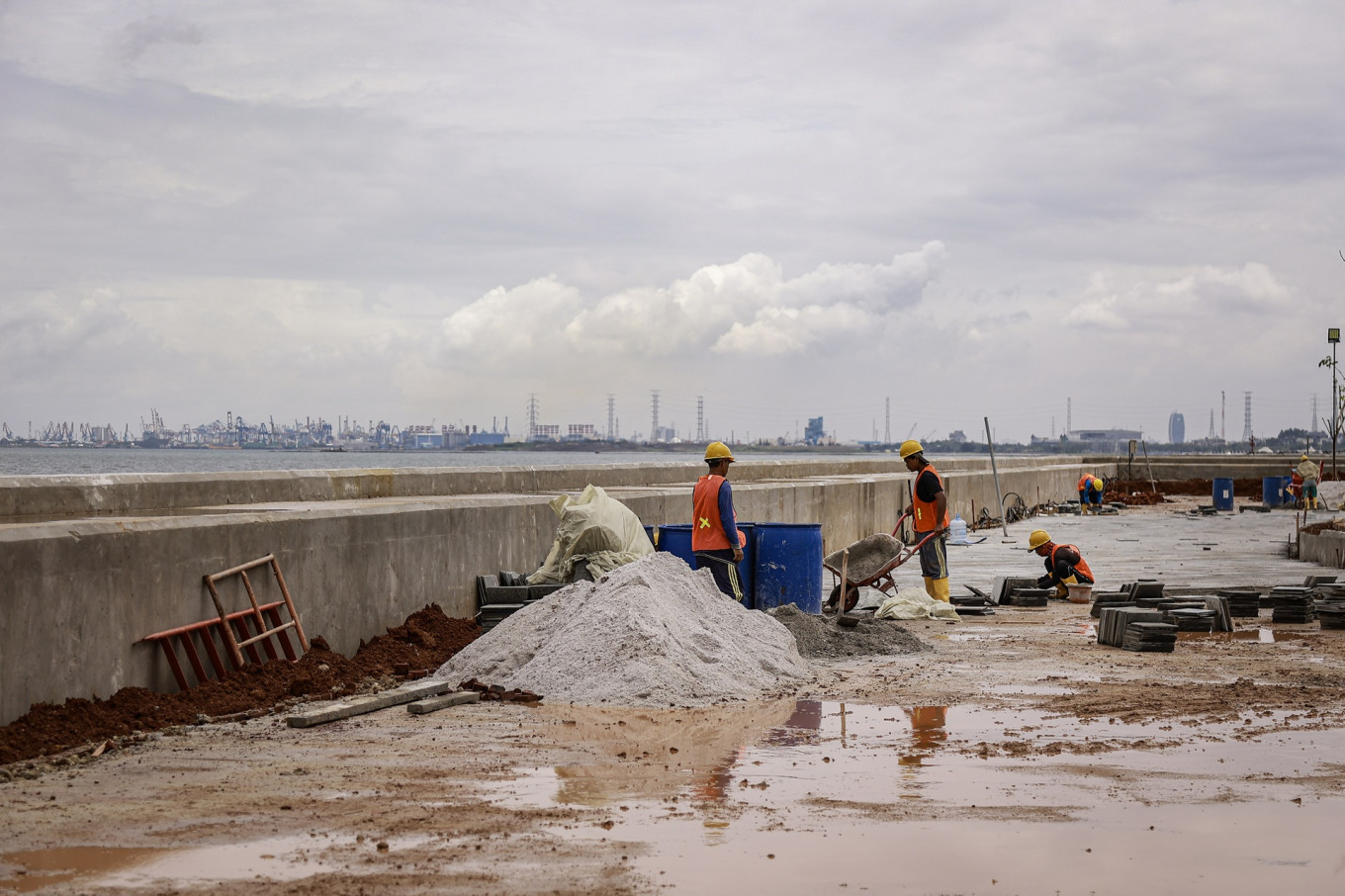 Workers work at the construction site on Dec. 19, 2025, on the National Capital Integrated Coastal Development (NCICD) seawall in the West Ancol area in North Jakarta. (Antara/Dhemas Reviyanto)
W
ith infrastructure now seen as the leading engine of growth across the Global South, governments are under pressure to build, and fast. But for most, fiscal space is limited, development aid is thinning and long-promised climate financing remains elusive. As a result, countries are turning to private capital and reviving an old idea with renewed urgency: public-private partnerships (PPPs).
According to the World Bank, in 2024, low- and middle-income countries received US$100 billion in private participation in infrastructure (PPI) investment, an impressive 20 percent increase from the five-year (2019-23) annual average of $83.7 billion. Yet history recommends caution. While the logic of mobilizing private finance is often compelling, the record is mixed. Too often, emerging markets have relied on models proselytized by global development finance institutions without paying adequate attention to local institutional constraints.
Moreover, the bankability of some types of infrastructure projects, meaning a strong risk-return profile, tends to be limited, even in advanced economies. For example, very few highways have been developed by the private sector, which, for obvious reasons, is less inclined to supply non-remunerative public goods and services. This is even more the case with infrastructure projects, which typically come with a heavy burden of long-term debt.
India’s experience is instructive. In the early 2000s, the country launched one of the world’s largest PPP infrastructure programs, hoping to close massive gaps in ports, airports, highways, power, telecoms and urban services. But the results have been mixed, partly because the expansion occurred just as India’s development finance institutions (DFIs) were being wound down, following financial-sector reforms in the 1990s.
With the government favoring PPPs in the absence of a mature bond market or DFIs, India leaned heavily on public-sector banks to fund long-gestation projects. But these institutions were not equipped to provide longer-term capital, assess risk or appraise and monitor complex, risky infrastructure ventures. As PPP activity accelerated and private investment in infrastructure surged between 2007-2014, so did bank lending to the sector. The share of infrastructure in non-food bank credit rose from 3.6 percent in 2007 to over 15 percent by 2015. Nominal bank credit to infrastructure increased more than sixfold, from around ₹1.4 trillion ($15.4 billion) to ₹9.2 trillion.
By the mid-2010s, structural weaknesses had become evident. Many road and power projects ran into land-acquisition issues, execution delays, and overoptimistic demand projections. Revenues underperformed, costs escalated, and developers defaulted. The fallout was severe. By 2018, Indian banks’ gross non-performing asset ratio had climbed to 11.2 percent, among the highest for major economies. Public-sector banks, which had financed most of these projects, bore a disproportionate share of the stress, with NPAs of 14.6 percent, compared to 4.8 percent for private banks. Nearly ₹4 trillion in public money was then spent on recapitalizing banks.

India is not an outlier. Spain’s toll-road PPPs faced a similar reckoning: between 2010 and 2014, nine of ten radial road projects defaulted after traffic volumes collapsed, forcing government intervention. Even the United Kingdom, often cited as a PPP pioneer, ultimately scaled back its Private Finance Initiative, citing high long-term costs and opaque contracts. It has since begun the process of nationalizing its rail network, three decades after privatizing it.