The Jakarta Post
Please Update your browser
Your browser is out of date, and may not be compatible with our website. A list of the most popular web browsers can be found below.
Just click on the icons to get to the download page.


Popular Reads
Top Results
No results found. Please check your search term and try again
Can't find what you're looking for?
View all search results
Popular Reads
Top Results
No results found. Please check your search term and try again
Can't find what you're looking for?
View all search resultsThe anatomy of jobless growth: Why 5.39% expansion isn't enough for Indonesia
Beyond the 5.39 percent headline, Indonesia’s economy is trapped in a cycle of "jobless growth" that prioritizes respectable statistics over stable careers.
Change text size
Gift Premium Articles
to Anyone
Share the best of The Jakarta Post with friends, family, or colleagues. As a subscriber, you can gift 3 to 5 articles each month that anyone can read—no subscription needed!
 Set as preferred source
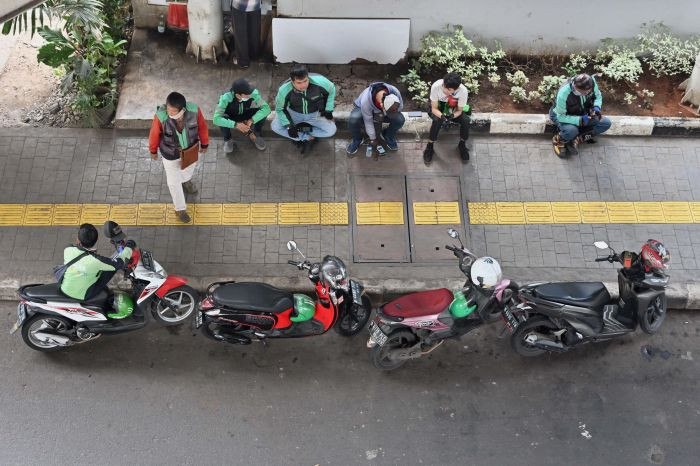 Drivers of on-demand transportation services Gojek and Grab wait for passengers on June 24, 2020, in Jakarta. The gig economy has contributed at least US$7 billion to the Indonesian economy and jobs for at least 4 million people, but falls short in offering decent work. (AFP/Adek Berry)
I
ndonesia closed out 2025 with its strongest economic performance in four years, posting a solid 5.39 percent expansion in the fourth quarter, a respectable clip by any Southeast Asian standard. But behind the celebratory tone of President Prabowo Subianto’s Labor Day pledges, which championed workers’ welfare and a corruption-free economy, lies a sobering reality.
Bridging the massive gap between current conditions and his grand ambitions requires more than populist rhetoric; it demands a rigorous policy recalibration. As The Jakarta Post warned on Jan. 14, 2026: "Without a massive increase in investment, our economy will diverge further from the RPJMN road map [...] Addressing these basics, rather than setting lofty targets, is the only path to strong growth."
More worrying than the headline figures is the structural pattern beneath them. Indonesia continues to endure what economists call jobless growth—an economic expansion that fails to generate sufficient, high-quality employment. While the post-pandemic rebound delivered positive data, it has not translated into broad-based job creation, particularly within the formal sector. The primary risk today is not recession, but stagnation: a trajectory that looks stable on paper yet feels fragile in reality.
The nation’s growth pattern remains stubbornly stagnant. The manufacturing sector remains the primary contributor to Gross Domestic Product (GDP) at 19.1 percent, followed by trade (13.2 percent), agriculture (13.1 percent), construction (9.8 percent), mining (8.8 percent) and transportation (6.2 percent). Together, these six pillars account for roughly 70 percent of the economy.
However, the two sectors that historically absorbed the most labor, agriculture and manufacturing, have gradually lost their dynamism. This weakening labor absorption capacity is the beating heart of the jobless growth phenomenon.
On the expenditure side, Indonesia remains heavily tethered to household consumption, which drove roughly 54 percent of fourth-quarter GDP. This is followed by investment at 30 percent and government expenditure at 10 percent. This structure underscores a persistent reality: Indonesia’s economic engine is fueled by spending rather than production.

While domestic demand provides a buffer during global uncertainty, an excessive reliance on consumption signals a limited deepening of productive capacity. Investment, although sizable, has not yet reached the scale or quality required to generate sustained productivity gains and high-value employment. Meanwhile, modest government spending constrains the state’s ability to play a countercyclical role during inevitable slowdowns.