TheJakartaPost
Please Update your browser
Your browser is out of date, and may not be compatible with our website. A list of the most popular web browsers can be found below.
Just click on the icons to get to the download page.


Popular Reads
Top Results
No results found. Please check your search term and try again
Can't find what you're looking for?
View all search results
Popular Reads
Top Results
No results found. Please check your search term and try again
Can't find what you're looking for?
View all search resultsThe privileges of MBG and the deteriorating state of education
The rapid promotion of SPPG employees stands in stark irony to the plight of honorary teachers, many of whom have dedicated decades to education without clear employment status.
Change text size
Gift Premium Articles
to Anyone
Share the best of The Jakarta Post with friends, family, or colleagues. As a subscriber, you can gift 3 to 5 articles each month that anyone can read—no subscription needed!
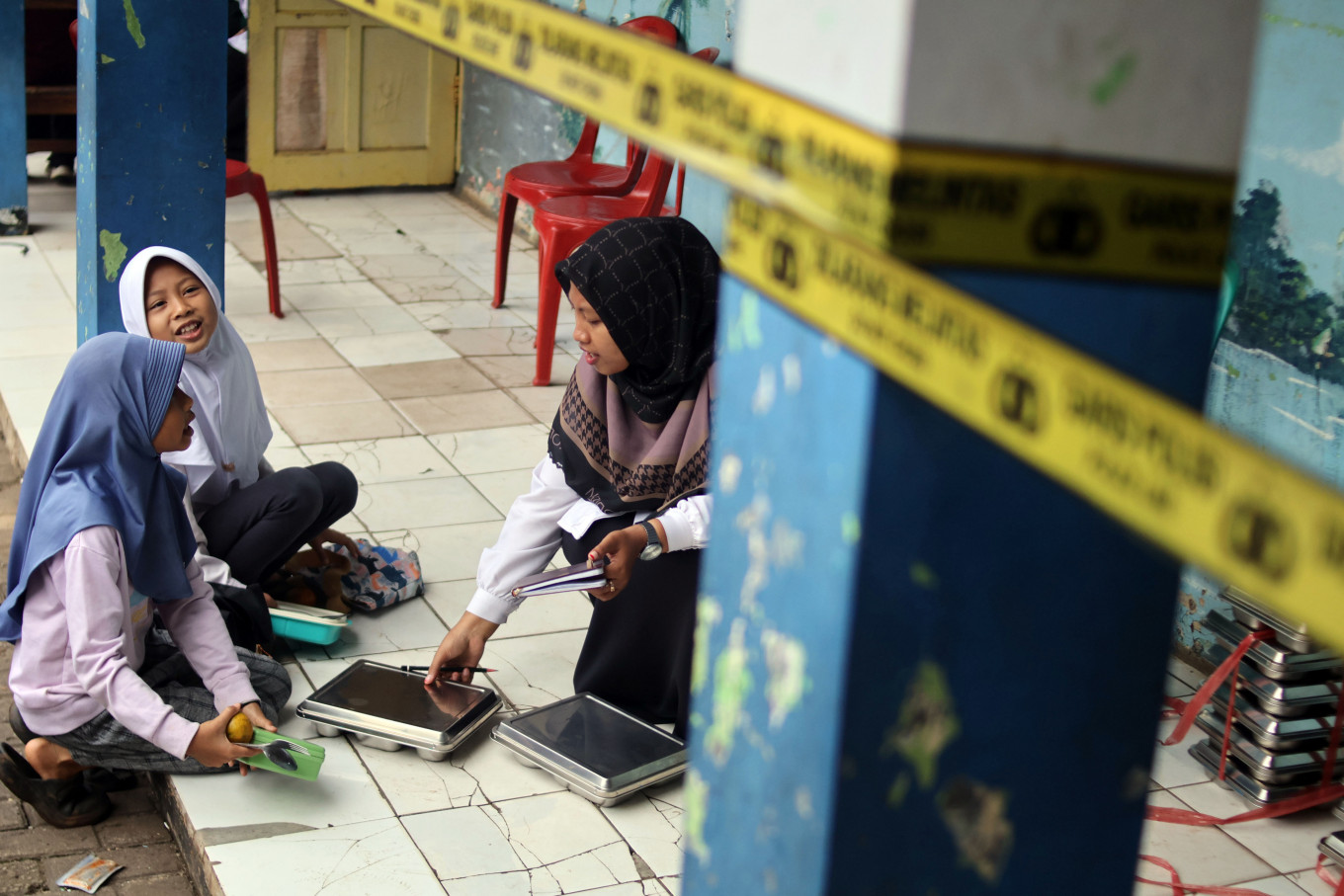 A teacher distributes free meals to students while schools remain closed following a building collapse at Madrasah Ibtidaiyah Miftahul Falah in Gunungputri, Bogor Regency, West Java, on Feb. 2, 2026. The government has confirmed that the program will continue during Ramadan, with menus and distribution times adjusted for students observing the fast. (Antara/Yulius Satria Wijaya)
T
wo years after its launch, the free nutritious meal program is facing widespread allegations of student poisoning. The Indonesian Education Monitoring Network (JPPI) reported a staggering 1,242 suspected cases between Jan. 1 and Jan. 13 alone.
Despite these alarming incidents, President Prabowo Subianto continues to extend unprecedented political privileges to this flagship initiative. This raises critical questions about the program’s alignment with the principles of professionalism and "service to the nation", as critics increasingly view its associated policies as discriminatory.
This perception of discrimination is formalized in Presidential Regulation No. 115/2025, which governs the free meals program. Article 17 allows employees of the Nutritional Fulfillment Service Unit (SPPG) to be appointed as Government Employees with Work Agreements (PPPK). According to Dadan Hindayana, the head of the National Nutrition Agency (BGN), these SPPG employees hold strategic positions, including unit heads, nutritionists and accountants.
By Feb. 1, a total of 32,000 SPPG employees were set for appointment as Class III PPPK, with 31,250 of those positions designated for Heads of SPPG. In contrast, the government opened only 750 positions for the general public. This PPPK designation grants employees a monthly basic salary ranging from Rp 2,206,500 (US$131,22) to Rp 3,201,200, supplemented by various allowances.
These SPPG employees were originally participants in the Indonesian Development Mobilization Program (SPPI). Initiated by President Prabowo through the Indonesian Defense University (Unhan), the program recruits young graduates to enhance regional nutrition, agriculture and livestock. During their tenure, participants receive basic military and managerial training, a background that appears to be a "fast track" to civil servant status.
The rapid promotion of SPPG employees stands in stark irony to the plight of honorary teachers, many of whom have dedicated decades to education without clear employment status. While SPPG staff gain immediate security, many honorary teachers earn wages well below the Regional Minimum Wage (UMR), with some receiving as little as Rp 500,000 every six months.

Today, these teachers are racing against time. Law No. 20/2023 concerning Civil Servants explicitly prohibits government agencies from hiring new honorary staff and required the reorganization of existing staff by December 2024. This prohibition aims for "personnel efficiency", yet in practice, it has led to mass dismissals. In February 2026, the Asahan Regency government, for example, removed hundreds of honorary teachers from the Basic Education Data system, effectively ending their careers overnight.