TheJakartaPost
Please Update your browser
Your browser is out of date, and may not be compatible with our website. A list of the most popular web browsers can be found below.
Just click on the icons to get to the download page.


Popular Reads
Top Results
No results found. Please check your search term and try again
Can't find what you're looking for?
View all search results
Popular Reads
Top Results
No results found. Please check your search term and try again
Can't find what you're looking for?
View all search resultsIndonesia’s Gaza mandate: Clarity is not yet closure
The Foreign Ministry has drawn its red lines in Gaza, but until the government addresses the legal and financial shadows of the mandate, the case for Indonesia’s participation remains far from closed.
Change text size
Gift Premium Articles
to Anyone
Share the best of The Jakarta Post with friends, family, or colleagues. As a subscriber, you can gift 3 to 5 articles each month that anyone can read—no subscription needed!
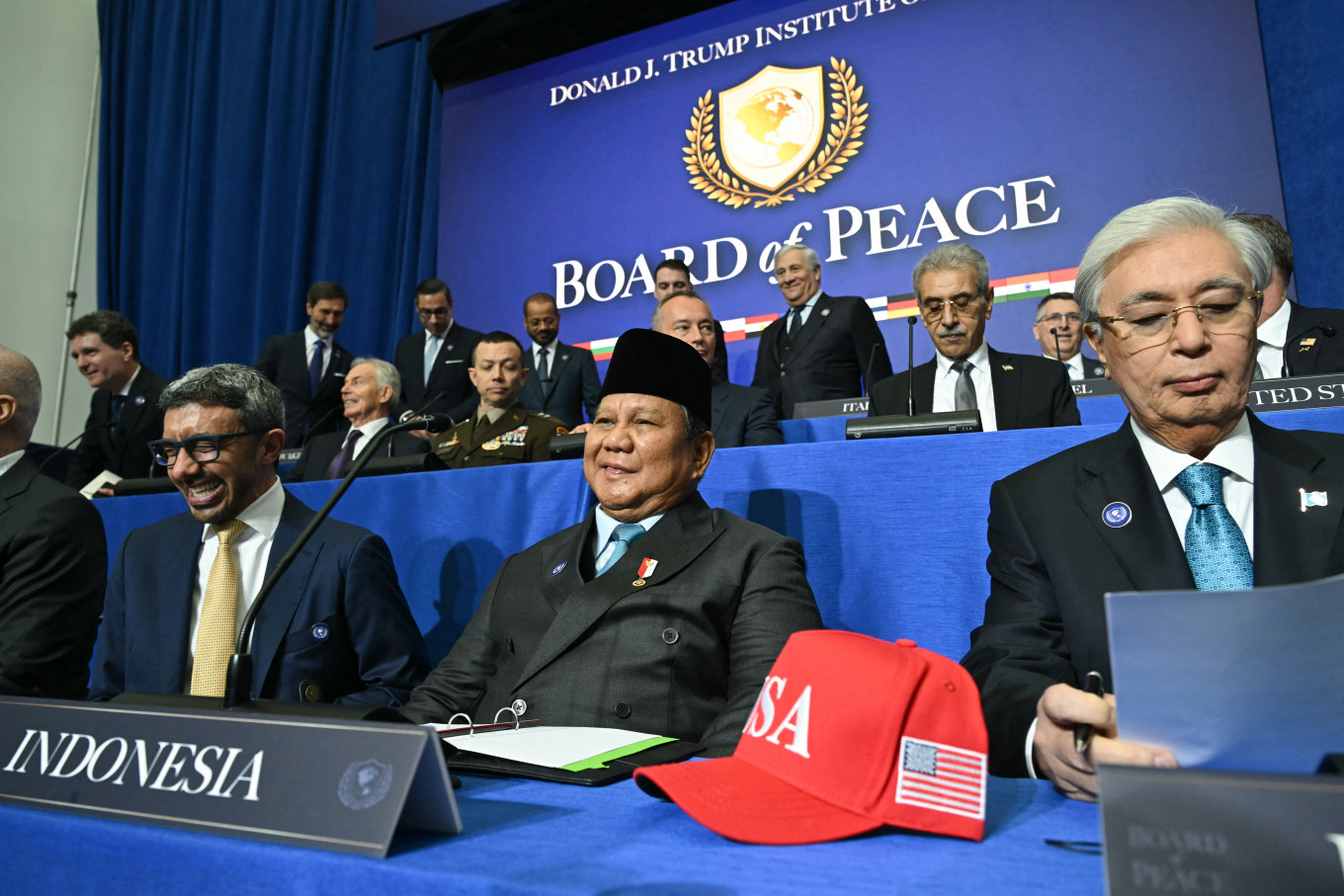 Indonesia's President Prabowo Subianto (front center) and Kazakhstan's President Kassym-Jomart Tokayev (front right) attend the inaugural meeting of the “Board of Peace“ hosted by United States President Donald Trump on Thursday at the US Institute of Peace in Washington, DC. President Trump on Thursday gathered allies to inaugurate the “Board of Peace,“ his new institution focused on progress on Gaza but whose ambitions reach much further. Around two dozen world leaders or other senior officials have come to Washington for the meeting -- including several of Trump's authoritarian-leaning friends and virtually none of the European democrats that traditionally sign on to US initiatives. (AFP/Saul Loeb )
I
n the high-stakes lead-up to this week’s Board of Peace summit in Washington, DC, a cloud of uncertainty has hung over Indonesia’s proposed role in Gaza. Public debate has been dominated by a set of recurring, existential questions: constitutional procedure, the risk of normalization, combat exposure and the very nature of Indonesian sovereignty.
To its credit, the Foreign Ministry has issued a hot-off-the-press clarification. It is a document designed to soothe a nervous public and draw firm lines in the sand regarding the International Stabilization Force (ISF). But while the ministry has succeeded in defining the operational boundaries of Indonesia’s involvement, it has yet to provide the structural closure the nation requires.
The most significant achievement of the ministry’s statement is its granular operational clarity. By explicitly labeling Indonesia’s participation as "noncombat" and "nondemilitarization," the government has attempted to derisk the political fallout of the mission. The mandate is strictly humanitarian - focusing on civilian protection, health services, reconstruction and the training of Palestinian police.
However, as any veteran of international peacekeeping knows, the bright lines drawn in a Jakarta office can quickly blur in the heat of a volatile environment. The government insists that Indonesian personnel will not be "pitted against any party" and that the use of force is restricted to self-defense and defense of mandate, proportional, gradual and a last resort.
While this reinforces international Rules of Engagement, the line between defensive and confrontational scenarios may blur in postwar Gaza. Operational clarity will depend on command arrangements and implementation.
The ministry also maintains that Indonesia’s participation remains fully under national control, governed by binding national caveats established by the Indonesian government and agreed with the ISF. This reaffirms sovereign control over personnel and mandate, but the precise chain of command within the ISF framework remains undefined in the public explanation.

Perhaps the most politically sensitive aspect of the clarification is its categorical denial of normalization with Israel. For decades, Indonesia’s refusal to recognize the state of Israel has been a cornerstone of its identity. The ministry was wise to state that participation "is not to be construed as recognition or normalization... with any party whatsoever."