The Jakarta Post
Please Update your browser
Your browser is out of date, and may not be compatible with our website. A list of the most popular web browsers can be found below.
Just click on the icons to get to the download page.


Popular Reads
Top Results
No results found. Please check your search term and try again
Can't find what you're looking for?
View all search results
Popular Reads
Top Results
No results found. Please check your search term and try again
Can't find what you're looking for?
View all search resultsBeyond Board of Peace: Jakarta secures $38.4b trade deal
While the world’s cameras were fixed on the billion-dollar debut of the Board of Peace, Jakarta was busy building a $38.4 billion economic foundation for Indonesia’s industrial future.
Change text size
Gift Premium Articles
to Anyone
Share the best of The Jakarta Post with friends, family, or colleagues. As a subscriber, you can gift 3 to 5 articles each month that anyone can read—no subscription needed!
 Set as preferred source
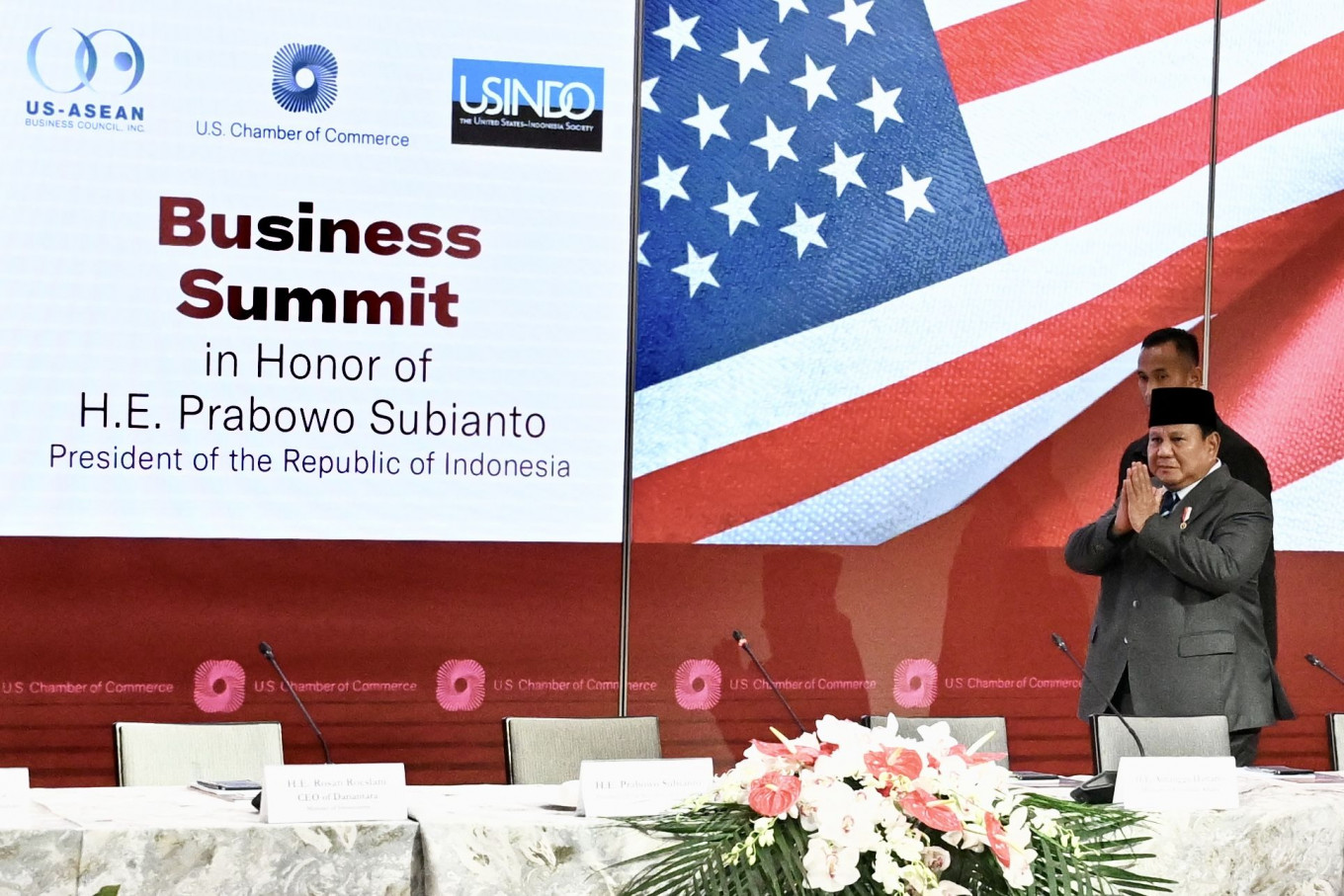 President Prabowo Subianto, speaks at a business summit on Feb. 18 hosted by the United States Chamber of Commerce in Washington, D.C. (BPMI/Cahyo )
O
n Feb. 19, the first meeting of the Board of Peace opened in Washington, drawing cameras, commentary and scrutiny over its US$1 billion price tag. For much of the world, that was the diplomatic main event. For Indonesia, it was not.
The day before at a dinner hosted by the United States Chamber of Commerce, President Prabowo Subianto oversaw the signing of business agreements valued at US$38.4 billion between Indonesian and US companies. While the Board of Peace continues to be the headliner, the real story from DC-Jakarta was the trade deals.
The 11 agreements span mining, energy, agribusiness, textiles, furniture and technology, precisely the sectors that sit at the center of Indonesia’s modernization and industrialization ambitions. “We hope to find partners who are ready to join us in our ongoing efforts to modernize and industrialize,” Prabowo said in his speech.
He described the agreements as implementing steps toward a broader US–Indonesia trade deal he was about to sign with President Donald Trump, an agreement Jakarta hopes will reduce Indonesia’s trade surplus with the US. “I’m very optimistic about the future of our relationship,” he added.
The scale matters. The $38.4 billion valuation significantly exceeds an earlier fact sheet from the US-ASEAN Business Council, which had outlined deals worth over $7 billion. That earlier figure included Indonesian commitments to purchase 1 million metric tonnes of US soybeans, 1.6 million tonnes of corn and 93,000 tonnes of cotton over unspecified periods, along with 1 million tonnes of wheat this year and up to 5 million tonnes by 2030.
Agriculture is a key pillar. Indonesia has imported roughly $3 billion in US farm goods annually in recent years, making it the 11th largest market for American agricultural exports. These new purchase commitments both deepen that relationship and signal responsiveness to US trade concerns. And emerging import commodities that buttress Prabowo’s signature free nutritious meal program, such as the dairy sector, could boost those numbers even higher. But agriculture is only one piece.

Among the headline agreements was a memorandum of understanding between Freeport-McMoRan and Indonesia’s Investment Ministry. This initial deal, which explores extending Freeport’s mining permit beyond 2041, was described by Chairman Richard Adkerson as a vital 'resource extension' capable of unlocking decades of future ore production. Additionally, the visit secured an oilfield recovery partnership between Pertamina and Halliburton, alongside two semiconductor joint ventures linking Indonesia’s Galang Bumi Energi with US partners Essence Global Group and Tynergy Technology Group.