TheJakartaPost
Please Update your browser
Your browser is out of date, and may not be compatible with our website. A list of the most popular web browsers can be found below.
Just click on the icons to get to the download page.


Popular Reads
Top Results
No results found. Please check your search term and try again
Can't find what you're looking for?
View all search results
Popular Reads
Top Results
No results found. Please check your search term and try again
Can't find what you're looking for?
View all search resultsClausewitz was right, Gaza proves it: War without politics serves nothing
Gaza underground fortress is the physical face of asymmetric war, a conflict where the weaker side does not need to win.
Change text size
Gift Premium Articles
to Anyone
Share the best of The Jakarta Post with friends, family, or colleagues. As a subscriber, you can gift 3 to 5 articles each month that anyone can read—no subscription needed!
 Set as preferred source
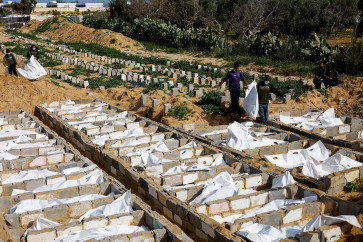
 People carry bodies on Feb 13, 2026, during a mass burial of unidentified Palestinians, whose bodies were released after being held in Israel during the recent conflict, in Deir Al-Balah, in the central Gaza Strip. (Reuters/Mahmoud Issa)
U
nder the Gaza Strip, a territory of just 365 square kilometers, lies a tunnel network stretching 350 to 500 kilometers, buried 10 to 40 meters deep. At 1.37 kilometers of tunnel per square kilometer of surface, it is denser than most city subway systems. Entry points are hidden inside homes, mosques, schools and hospitals. This underground fortress is the physical face of asymmetric war, a conflict where the weaker side does not need to win. It only needs to survive.
Two centuries ago, the Prussian military thinker Carl von Clausewitz wrote that war is the continuation of politics by other means. War is never an end in itself. It is always a tool to achieve a political goal. If it fails to serve that purpose, then all its destruction amounts to nothing. For two hundred years, generals and statesmen have debated this idea. Gaza now proves Clausewitz was right, and proves it in the harshest way possible.
In conventional war between equally matched armies, the link between military victory and political outcome is straightforward. One side wins on the battlefield, and that victory becomes leverage at the negotiating table. But in an asymmetric war like Gaza, Clausewitz’s truth becomes a blade that cuts both ways. This is what we call the Clausewitz Dilemma.
In asymmetric war, every military operation, no matter how precise, no matter how overwhelming, can only create conditions for a political solution. It can never replace one.
Military forces can clear tunnels, destroy weapons and dismantle command centers. But it cannot resolve the political grievances that built those tunnels, occupation, statelessness, blockade and decades of unresolved injustice.
Henry Kissinger captured this paradox: guerrillas win if they do not lose, and conventional forces lose if they do not win. Even after operations that destroyed 85 percent of Gaza’s buildings, militant recruitment remained intact. The roots are political. Destroy a tunnel today, and the grievance that built it will build another one tomorrow.

This is the first edge of Clausewitz’s blade: the military trap. An International Stabilization Force that focuses only on destroying tunnels without building political legitimacy will simply postpone the next war. Destruction without justice creates a vicious cycle, destroy, create a vacuum, radicalize a new generation, watch the network rebuild. Tunnels built for 30 to 90 million dollars would require 32,000 troops and over 30 billion dollars to neutralize. Even then, if just 5 percent of the network escapes detection, remilitarization survives. The harder you strike without political purpose, the more enemies you create. Force without politics does not end the war. It fertilizes the next one.