TheJakartaPost
Please Update your browser
Your browser is out of date, and may not be compatible with our website. A list of the most popular web browsers can be found below.
Just click on the icons to get to the download page.


Popular Reads
Top Results
No results found. Please check your search term and try again
Can't find what you're looking for?
View all search results
Popular Reads
Top Results
No results found. Please check your search term and try again
Can't find what you're looking for?
View all search resultsTariffs are numbers. Positioning is strategy
Change text size
Gift Premium Articles
to Anyone
Share the best of The Jakarta Post with friends, family, or colleagues. As a subscriber, you can gift 3 to 5 articles each month that anyone can read—no subscription needed!
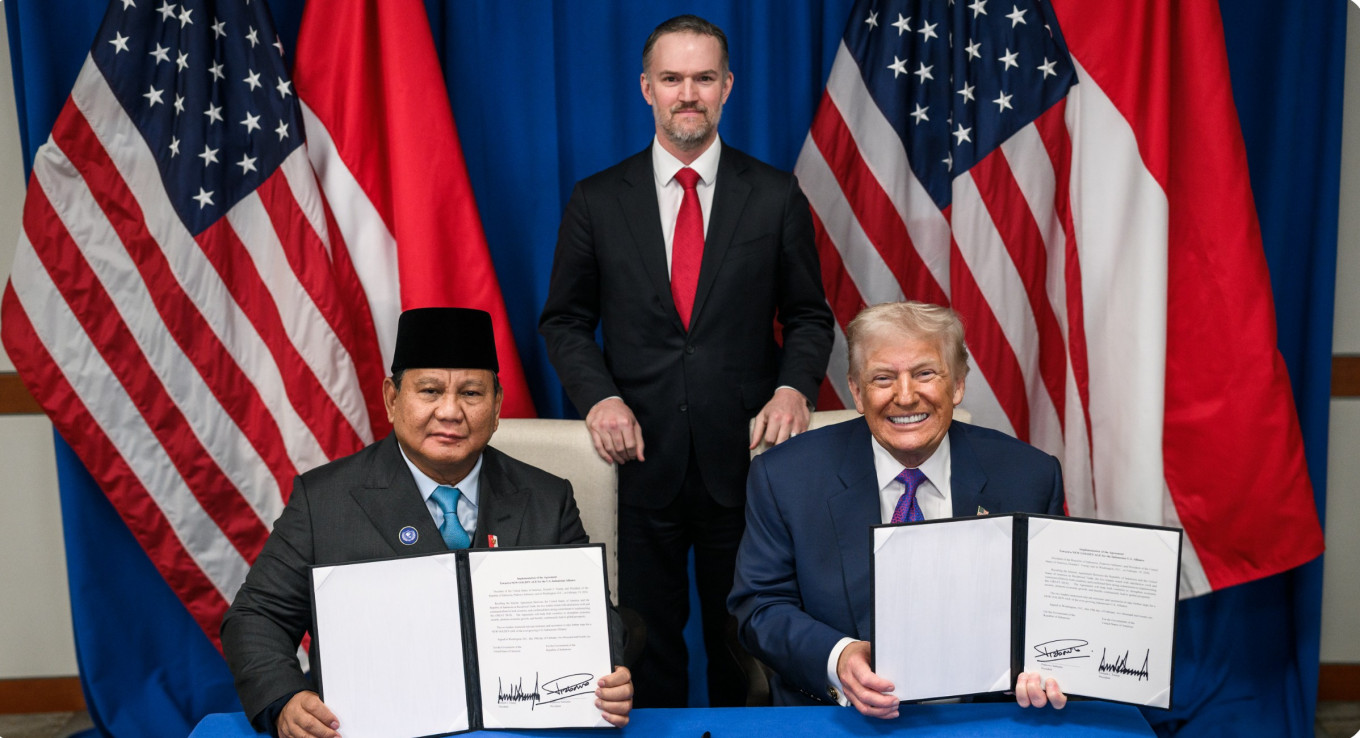 President Prabowo Subianto (left) and United States President Donald Trump (right) show the signed trade deal documents in Washington, US, on Feb. 19, 2026, as witnessed by US Trade Representative Jamieson Greer. (Office of the United States Trade Representative/-)
Trade debates often begin with numbers. Yet global trade rarely turns on the numbers themselves. It turns on relative positioning.
This is why the recent Indonesia–United States trade agreement should not be read through simple tariff arithmetic. The widely cited figure, a 19 percent reciprocal tariff, appears, at first glance, less favorable than a global tariff environment of around 15 percent. But that comparison misunderstands how export competition actually works.
Indonesia does not primarily compete with US producers in the US market. It competes with exporters from other countries. In practical terms, the US is a third-country competition space, an arena where relative tariff treatment, not bilateral symmetry, determines competitiveness.
Seen from this perspective, the agreement looks very different.
The relevant baseline was not 15 percent. It was the previously imposed unilateral reciprocal tariff of around 32 percent on Indonesian exports. Reducing that rate to 19 percent, combined with tariff exemptions for many priority export products, represents a clear improvement in Indonesia’s competitive position.
Trade economics has long recognized that what matters is not the absolute tariff level, but the tariff differential relative to competitors. This concept, known as the preference margin, often shapes trade flows and supply chain decisions more strongly than headline tariff rates.

Even small differences in relative tariffs can redirect production, investment and sourcing strategies. For multinational firms, a few percentage points can determine whether manufacturing takes place in Vietnam, Mexico, Bangladesh or Indonesia.