The Jakarta Post
Please Update your browser
Your browser is out of date, and may not be compatible with our website. A list of the most popular web browsers can be found below.
Just click on the icons to get to the download page.


Popular Reads
Top Results
No results found. Please check your search term and try again
Can't find what you're looking for?
View all search results
Popular Reads
Top Results
No results found. Please check your search term and try again
Can't find what you're looking for?
View all search resultsA trade pact that weakens Indonesia
What makes this agreement especially indefensible is not only its deeply asymmetrical substance but also its disastrous timing.
Change text size
Gift Premium Articles
to Anyone
Share the best of The Jakarta Post with friends, family, or colleagues. As a subscriber, you can gift 3 to 5 articles each month that anyone can read—no subscription needed!
 Set as preferred source
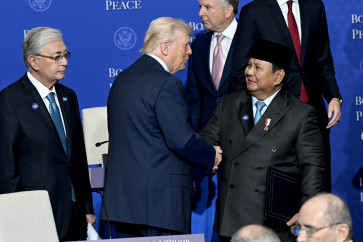
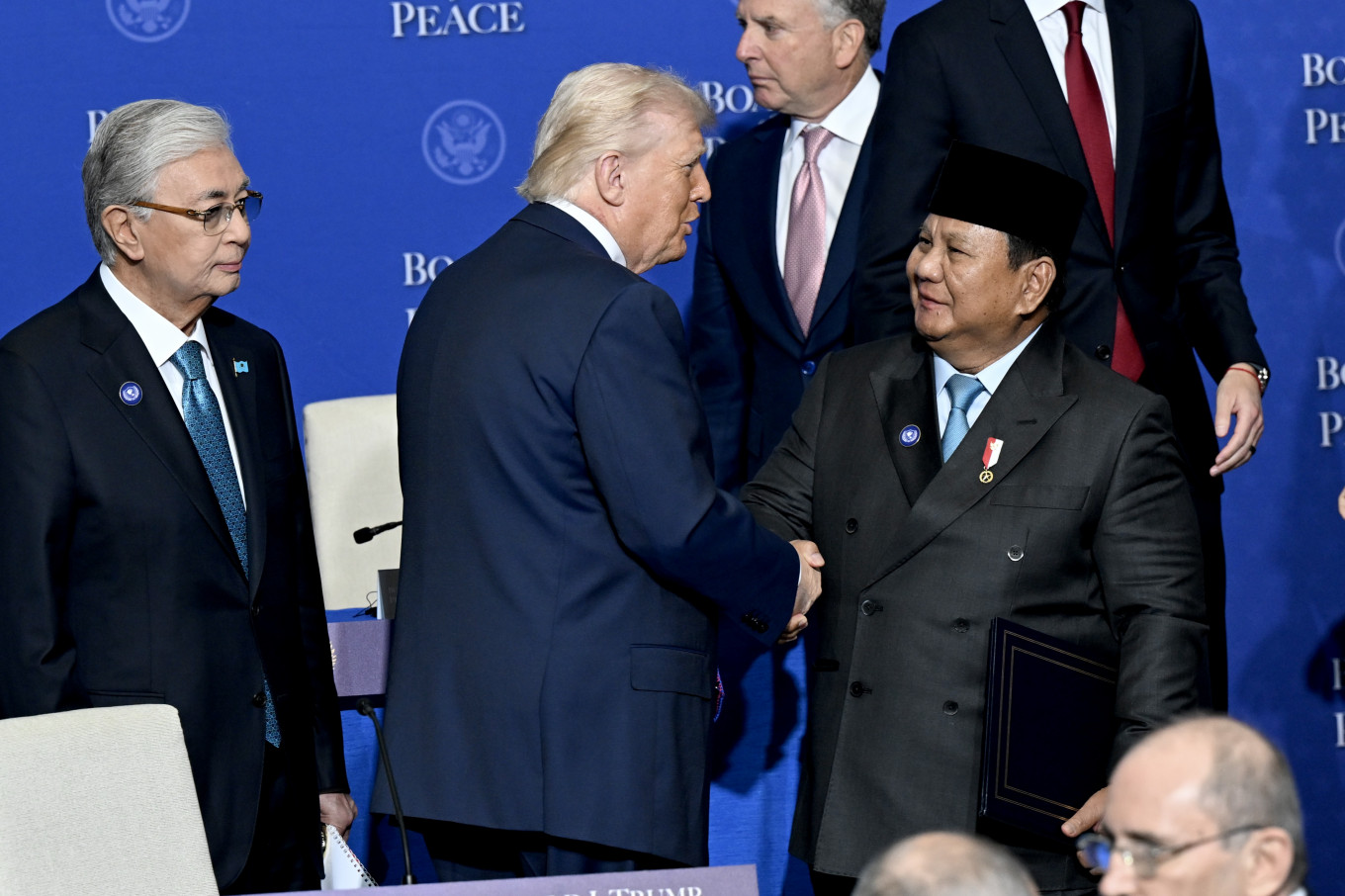 President Prabowo Subianto (right) on Feb. 19, shakes hands with United States President Donald Trump during the Board of Peace council summit at the United States Institute of Peace in Washington, DC. (Courtesy of Presidential Secretariat Press Bureau, United States Institute of Peace, Washington, DC/Cahyo)
P
resident Prabowo Subianto has signed an economic agreement with United States President Donald Trump that constitutes one of the most questionable moves in recent memory. This is a flawed trade pact, and an act of submission so unnecessary, and so catastrophically miscalculated that it exposes the intellectual poverty, political cowardice and strategic incompetence of the administration that engineered it.
Beyond structural market liberalization, Indonesia has also committed to purchase between US$33 and 38.4 billion worth of US energy, agricultural and aviation products, transforming this agreement into a coercive procurement pact rather than a reciprocal trade partnership.
What makes this agreement especially indefensible is not only its deeply asymmetrical substance but also its disastrous timing. It was concluded precisely as the US Supreme Court was striking down Trump’s emergency tariff regime, a ruling that dismantles the very coercive instrument upon which Trump’s trade diplomacy rests. If Prabowo has a capable team, he should have had the information beforehand and could have postponed the signing, with the possibility of securing a 10 percent or 15 percent tariff for Indonesia instead of 19 percent, agreeing to such an imbalance trade pact.
For months, many had warned that Trump’s tariff powers were constitutionally fragile and likely to collapse. Yet Prabowo’s government rushed headlong into submission, seemingly with zero analysis or knowledge of the imminent US Supreme Court ruling against Trump’s global tariff. In the aftermath, while criticizing the ruling, Trump announced the resumption of only a 10 percent global tariff.
Formally titled Agreement between the United States of America and the Republic of Indonesia on Reciprocal Trade, the pact cloaks itself in the language of partnership and shared prosperity. In reality, its architecture systematically privileges US economic power while hollowing out Indonesia’s regulatory sovereignty, policy autonomy and developmental capacity.
Article 1.1 compels Indonesia to apply US-determined tariff rates to US goods, while Article 1.2 prohibits quantitative restrictions, including import licenses and commodity balancing programs, effectively dismantling Indonesia’s capacity to manage import volumes and protect strategic sectors. These clauses remove two of the most fundamental instruments of industrial policy: tariffs and quantitative control.

Tariffs have historically functioned as the backbone of national development. The US itself relied on aggressive protectionism for over a century to build its industrial base before preaching liberalization abroad. By surrendering tariff autonomy under Article 1.1, Indonesia abandons one of its most powerful tools for nurturing domestic industry, protecting small and medium enterprises and pursuing technological upgrading.