The Jakarta Post
Please Update your browser
Your browser is out of date, and may not be compatible with our website. A list of the most popular web browsers can be found below.
Just click on the icons to get to the download page.


Popular Reads
Top Results
No results found. Please check your search term and try again
Can't find what you're looking for?
View all search results
Popular Reads
Top Results
No results found. Please check your search term and try again
Can't find what you're looking for?
View all search resultsAnalysis: Indonesia’s high-stakes trade bet with Washington nears its moment of truth
Change text size
Gift Premium Articles
to Anyone
Share the best of The Jakarta Post with friends, family, or colleagues. As a subscriber, you can gift 3 to 5 articles each month that anyone can read—no subscription needed!
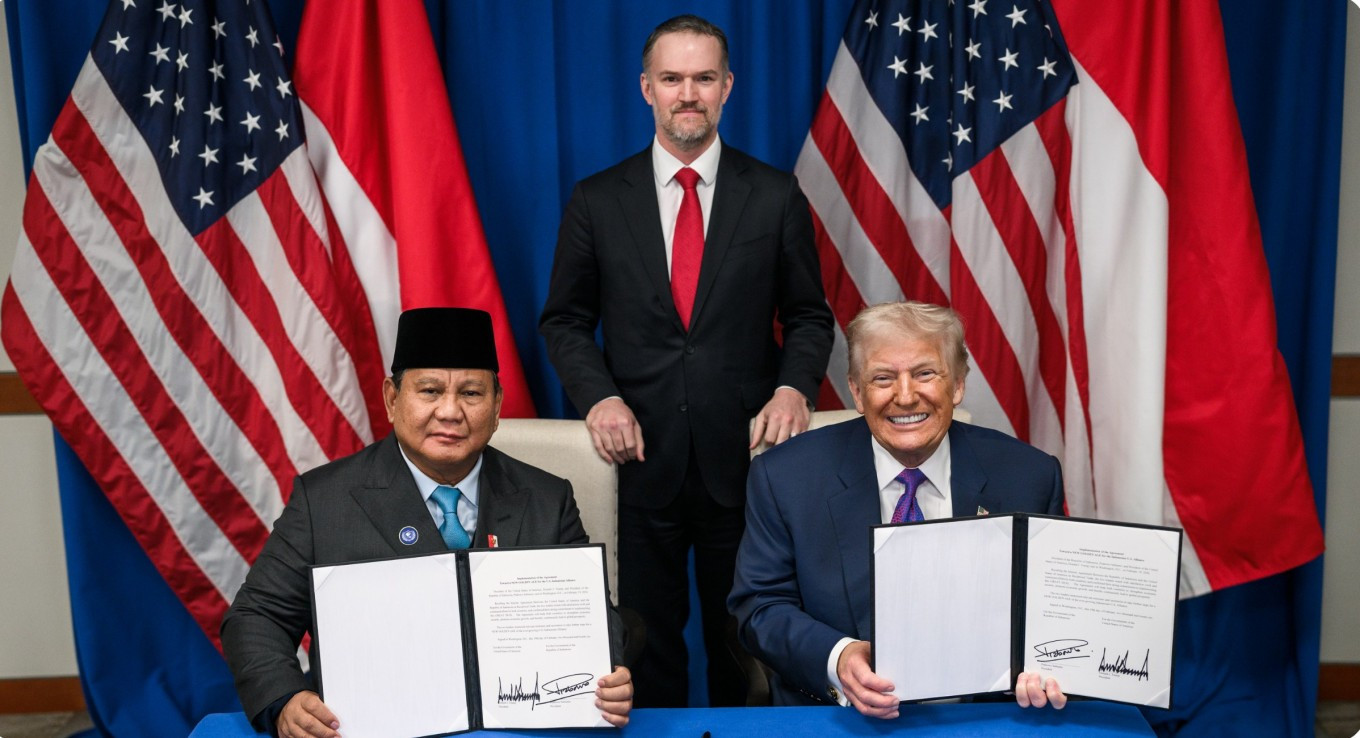 Indonesia President Prabowo Subianto (left) and United States President Donald Trump show the signed trade deal documents on Feb. 19 in Washington, US, as witnessed by US Trade Representative Jamieson Greer. Indonesia and the US finalized a trade deal locking in tariff rates and non-tariff barriers to commerce. (Office of the United States Trade Representative)
U
ncertainty continues to surround Indonesia’s latest trade breakthrough as President Prabowo Subianto and United States President Donald Trump prepare to formalize the Agreement on Reciprocal Trade (ART) on Thursday, following their attendance at the first US-led Board of Peace meeting a day earlier. The framework unveiled in July 2025 sets a 19 percent tariff on Indonesian exports to the US market, a rate the Indonesian government portrays as a major diplomatic victory despite its magnitude. Yet it remains unclear whether the July framework represents the final terms to be signed or whether negotiations are still unfolding behind closed doors.
The 19 percent rate was quickly framed as a hard-won concession, especially because it marks a significant drop from the initial 32 percent tariff set under Washington’s "reciprocal" trade framework. At that earlier level, Indonesian officials warned the measure would have severely undermined the competitiveness of the country’s labor-intensive and commodity exports. By negotiating the rate down to 19 percent, the government argues it secured a substantial reduction that preserves access to the US market. State representatives also emphasize that several key Indonesian export commodities, including palm oil, coffee and cocoa, are exempt from the new tariff measures. Officials describe this carve-out as critical for safeguarding rural livelihoods and maintaining Indonesia’s trade surplus in agricultural products.
Beyond tariffs, the ART carries sweeping non-tariff commitments that could reshape Indonesia’s industrial landscape. According to a White House press release, Jakarta has agreed to exempt US companies and originating goods from local content requirements, accept vehicles built to US federal safety and emissions standards and recognize US Food and Drug Administration certifications and prior marketing authorizations for certain medical devices and pharmaceuticals.
These commitments carry significant implications for Indonesia’s long-standing industrial and regulatory framework. Many of the policies, such as local content requirements, conformity assessments and layered certification procedures were originally designed to nurture domestic manufacturing and shield emerging industries from direct competition with more established global players. For years, such measures have been central to Jakarta’s strategy of moving up the value chain, particularly in automotive production, pharmaceuticals and consumer goods.
The broader strategic question extends beyond domestic industry. The ART could also reverberate across Indonesia’s relationships with other major trade partners, most notably China. Beijing, Indonesia’s largest trading partner and a dominant investor in downstream minerals and manufacturing, previously cautioned that trade disputes and negotiations should be resolved through dialogue on an equal footing. The statement, delivered last year in response to developments in Indonesia–US tariff talks, signaled Beijing’s sensitivity to arrangements that could alter competitive dynamics or create preferential treatment for US firms. While not a direct rebuke of Jakarta, the message underscored the geopolitical balancing act embedded in the deal.
Whether the ART ultimately proves to be a strategic breakthrough or a costly compromise will depend on the fine print that has yet to be fully disclosed. For now, what is clear is that Indonesia has made significant concessions in exchange for preserving access to the world’s largest consumer market. As businesses await clarity and regional partners watch closely, the agreement places Jakarta in a delicate position between defending the deal at home while navigating the broader geopolitical currents between Washington and Beijing.

What we’ve heard