The Jakarta Post
Please Update your browser
Your browser is out of date, and may not be compatible with our website. A list of the most popular web browsers can be found below.
Just click on the icons to get to the download page.


Popular Reads
Top Results
No results found. Please check your search term and try again
Can't find what you're looking for?
View all search results
Popular Reads
Top Results
No results found. Please check your search term and try again
Can't find what you're looking for?
View all search resultsIntegrating the Giuseppe Garibaldi into Indonesia’s national defense
As Indonesia enters the 2025–2029 strategic planning cycle, the shifting geopolitical dynamics of the Indo-Pacific demand a transition from static territorial defense to a highly mobile, networked maritime posture. The integration of the ex-Italian Navy aircraft carrier cruiser, Giuseppe Garibaldi, into the Indonesian Military is a strategic necessity as the new platform can serve as a vital anti-submarine warfare (ASW) hub and mobile command node.
Change text size
Gift Premium Articles
to Anyone
Share the best of The Jakarta Post with friends, family, or colleagues. As a subscriber, you can gift 3 to 5 articles each month that anyone can read—no subscription needed!
 Set as preferred source
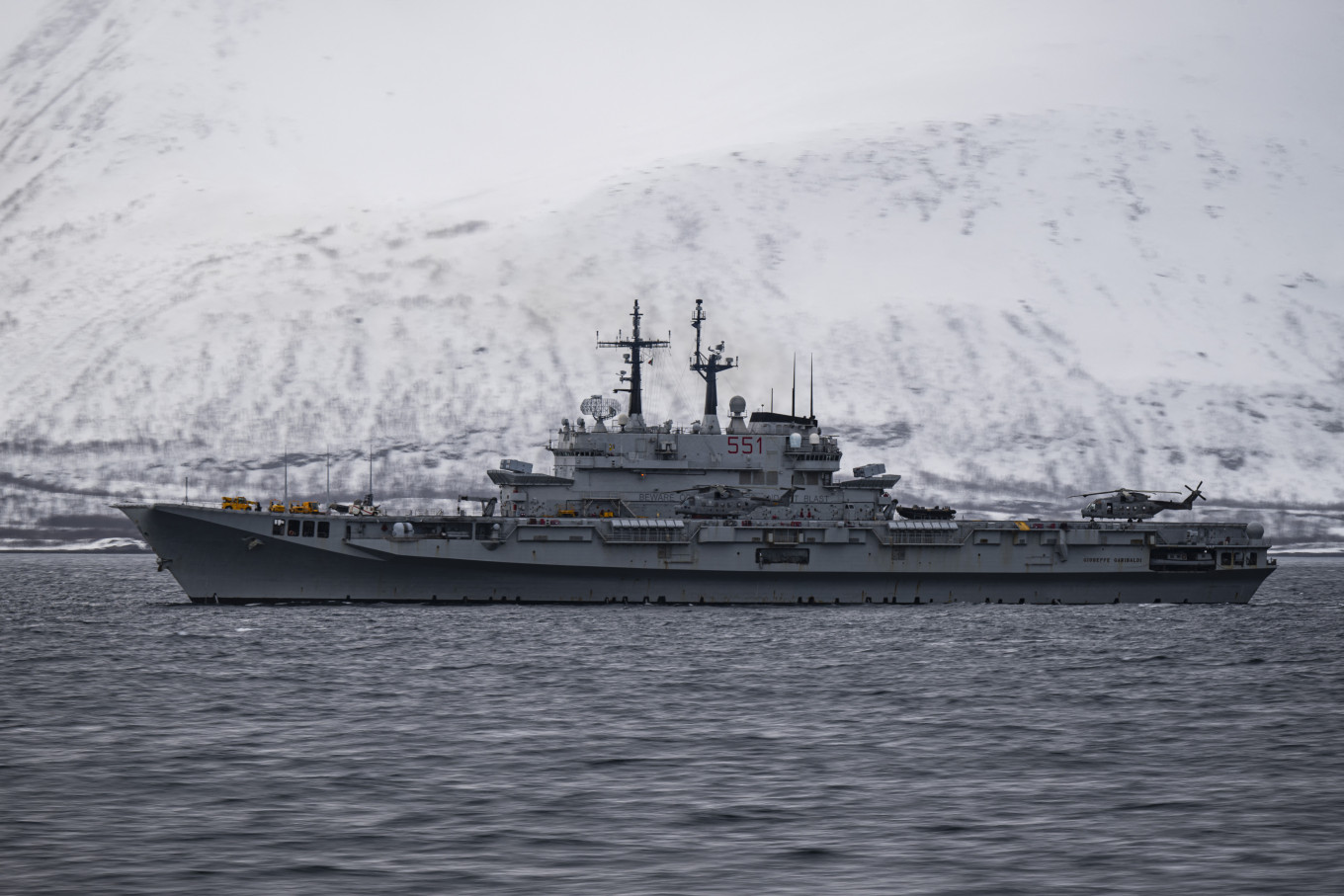 The Giuseppe Garibaldi, an Italian aircraft carrier, the first through-deck aviation ship ever built for the Italian Navy, is pictured on March 10, 2024, during the Nordic Response 24 military exercise at sea near Sorstraumen, above the Arctic Circle in Norway. (AFP/Jonathan Nackstrand)
I
ndonesia, the world’s largest archipelagic state, oversees approximately 6.4 million square kilometers of maritime territory, including the vital Indonesian Archipelagic Sea Lanes (ALKI) and a vast exclusive economic zone (EEZ). National defense doctrine, Sishankamrata (Total People’s Defense and Security System), and the updated 2025 Indonesian Military (TNI) Law emphasize a layered defense capable of protecting the buffer, main and resistance zones.
The relocation of the national center of gravity to the future capital of Nusantara in East Kalimantan places the city in immediate proximity to the strategic ALKI II and maritime flashpoints in the North Natuna Sea. Current planning, outlined in the National Defense General Policy 2025–2029, necessitates a "mobile defense" strategy adaptive to the Revolutions in Military Affairs (Industry 4.0 and 5.0).
In this context, acquiring a high-mobility platform like the Giuseppe Garibaldi aircraft carrier cruiser is not a luxury, but a structural necessity to bridge gaps in sensor coverage and rapid-response capabilities.
The strategic value of the Giuseppe Garibaldi is best understood through the lens of Indonesia’s "choke point" geography. The ALKI I (Natuna-Sunda Strait), ALKI II (Lombok-Makassar Strait) and ALKI III (Molucca Sea) are the world's most critical maritime arteries. As regional tensions rise, the ability to monitor and control these lanes is paramount.
The Giuseppe Garibaldi provides a "forward presence" that fixed land bases cannot match. By patrolling the North Natuna Sea, the vessel acts as a sovereign symbol of deterrence, effectively countering "gray zone" tactics, such as the encroachment of foreign fishing fleets and coast guard vessels, that seek to undermine Indonesian maritime authority. The ship’s ability to remain on station for extended periods ensures that Indonesia’s response to territorial violations is measured in minutes, not hours.
The Giuseppe Garibaldi, former flagship of the Italian navy from 1985 until its 2024 decommissioning, is classified as an aircraft-carrying cruiser. This distinction is critical: unlike transport-oriented landing helicopter docks (LHDs), the Giuseppe Garibaldi features organic heavy armament and high-speed propulsion. Powered by four GE Avio LM2500 gas turbines generating 81,000 horse power, the vessel maintains a range of 7,000 nautical miles at a sustained 20 knots.

The vessel's versatility is defined by its short take-off and vertical landing (STOVL) flight deck, which can accommodate up to 18 helicopters or a mix of STOVL aircraft such as the AV-8B Harrier II. In the TNI context, this deck serves as a joint-service platform hosting Army AH-64E Apache attack helicopters, Navy ScanEagle drones and Air Force EC-725 Caracal heavy-lift assets.