TheJakartaPost
Please Update your browser
Your browser is out of date, and may not be compatible with our website. A list of the most popular web browsers can be found below.
Just click on the icons to get to the download page.


Popular Reads
Top Results
No results found. Please check your search term and try again
Can't find what you're looking for?
View all search results
Popular Reads
Top Results
No results found. Please check your search term and try again
Can't find what you're looking for?
View all search resultsAfter the court ruling: What’s next for the Indonesia-US trade deal?
For greater durability, Jakarta needs to explore pathways toward a more institutionalized trade framework with Washington, while preparing a US+1 contingency strategy and articulating a clearer vision of its role within the evolving international economic order.
Change text size
Gift Premium Articles
to Anyone
Share the best of The Jakarta Post with friends, family, or colleagues. As a subscriber, you can gift 3 to 5 articles each month that anyone can read—no subscription needed!
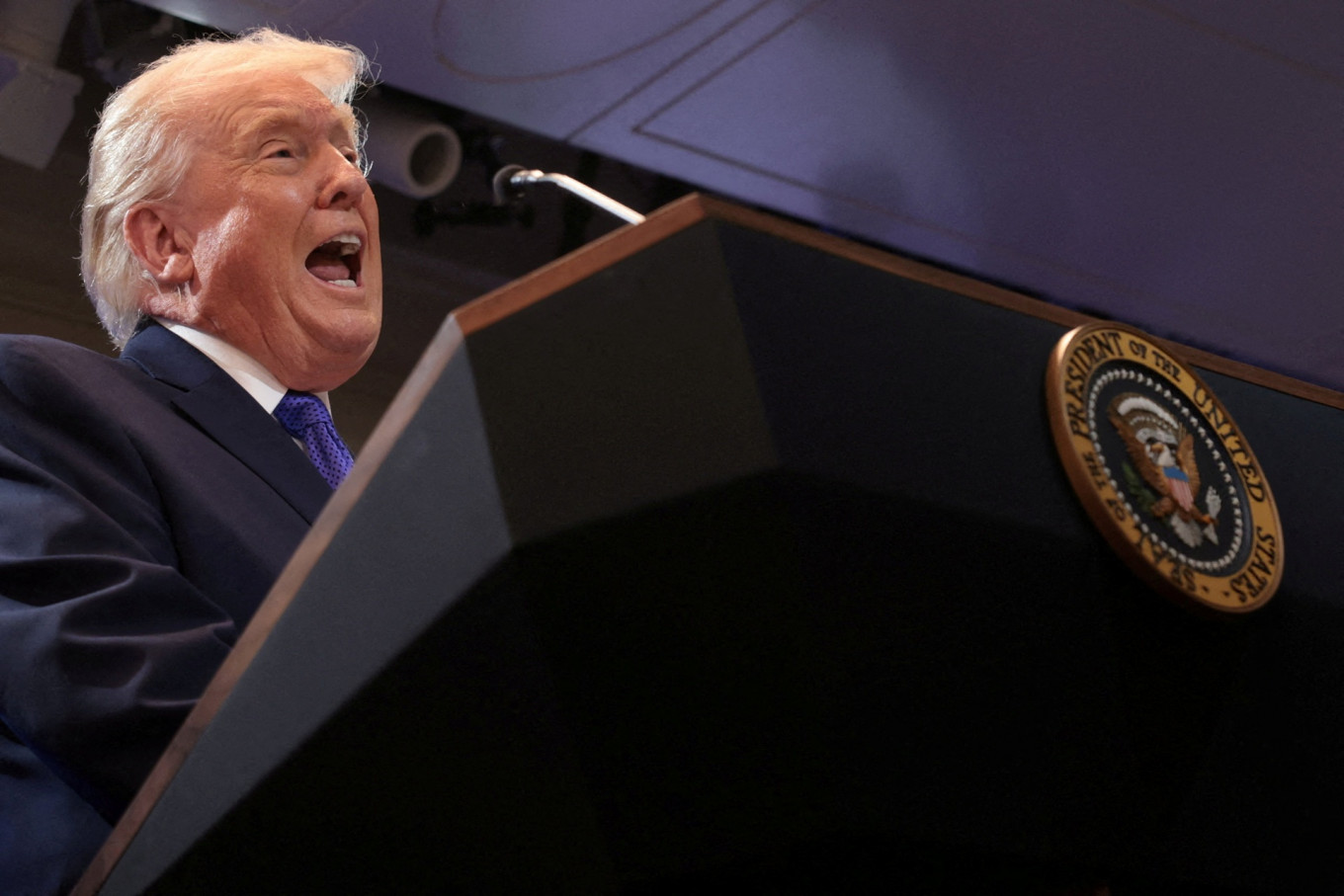 United States President Donald Trump speaks during a press briefing on Feb. 20 at the White House in Washington, D.C., following the Supreme Court's ruling that Trump had exceeded his authority when he imposed tariffs. (Reuters/Jonathan Ernst)
h
e United States Supreme Court has ruled against the tariffs imposed under the International Emergency Economic Powers Act (IEEPA). The decision came just one day after the signing of the Indonesia-US Agreement on Reciprocal Trade (ART). The immediate question, therefore, is what this means for the deal.
The argument here is that the court’s decision does not kill the bilateral trade arrangement. If anything, it clarifies the terrain. The ART operates within an executive-centered trade regime whose stability is inherently contingent, and Indonesia enters the regime with structural asymmetries of its own.
There are three reasons for this assessment. First, the court’s decision addresses tariffs imposed under IEEPA authority alone. The Indonesia-US ART, however, is not confined to that instrument. It extends to non-tariff matters such as investment cooperation and supply chain coordination.
Second, even on tariffs, the legal foundation is not confined to IEEPA. Sectoral measures rest on Section 232 of the Trade Expansion Act of 1962 under the national security exception, which grants wide executive discretion.
Third, political intent reinforces this reality. On the same day, US President Donald Trump issued three executive orders. One of them invoked Section 122 of the Trade Act of 1974 through a proclamation framed as imposing a temporary import surcharge to address international payments concerns.
The Trump administration has also indicated that the current 10 percent surcharge will be increased to 15 percent, the statutory ceiling under Section 122. Though such escalation may not endure if market and consumer pressures mount, the broader signal is clear: Executive trade authority can shift rather than recede.

For Indonesia, the immediate effects are uneven. Products that were previously subjected to an additional 19 percent tariff under IEEPA revert to the Most Favored Nation (MFN) rate. The reciprocal layer disappears. Yet once Section 122 is activated, a 10 percent ad valorem surcharge may apply for up to 150 days.