TheJakartaPost
Please Update your browser
Your browser is out of date, and may not be compatible with our website. A list of the most popular web browsers can be found below.
Just click on the icons to get to the download page.


Popular Reads
Top Results
No results found. Please check your search term and try again
Can't find what you're looking for?
View all search results
Popular Reads
Top Results
No results found. Please check your search term and try again
Can't find what you're looking for?
View all search resultsThe authoritarian trap: Why Prabowo’s cure may deepen corruption
As Indonesia's corruption score falls to 34, the President suggests authoritarianism might help. His own fiscal policies prove otherwise.
Change text size
Gift Premium Articles
to Anyone
Share the best of The Jakarta Post with friends, family, or colleagues. As a subscriber, you can gift 3 to 5 articles each month that anyone can read—no subscription needed!
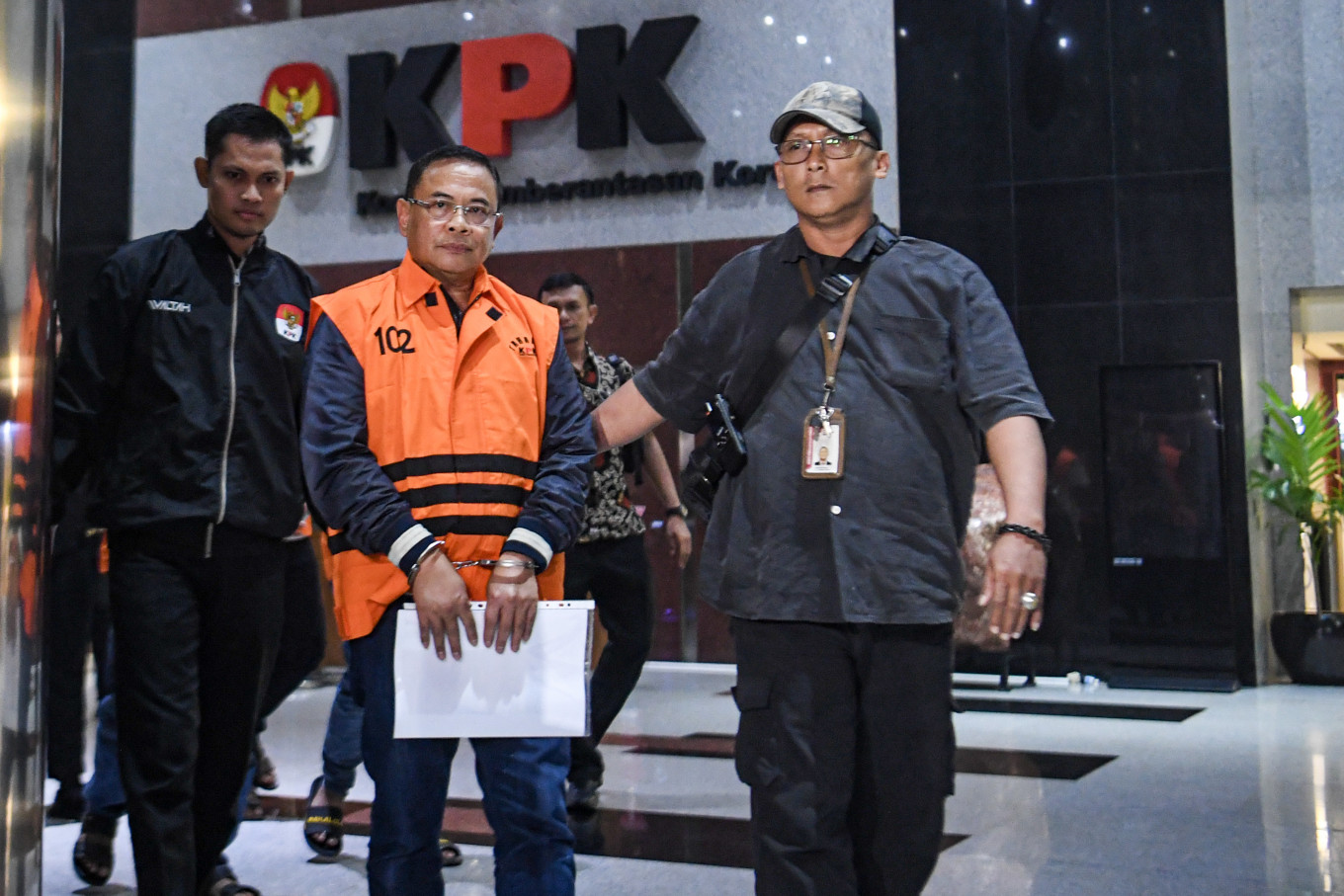 Graft suspect and Pati Regent Sudewo (center) is escorted by Corruption Eradication Commission (KPK) staff on Jan. 20, 2026, after a questioning session at the KPK headquarters in Jakarta. (Antara/Muhammad Adimaja)
P
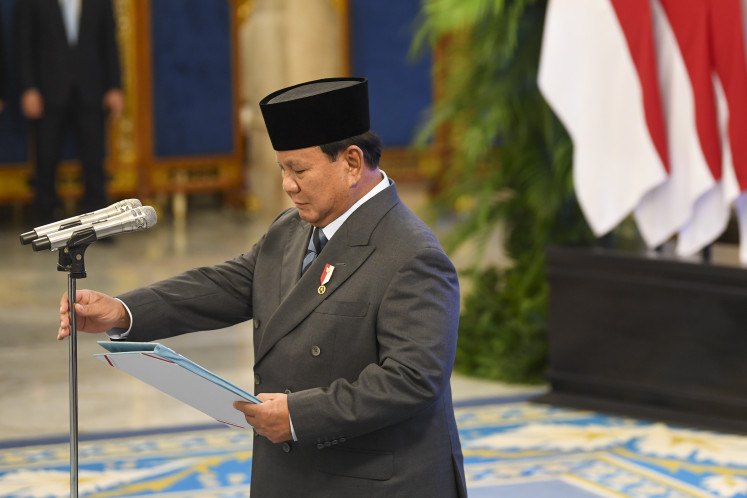
resident Prabowo Subianto told business leaders and foreign ambassadors on Feb. 13 that Indonesia might need “a little bit of authoritarianism” to fight deep-rooted corruption. He said this with a smile, acknowledging the laughter in the room, before quickly adding that he remains “completely democratic”.
The timing makes this more than an offhand remark. Days earlier, Transparency International released its 2025 Corruption Perceptions Index showing that Indonesia's score had dropped from 37 to 34. The country fell from 99th to 109th place globally, the lowest since 2021, and now sits nine points below the Asia-Pacific average score.
These two events tell the same story. Looking at what is happening with government spending under Prabowo's leadership shows exactly why authoritarianism will not solve Indonesia's entrenched corruption. It is creating it.
History shows corruption, collusion and nepotism thrived during the New Order authoritarian regime. Soeharto, the New Order’s founder who ruled the country for more than 30 years, was even touted as the world’s most corrupt leader.
Indonesia's declining corruption perceptions are evident across multiple international assessments. The IMD World Competitiveness Yearbook shows business executives' growing concerns about bribery risks in commercial transactions. The Bertelsmann Transformation Index reflects worsening evaluations of anticorruption enforcement and legal integrity. Meanwhile, the World Economic Forum's Executive Opinion Survey captures increased perceptions that irregular payments are becoming more common in business operations. What are these diverse groups of assessors actually seeing? Massive spending programs controlled from the center, minimal independent oversight and virtually no accountability to the House of Representatives or the public.
Consider the free nutritious meal program. This flagship initiative involves trillions of rupiah flowing to districts to provide free meals to schoolchildren and pregnant women. Yet the money moves with barely any legislative scrutiny. The House, now under the control of a supermajority coalition, has not conducted serious oversight hearings. Transparent procurement data showing which vendors won contracts or how they were selected does not exist, and the Supreme Audit Agency (BPK) has not published comprehensive audits.

The Red and White Rural Cooperatives scheme also follows the same pattern. The government has redirected 58 percent of the 2026 Village Fund away from direct village control into this centralized program. The money now streams from the state coffers directly to special holding accounts, bypassing the village cash accounts that local governments previously managed.