TheJakartaPost
Please Update your browser
Your browser is out of date, and may not be compatible with our website. A list of the most popular web browsers can be found below.
Just click on the icons to get to the download page.


Popular Reads
Top Results
No results found. Please check your search term and try again
Can't find what you're looking for?
View all search results
Popular Reads
Top Results
No results found. Please check your search term and try again
Can't find what you're looking for?
View all search resultsThe economics of the US Supreme Court's tariff ruling
The US Supreme Court did the right thing by ruling that the International Emergency Economic Powers Act of 1977 (IEEPA) “does not authorize the President to impose tariffs.”
Change text size
Gift Premium Articles
to Anyone
Share the best of The Jakarta Post with friends, family, or colleagues. As a subscriber, you can gift 3 to 5 articles each month that anyone can read—no subscription needed!
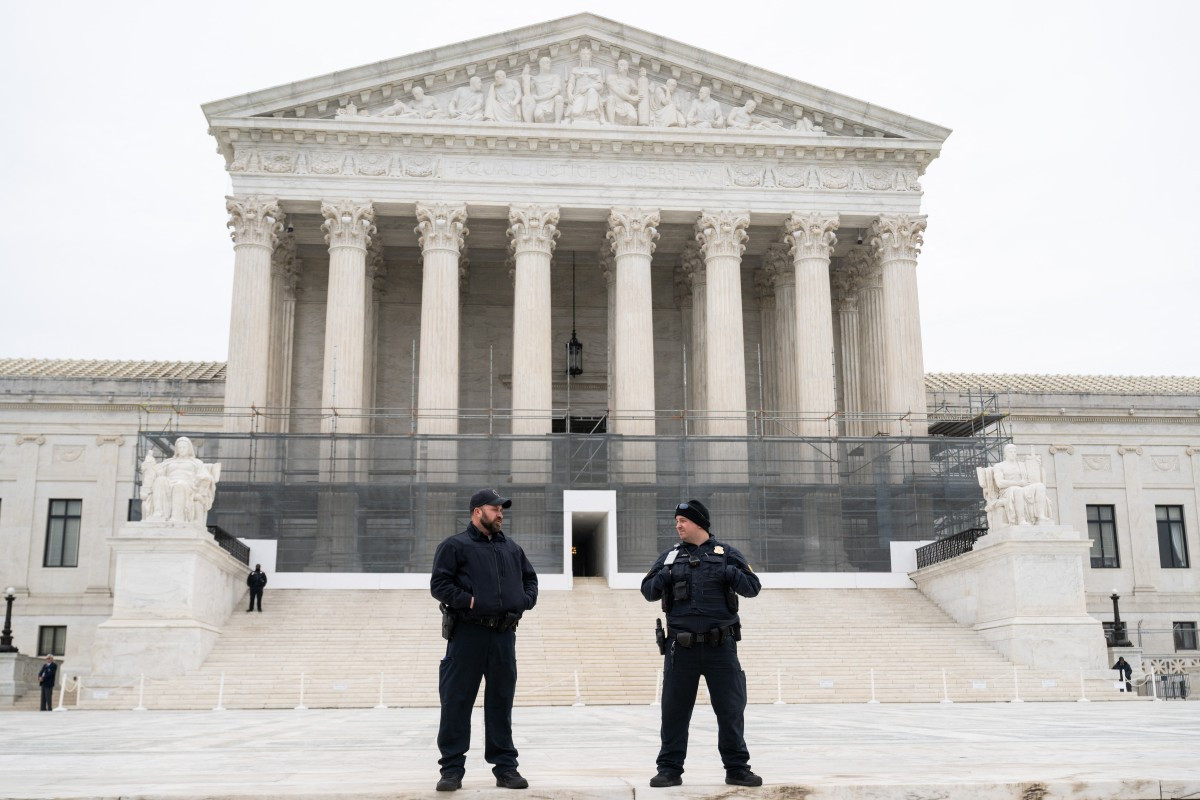 Police guard the United States Supreme Court in Washington, DC, on Jan. 9, 2026. (AFP/Saul Loeb)
T
he United States Supreme Court did the right thing by ruling that the International Emergency Economic Powers Act of 1977 (IEEPA) “does not authorize the President to impose tariffs.” Half of the Court’s conservative majority has, at long last, stood up to US President Donald Trump’s brazen overreach of executive power.
The court, claiming “no special competence in matters of economics or foreign affairs,” stayed in its lane, as dictated by Article III of the US Constitution, and focused solely on the legality of Trump’s signature tariff policies. Its six-three decision, with three conservatives joining the Court’s three liberal justices, effectively positioned the rule of law as the ultimate arbiter of terrible economic policy.
The court’s argument is based on a simple principle that Americans learn early in their education: Under the separation of powers doctrine, the Constitution grants taxing power solely to Congress. The corollary is that, notwithstanding the Trump administration’s absurd protestations, tariffs are indeed taxes on US companies and households. As Chief Justice John Roberts wrote in the majority opinion, the Court was not about to allow such a “transformative expansion of the President’s authority over tariff policy.”
Claiming no special competence in legal matters (apart from having a small office at Yale Law School), I am compelled to weigh in on the ruling’s economic implications, which align with the court’s underlying reasoning for three key reasons.
First, trade deficits are not the “emergency” that Trump claims, his justification for invoking the IEEPA and recklessly wielding the tariff cudgel. The US has run annual trade deficits in manufactured goods since 1976. Last year, despite the sharp increase in Trump’s now-illegal tariffs, the US trade deficit in goods hit a new record of US$1.2 trillion.
The real emergency is America’s extraordinary lack of savings. The net domestic saving rate fell to an estimated 0.2 percent of national income in 2025. Without domestic savings to fund economic growth, the US must import surplus savings from abroad and run outsize balance-of-payments and trade deficits to attract this foreign capital. Owing to massive, persistent federal budget deficits, aided and abetted by Trump’s own policies, an anemic savings trajectory promises huge trade deficits in the years to come.

Second, tariffs hurt US businesses and consumers. Despite Trump’s ridiculous claims to the contrary, tariffs are not paid by foreign countries; they are duties paid by importers for goods upon arrival in the US. The principal dissent to the majority opinion, written by Justice Brett Kavanaugh, claims that “Congress ordinarily seeks ‘to give the President substantial authority and flexibility to protect America and the American people.’” Trump’s tariffs have done the opposite.