The Jakarta Post
Please Update your browser
Your browser is out of date, and may not be compatible with our website. A list of the most popular web browsers can be found below.
Just click on the icons to get to the download page.


Popular Reads
Top Results
No results found. Please check your search term and try again
Can't find what you're looking for?
View all search results
Popular Reads
Top Results
No results found. Please check your search term and try again
Can't find what you're looking for?
View all search resultsA tactical win, not a strategic settlement: The new RI-US deal
The Indonesia–US tariff deal is a pragmatic adjustment in an era of managed globalization.
Change text size
Gift Premium Articles
to Anyone
Share the best of The Jakarta Post with friends, family, or colleagues. As a subscriber, you can gift 3 to 5 articles each month that anyone can read—no subscription needed!
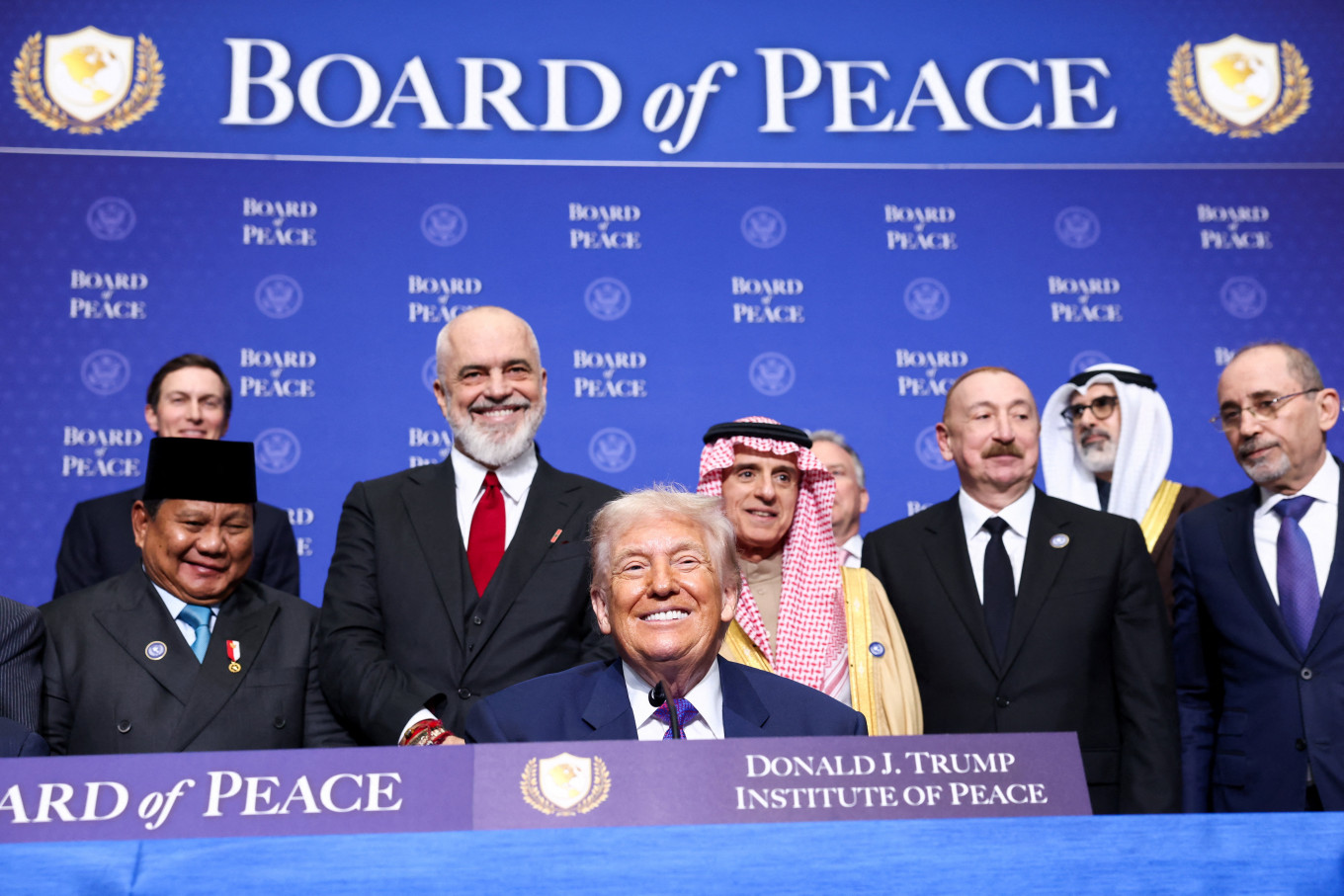 United States President Donald Trump, President Prabowo Subianto, Albania's Prime Minister Edi Rama, Saudi Minister of State for Foreign Affairs, Cabinet Member and Climate Envoy Adel Al-Jubeir, Azerbaijani President Ilham Aliyev and Jordan's Foreign Minister Ayman Safadi attend the inaugural Board of Peace meeting on Feb. 19 at the US Institute of Peace in Washington, D.C. (Reuters/Kevin Lamarque)
T
he newly signed tariff agreement between Indonesia and the United States has been greeted in some quarters as a breakthrough. In truth, it is something more measured: a tactical adjustment within a global trade system increasingly defined by protection, reciprocity and strategic rivalry.
Indonesia has secured zero-tariff access for certain textile and garment exports under a Tariff-Rate Quota (TRQ) mechanism. Under this system, a defined volume of goods enters at zero or reduced tariffs, after which a tariff, roughly 19 percent, applies. Most Indonesian exports remain subject to that broader tariff level.
Is this good for Indonesia? Yes, but only partially.
The textile and garment sector stands to gain the most. Zero tariffs within quota limits reduce landed costs in the US market and provide breathing space for labor-intensive exporters competing against Vietnam, Malaysia and Thailand. Because the US has applied similar reciprocal frameworks across ASEAN competitors, Indonesia is not uniquely disadvantaged. In a climate of rising trade barriers, parity itself is a form of protection.
Certain agricultural lines, including palm oil derivatives, also gain limited market openings. For export sectors under domestic pressure, these adjustments matter. They may not transform the trade balance, but they stabilize access to a major market.
Equally important, the agreement restores predictability in bilateral economic relations. The US remains one of Indonesia’s key export destinations and an important source of investment, technology, and financial influence. In an era where trade can be weaponized overnight, stabilization has its own value.

Yet enthusiasm must be tempered.