TheJakartaPost
Please Update your browser
Your browser is out of date, and may not be compatible with our website. A list of the most popular web browsers can be found below.
Just click on the icons to get to the download page.


Popular Reads
Top Results
No results found. Please check your search term and try again
Can't find what you're looking for?
View all search results
Popular Reads
Top Results
No results found. Please check your search term and try again
Can't find what you're looking for?
View all search resultsAnalysis: Stabilizing coal prices through production cuts, DMO expansion
Change text size
Gift Premium Articles
to Anyone
Share the best of The Jakarta Post with friends, family, or colleagues. As a subscriber, you can gift 3 to 5 articles each month that anyone can read—no subscription needed!
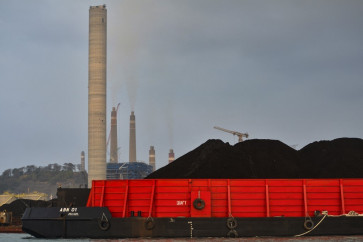
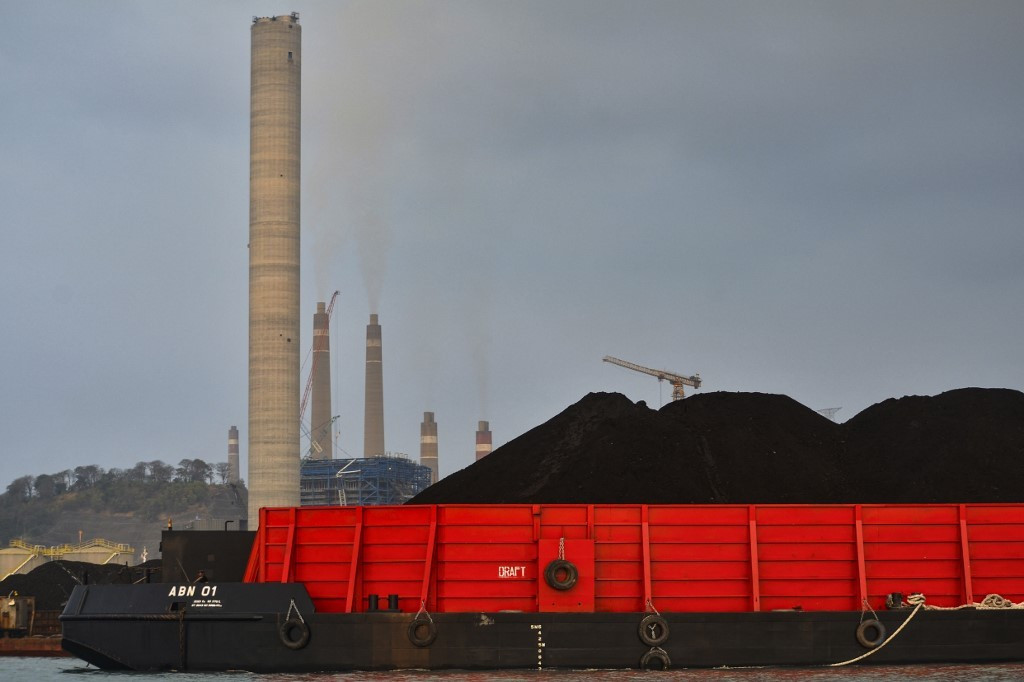 A barge carries coal at the dock next to the Suralaya coal-fired power plant on Oct. 31, 2023, in Cilegon, Banten. (AFP/Ronald Siagian)
G
lobal coal oversupply and falling prices have prompted the Indonesian government to cut domestic coal production this year in an effort to stabilize the market. The move has raised concern among coal producers, who warn that smaller operational scales could reduce employment and non-tax state revenue (PNBP). At the same time, to secure coal supply for state-owned electricity company PT PLN, the government plans to increase the domestic market obligation (DMO). This dual pressure on producers raises an important question: will the production cut outlined in the 2026 annual work plan (RKAB) for the mining sector help restore prices, or will it create further challenges?
The Energy and Mineral Resources (ESDM) Ministry announced in January that Indonesia’s coal production target for 2026 has been reduced to 600 million tonnes (Mt), down from the 750-790 Mt realized in 2025, in response to weakening commodity prices. According to ESDM data, total coal production in 2025 consisted of 254 Mt for domestic consumption and mostly, 514 Mt, for exports. The remaining 22 Mt are stockpiled.
The Coal 2025 annual market report published in December 2025 by the International Energy Agency forecast global coal production to plateau from 9.1 billion tonnes in 2024 to 9.11 billion tonnes in 2025. Global coal trade is projected to decline by 5 percent year-on-year (yoy), reversing the positive growth from a record 1.54 billion tonnes in 2024 to nearly 1.47 billion tonnes in 2025. Indonesia’s coal export volume, dominated by thermal coal, is expected to fall by about 9 percent yoy from 555 Mt in 2024 to 505 Mt in 2025. As a result, Indonesia’s share of global coal trade would decline from 35.95 percent in 2024 to 34.4 percent in 2025, according to the IEA.
Thermal coal used for power generation is classified by calorific value into low CV below 4,200 kilocalories per kilogram, mid CV between 4,200 and 5,700 kcal/kg, and high CV above 5,700 kcal/kg. During January to August 2025, average prices stood at US$45 per tonne for low CV coal, $71 per tonne for mid CV coal, and $104 per tonne for high CV coal. High CV prices fluctuated between $92 and $122 per tonne during the period. Meanwhile, metallurgical coal used mainly for steel production averaged $186 per tonne.
The ESDM Ministry stated that companies holding first generation coal contracts of work (PKP2B) and state-owned enterprises with mining business permits (IUP) will not be subject to the 2026 production quota reduction. In exchange, these companies are required to fulfill their DMO commitments in the first half of 2026 to ensure sufficient supply for PLN, as many companies have not yet finalized their 2026 RKAB submissions.
Seven first generation PKP2B holders have converted their contracts into special mining business permits (IUPK), namely Adaro Indonesia, Arutmin Indonesia, Berau Coal, Kaltim Prima Coal, Kendilo Coal Indonesia, Kideco Jaya Agung, Multi Harapan Utama and Tanito Harum. Only Indominco Mandiri remains under a first generation PKP2B contract until October 4, 2028.

The ministry expects coal supply from first generation PKP2B companies and state-owned enterprises to reach 75 Mt in the first half of 2026. However, the government does not plan to increase DMO prices, which have remained at $70 per tonne for the electricity sector and $90 per tonne for the cement and fertilizer sectors since 2018.