TheJakartaPost
Please Update your browser
Your browser is out of date, and may not be compatible with our website. A list of the most popular web browsers can be found below.
Just click on the icons to get to the download page.


Popular Reads
Top Results
No results found. Please check your search term and try again
Can't find what you're looking for?
View all search results
Popular Reads
Top Results
No results found. Please check your search term and try again
Can't find what you're looking for?
View all search resultsPromise or performance? Weighing the macroeconomic footprint of cooperatives
While Indonesia’s Red and White initiatives aim to revitalize cooperatives as constitutional cornerstones of the economy, empirical data reveals a sector struggling to translate scale into growth. True economic sovereignty will require shifting the focus from administrative expansion to high-value productivity and human capital reform.
Change text size
Gift Premium Articles
to Anyone
Share the best of The Jakarta Post with friends, family, or colleagues. As a subscriber, you can gift 3 to 5 articles each month that anyone can read—no subscription needed!
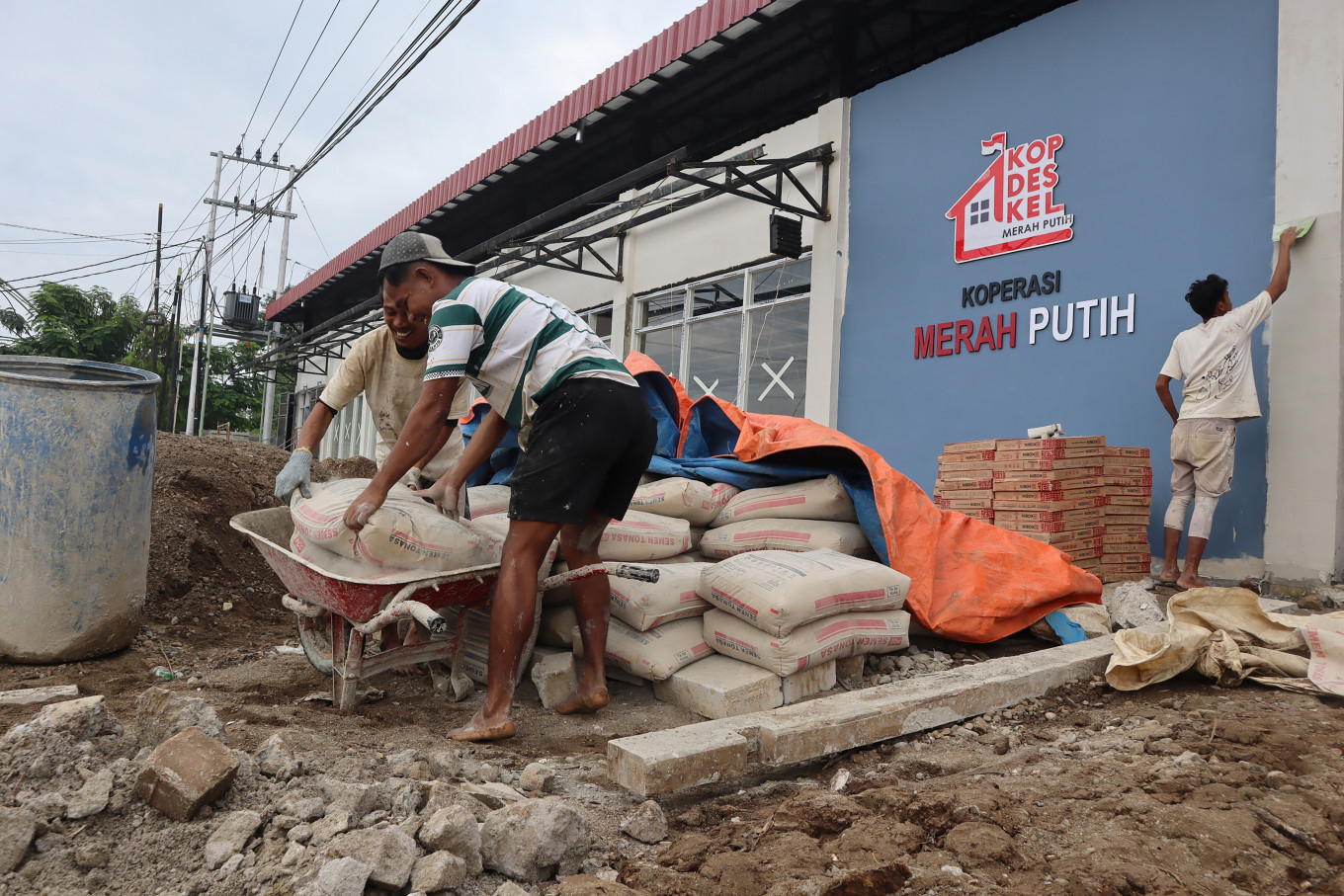 Workers construct Red and White Cooperatives (KDMP) outlet on Jan. 27, 2026, in Wae Kelambu, West Manggarai regency, East Nusa Tenggara. Several villages are reportedly struggling to establish the new cooperatives, citing limited land and insufficient funding as major obstacles. (Antara/Geicio Viana)
I
ndonesia has long positioned cooperatives as the cornerstone and constitutional center of its economic development. Rooted in and explicitly referenced by Article 33 of the 1945 Constitution, cooperatives are envisioned not merely as business entities but as institutional embodiments of collective ownership and democratic control.
The 2025–2029 National Medium-Term Development Plan reinforces this ambition, identifying cooperatives as primary vehicles for inclusive growth, micro, small and medium enterprise (MSME) empowerment, and community-based economic sovereignty.
The role of cooperatives as engines of development is arguably more critical now than ever, particularly through the establishment of the Red and White Cooperatives, one of President Prabowo Subianto’s signature programs.
To support this initiative, just recently Finance Minister Purbaya Yudhi Sadewa issued Regulation No. 7/2026, mandating that 58.03 percent of the 2026 Village Fund allocation, amounting to Rp 34.57 trillion (US$2 billion), be directed toward cooperative development. This leaves approximately Rp 25 trillion for regular village priorities, representing a massive fiscal bet on the cooperative model's efficacy.
The crucial question remains: What does empirical data from Statistics Indonesia (BPS) tell us about the actual performance of these institutions?
A comprehensive assessment by IFG Progress, covering 514 regencies and municipalities and drawing from SUSENAS, SAKERNAS, and PODES data, offers vital nuance. The study analyzes three key regional economic indicators driven by cooperative establishments: regional gross domestic product growth, unemployment rates and average household consumption.

The 2024 BPS Potensi Desa (PODES) survey recorded 51,505 cooperative units across districts, representing nearly half of the 130,119 cooperatives reported nationally in 2023. While each district hosts an average of 91 units, distribution remains highly uneven, ranging from high concentrations in Wonogiri, Central Java to a total absence in parts of Papua.