The Jakarta Post
Please Update your browser
Your browser is out of date, and may not be compatible with our website. A list of the most popular web browsers can be found below.
Just click on the icons to get to the download page.


Popular Reads
Top Results
No results found. Please check your search term and try again
Can't find what you're looking for?
View all search results
Popular Reads
Top Results
No results found. Please check your search term and try again
Can't find what you're looking for?
View all search resultsAnalysis: Questioning the government’s health commitment to the poor
Change text size
Gift Premium Articles
to Anyone
Share the best of The Jakarta Post with friends, family, or colleagues. As a subscriber, you can gift 3 to 5 articles each month that anyone can read—no subscription needed!
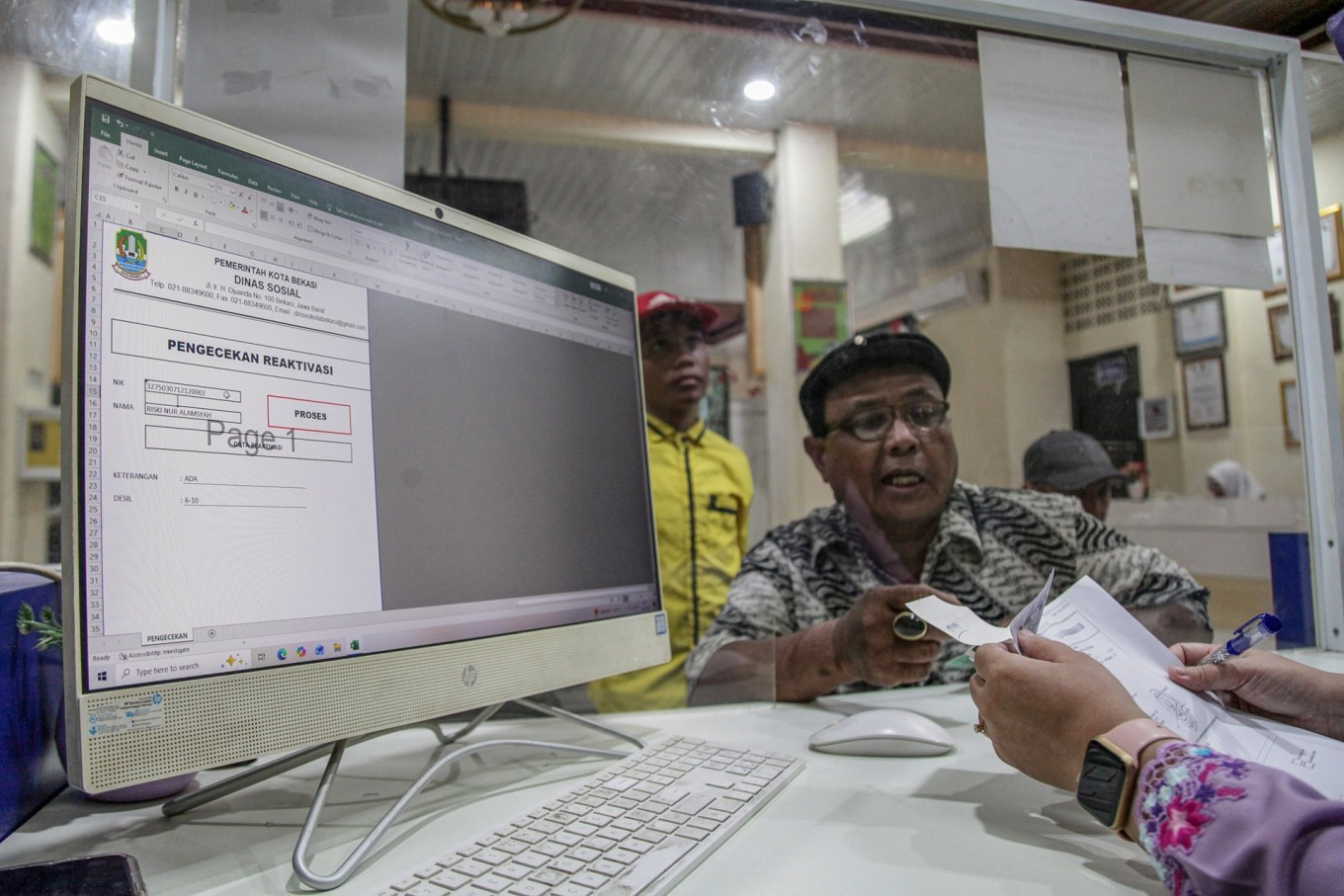 A patient files a request on Feb. 13, 2026, to reactivate his subsidized national health insurance (JKN) policy at the Bekasi Municipality Social Affairs Agency in Bekasi, West Java. (Antara/Darryl Ramadhan)
T
he recent deactivation of millions of National Health Insurance (JKN) contribution assistance recipients (PBI) has been revealed as more than a mere data-cleaning exercise. It has exposed a systemic failure to recognize the vulnerability of the poor, for whom subsidized health care is a necessity, not an option. This episode underscores persistent flaws in the design and execution of Indonesia’s health protection framework.
Under Social Affairs Ministerial Decree No. 3/2026, approximately 11 million PBI participants were deactivated on Feb. 1. The PBI remains the largest segment of the JKN system; as of Dec. 31, 2025, total participation reached 282.7 million, with 40.2 percent receiving subsidies. Given its scale, this cohort is a fiscal pillar of Indonesia’s health financing, funded through both state (APBN) and regional (APBD) budgets.
The deactivation occurred because these individuals were missing from the National Integrated Socioeconomic Data (DTSEN) and were thus deemed ineligible. The DTSEN is the government’s new central welfare database, replacing the Integrated Social Welfare Data (DTKS) following 2025 instructions from Social Affairs Minister Saifullah Yusuf.
Nearly a year into this transition, the reform has left many citizens blindsided. Media reports highlight patients discovering their coverage had been terminated only while seeking treatment. The most acute disruptions affected those requiring continuous, life-sustaining care, such as dialysis patients whose treatments are strictly time-bound.
Tony Richard Samosir, chairperson of the Indonesia Dialysis Patient Community (KPCDI), said that the vast majority of dialysis patients whose PBI status was deactivated received no prior notification. He characterized this sudden termination of coverage as inhumane and a violation of fundamental human rights.
Policy-wise, the overhaul aims to ensure limited subsidies reach those most in need. The government maintains a fixed quota of 96.8 million PBI beneficiaries, targeting the poorest five deciles. Thus, removals are designed to create fiscal space for newly eligible recipients.

Yet, ground realities reveal the social cost of this administrative rationalization. Following a public backlash, Statistics Indonesia (BPS) accelerated the verification of the 11 million deactivated participants. Health Minister Budi Gunadi Sadikin also announced that coverage for patients with "catastrophic" illnesses would be automatically reactivated for three months. Of those removed, roughly 120,000 suffered from such conditions.