TheJakartaPost
Please Update your browser
Your browser is out of date, and may not be compatible with our website. A list of the most popular web browsers can be found below.
Just click on the icons to get to the download page.


Popular Reads
Top Results
No results found. Please check your search term and try again
Can't find what you're looking for?
View all search results
Popular Reads
Top Results
No results found. Please check your search term and try again
Can't find what you're looking for?
View all search resultsThe gavel, not the gun: Rethinking TNI’s role in counterterrorism
As Indonesia deliberates the military’s role in domestic security, the priority must remain the preservation of the criminal justice system over purely kinetic solutions. Effective counterterrorism is measured not by the neutralization of threats, but by the state’s ability to uphold legal accountability under civilian oversight.
Change text size
Gift Premium Articles
to Anyone
Share the best of The Jakarta Post with friends, family, or colleagues. As a subscriber, you can gift 3 to 5 articles each month that anyone can read—no subscription needed!
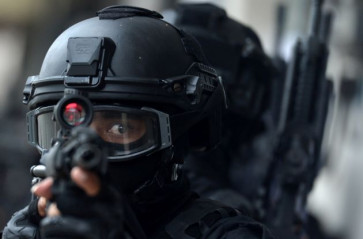
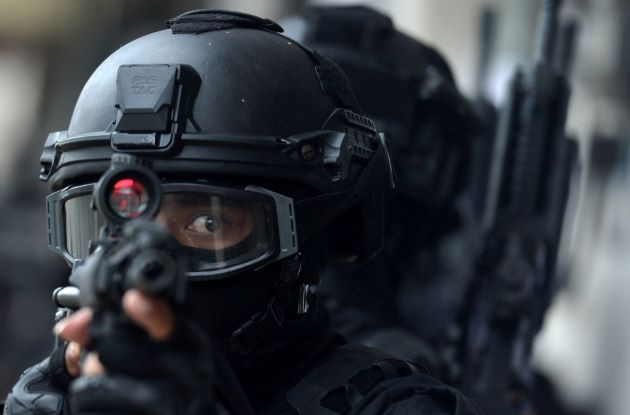 Sights set: An Indonesian Military (TNI) soldier takes part in a counterterrorism drill on Oct. 20, 2022, in Sanur, Denpasar, Bali, ahead of a G20 Summit in Bali the next month. (Antara/Fikri Yusuf)
T
o this day, the proposed involvement of the Indonesian Military (TNI) in counterterrorism remains one of the most deeply polarized subjects in public discourse. This debate escalated in mid-2020 as a logical consequence of Law No. 5/2018, which revised the legal framework for the eradication of terrorism.
Essentially, the 2018 Law opened a legal avenue for the TNI’s involvement by classifying counterterrorism under military operations other than war (MOOTW). This aligns with the military’s primary duties as outlined in TNI Law No. 34/2004 and the subsequent Law No. 3/2025. Consequently, from a constitutional standpoint, a military role in counterterrorism is not an anomaly; rather, it is a justified action built upon a solid legal foundation.
However, this legal reality raises a crucial question: How should we define the limits of military involvement to ensure it remains harmonious with the country’s criminal justice system? Establishing a proportional role is essential to guarantee that every operation stays strictly within legal boundaries.
We must emphasize that the ultimate indicator of successful counterterrorism is the upholding of legal accountability, specifically, the state’s ability to bring perpetrators to justice through a court of law, rather than merely neutralizing threats on the ground through the use of force.
A 2020 CSIS Commentary, “Legal Observation on TNI’s Involvement in Counterterrorism”, previously underlined that early drafts of the Presidential Regulation contained numerous legal loopholes. These gaps risked overlapping with the jurisdictions of civilian authorities such as the National Police and the National Counterterrorism Agency (BNPT), potentially threatening human rights and disrupting the criminal justice system.
Therefore, any military involvement must be regulated with exceptionally strict boundaries, subjected to civilian oversight, and positioned strictly as a supporting system rather than a primary actor during times of civil order.

Recent developments offer some cause for optimism. The draft presidential regulation (Perpres) circulating in early 2026 shows significant improvements in financial governance. While the 2020 draft risked financial deviations by allowing non-state budget (APBN) funding, a direct violation of the TNI Law, the 2026 iteration has corrected this path. The current policy underscores a centralized funding system strictly through the APBN, ensuring that all military operations remain fully accountable to the state’s fiscal oversight.