The Jakarta Post
Please Update your browser
Your browser is out of date, and may not be compatible with our website. A list of the most popular web browsers can be found below.
Just click on the icons to get to the download page.


Popular Reads
Top Results
No results found. Please check your search term and try again
Can't find what you're looking for?
View all search results
Popular Reads
Top Results
No results found. Please check your search term and try again
Can't find what you're looking for?
View all search resultsAnalysis: Indonesia’s trade gamble amid Trump’s policy mood swings
Change text size
Gift Premium Articles
to Anyone
Share the best of The Jakarta Post with friends, family, or colleagues. As a subscriber, you can gift 3 to 5 articles each month that anyone can read—no subscription needed!
 Set as preferred source
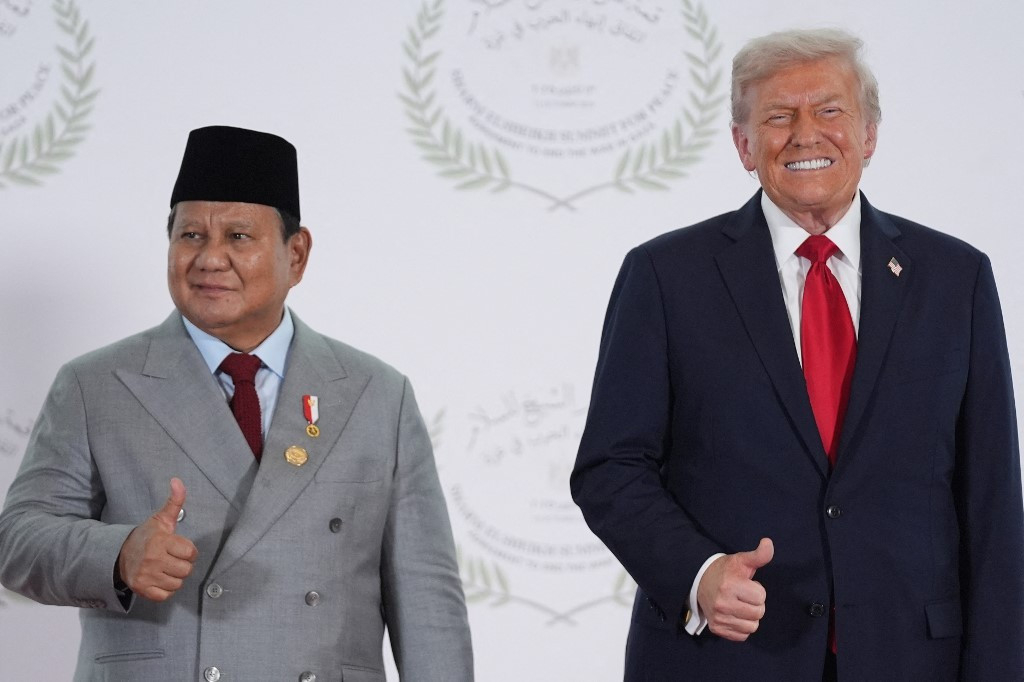 US President Donald Trump greets President Prabowo Subianto during a summit on Gaza in Sharm el-Sheikh on October 13, 2025. Trump landed in Egypt on October 13 for a summit on Gaza, following a lightning visit to Israel after a ceasefire he brokered entered into force. (AFP/Evan Vucci)
I
ndonesia’s much-celebrated breakthrough in lowering United States tariffs is already losing its shine. Just one day after the Agreement on Reciprocal Trade (ART) was sealed, securing a headline tariff cut to 19 percent, the US Supreme Court ruled that President Donald Trump’s earlier tariff regime was unlawful. The question now is not how deep the cut appears on paper, but whether Indonesia has genuinely strengthened its bargaining position or is merely navigating an increasingly unpredictable trade landscape.
On Feb. 20, the Supreme Court found that most of Trump’s sweeping tariff measures could not be justified under the 1977 International Emergency Economic Powers Act (IEEPA), ruling that the administration had acted arbitrarily in imposing blanket tariffs.
A day later, Trump responded by authorizing a 10 percent global tariff under Section 122 of the Trade Act of 1974, which allows temporary measures of up to 150 days, with implementation scheduled for Feb. 24. Yet within hours, the policy shifted again: global tariffs were raised to 15 percent, with Trump insisting the increase was fully lawful.
Against this backdrop, the substance of the ART takes on greater significance. On Feb. 19, both governments finalized its contours with apparent clarity. While Indonesia is expected to undertake at least 217 commitments compared with only six on the US side, the deal was nonetheless framed as mutually beneficial.
Most significantly, 1,819 Indonesian tariff lines will receive zero-duty access to the US market, covering major export earners such as crude palm oil, coffee, cocoa, spices, rubber, electronic components, semiconductors and aircraft parts. Textiles and apparel will also enjoy zero tariffs under a tariff-rate quota scheme, with quotas linked to Indonesia’s imports of US cotton and man-made fibers.
This preferential access is economically defensible. In 2025, the US recorded a US$23.7 billion goods trade deficit with Indonesia, suggesting that expanded access for Indonesian exports could just as plausibly widen rather than reduce that imbalance.

Some critics may therefore view the agreement as disproportionately costly. Yet its logic lies less in headline tariff rates than in strategic differentiation. In international trade, even small tariff differentials can influence sourcing decisions, supply chain allocation and long-term investment flows. By securing selective zero-tariff access, Indonesia avoids uniform competition and preserves relative advantages in priority sectors.