The Jakarta Post
Please Update your browser
Your browser is out of date, and may not be compatible with our website. A list of the most popular web browsers can be found below.
Just click on the icons to get to the download page.


Popular Reads
Top Results
No results found. Please check your search term and try again
Can't find what you're looking for?
View all search results
Popular Reads
Top Results
No results found. Please check your search term and try again
Can't find what you're looking for?
View all search resultsStrikes without shield: Indonesia cannot mediate what it cannot survive
Diplomatic capital may be Indonesia’s greatest asset, but in a Middle East redefined by missile exchanges and succession crises, Jakarta is discovering that moral authority cannot stop a warhead it has no defense against.
Change text size
Gift Premium Articles
to Anyone
Share the best of The Jakarta Post with friends, family, or colleagues. As a subscriber, you can gift 3 to 5 articles each month that anyone can read—no subscription needed!
 Set as preferred source
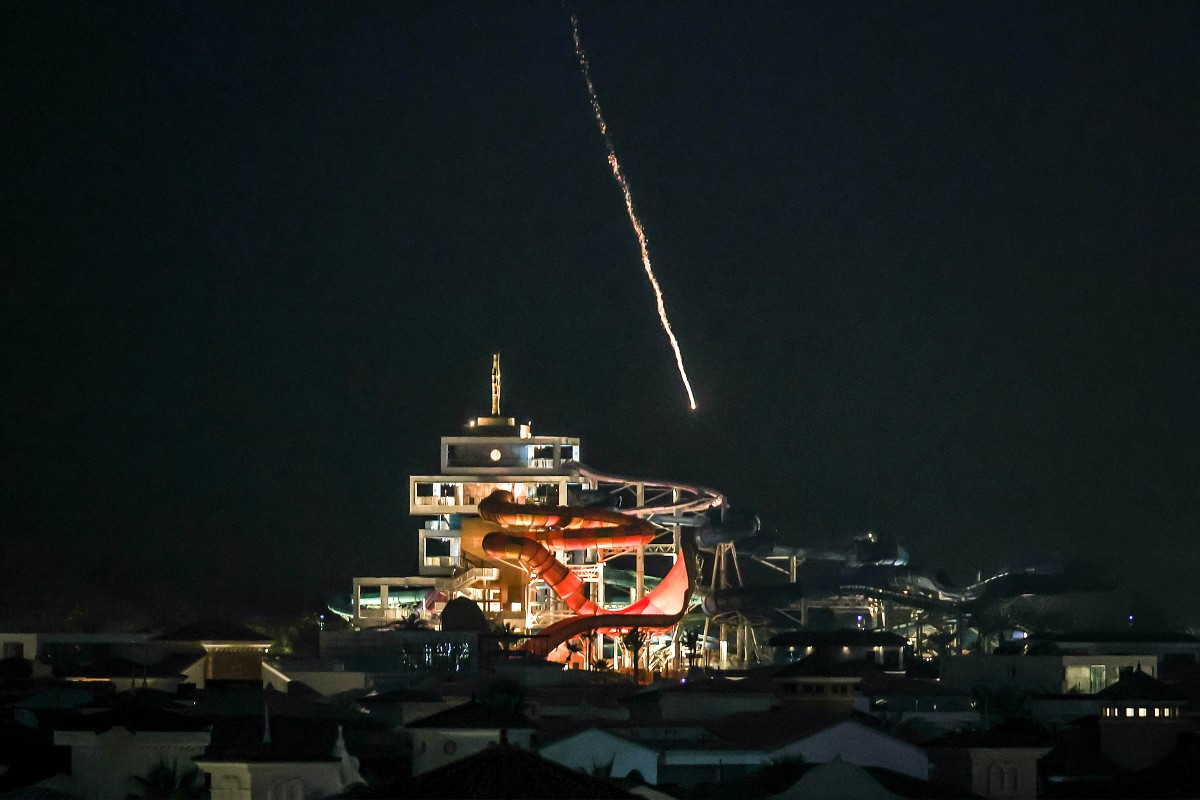 An intercepted projectile falls into the sea on March 1, 2026, near Dubai's Palm Jumeirah archipelago. The United States and Israel launched strikes against Iran on Feb. 28, 2026, killing Iran's supreme leader and top military leaders, prompting authorities to retaliate with strikes on Israel, and US bases across the Gulf. (AFP/Fadel Senna)
H
ours after the United States and Israel launched Operation Epic Fury last Saturday, Iran fired missiles at every Gulf Arab state hosting US forces, claiming several lives and injuring many others. The Strait of Hormuz, through which roughly a fifth of global oil and liquefied natural gas (LNG) transits, was declared effectively closed by Iran's Revolutionary Guards.
Within 12 hours of the first US bomb falling on Tehran, what had begun as a bilateral confrontation had become a region-wide missile exchange, one that reached countries where more than half a million Indonesian citizens live and work.
Jakarta's response arrived later that evening. The Foreign Ministry expressed deep regret, urged maximum restraint, and announced that President Prabowo Subianto was "willing to travel to Tehran to conduct mediation".
By the time the statement was published, however, Iran's supreme leader Ayatollah Ali Khamenei was dead, killed in an Israeli airstrike. Iranian state media confirmed the death shortly thereafter. Tehran plunged into a succession crisis, and while Iran's constitution does provide for an interim leadership council, no figure in Tehran at this moment commands the political standing to negotiate with a foreign mediator. The offer was principled, yet it was instantly obsolete.
The chasm between intention and reality runs deeper than one statement. Indonesia signed the Board of Peace (BoP) charter on the sidelines of the World Economic Forum in Davos, Switzerland, in January 2026, joining the body established under United Nations Security Council Resolution 2803 to oversee Gaza's reconstruction.
Prabowo framed it as a continuation of the Bandung Principles, of sovereignty, noninterference and peaceful settlement of disputes, deliberately casting the scope wider than Gaza by invoking "regional stability" and the principle’s broader mandate.

That ambiguity was strategic at the time; it gave Jakarta diplomatic flexibility. After Feb. 28, it became a liability. A charter broad enough to cover "regional stability" is broad enough to drag Indonesia into a conflict it has no capacity to manage.