The Jakarta Post
Please Update your browser
Your browser is out of date, and may not be compatible with our website. A list of the most popular web browsers can be found below.
Just click on the icons to get to the download page.


Popular Reads
Top Results
No results found. Please check your search term and try again
Can't find what you're looking for?
View all search results
Popular Reads
Top Results
No results found. Please check your search term and try again
Can't find what you're looking for?
View all search resultsAfter 50 years ASEAN's peace treaty needs new teeth
While the Treaty of Amity and Cooperation remains a global gold standard for diplomacy, ASEAN must bridge the gap between its aspirational principles and the political will required to actually use them.
Change text size
Gift Premium Articles
to Anyone
Share the best of The Jakarta Post with friends, family, or colleagues. As a subscriber, you can gift 3 to 5 articles each month that anyone can read—no subscription needed!
 Set as preferred source
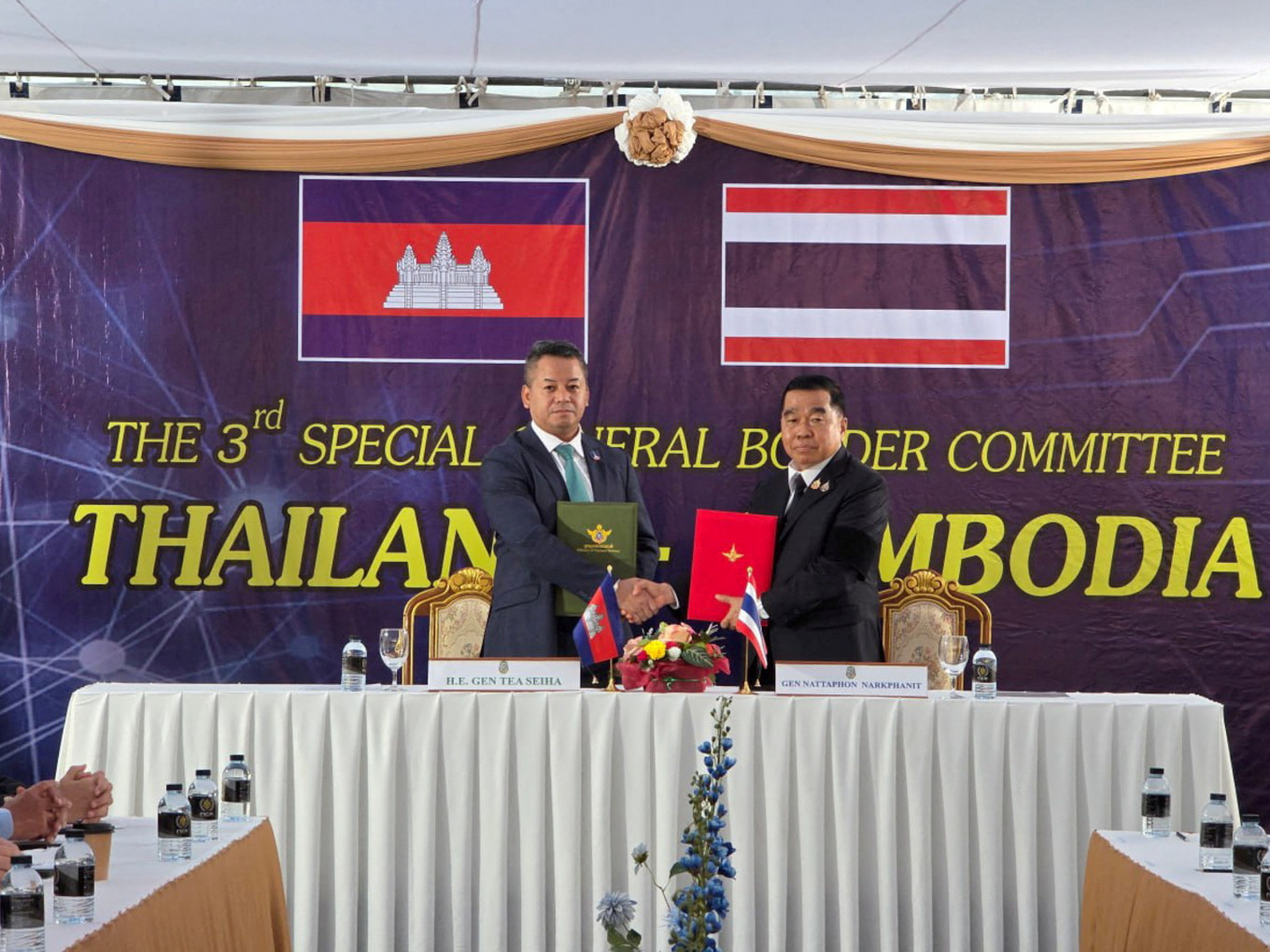 Cambodia's Defense Minister Tea Seiha and Thailand's Defense Minister Natthaphon Narkphanit pose with documents during a special General Border Committee (GBC) meeting on Dec. 27, 2025, at a border checkpoint, in Chanthaburi province, Thailand. (Reuters via Agence Kampuchea Press/handout)
T
he Treaty of Amity and Cooperation in Southeast Asia (TAC) is now 50 years old. Since its adoption at the first ASEAN Summit in Bali on Feb. 24, 1976, the TAC has stood as a foundational pillar of peace and stability within the region. It is widely recognized as the most important regional code of conduct for maintaining harmonious relations among its diverse member states.
Its core principles, respect for sovereignty and territorial integrity, non-interference in internal affairs, the renunciation of the threat or use of force and the peaceful settlement of all disputes, are legally binding on all signatories.
The treaty’s significance is further underscored by the growing number of non-ASEAN countries acceding to its principles; there are now 58 high contracting parties, signifying global recognition of its role in fostering trust. Today, all countries wishing to become dialogue partners of ASEAN must accede to the TAC, which embodies the aspirations for a prosperous and secure Southeast Asia, free from both intra-regional conflicts and external interventions in the region.
For decades, the TAC has served as an effective framework, guiding interactions and preventing potential conflicts from escalating into full-blown crises. Its success in promoting a culture of dialogue and consultation has been instrumental in creating an environment conducive to economic growth and regional integration. These inherent principles have fostered a sense of community and shared responsibility, encouraging nations to address differences through diplomatic channels rather than confrontational approaches.
However, a critical analysis reveals that the TAC's historical efficacy has primarily stemmed from the voluntary restraint and political will exercised by ASEAN member states. It is this unspoken commitment to uphold the spirit of the treaty, even more than its explicit mechanisms, that has largely contributed to its enduring success. Members have often chosen to de-escalate tensions and seek amicable solutions, implicitly relying on the moral authority and collective interest embodied by the TAC.
Although the treaty contains provisions for conflict mediation through the invocation of a high council—comprising ministerial-level officials—in practice, the High Council has never been called upon to mediate directly in disputes. Member states have, for the most part, preferred to settle their disputes through bilateral negotiations or by taking their cases to the International Court of Justice (ICJ).

Examples include the disputes between Malaysia and Singapore over Pedra Branca and between Indonesia and Malaysia over Sipadan and Ligitan. Nevertheless, the existence of the TAC provided a conducive climate for these parties to commit to peaceful settlements in the first place and, crucially, to accept the rulings of the ICJ, even by the losing sides.