TheJakartaPost
Please Update your browser
Your browser is out of date, and may not be compatible with our website. A list of the most popular web browsers can be found below.
Just click on the icons to get to the download page.


Popular Reads
Top Results
No results found. Please check your search term and try again
Can't find what you're looking for?
View all search results
Popular Reads
Top Results
No results found. Please check your search term and try again
Can't find what you're looking for?
View all search resultsAnalysis: Agrinas’ KMP import plan triggers automotive industry backlash
Change text size
Gift Premium Articles
to Anyone
Share the best of The Jakarta Post with friends, family, or colleagues. As a subscriber, you can gift 3 to 5 articles each month that anyone can read—no subscription needed!
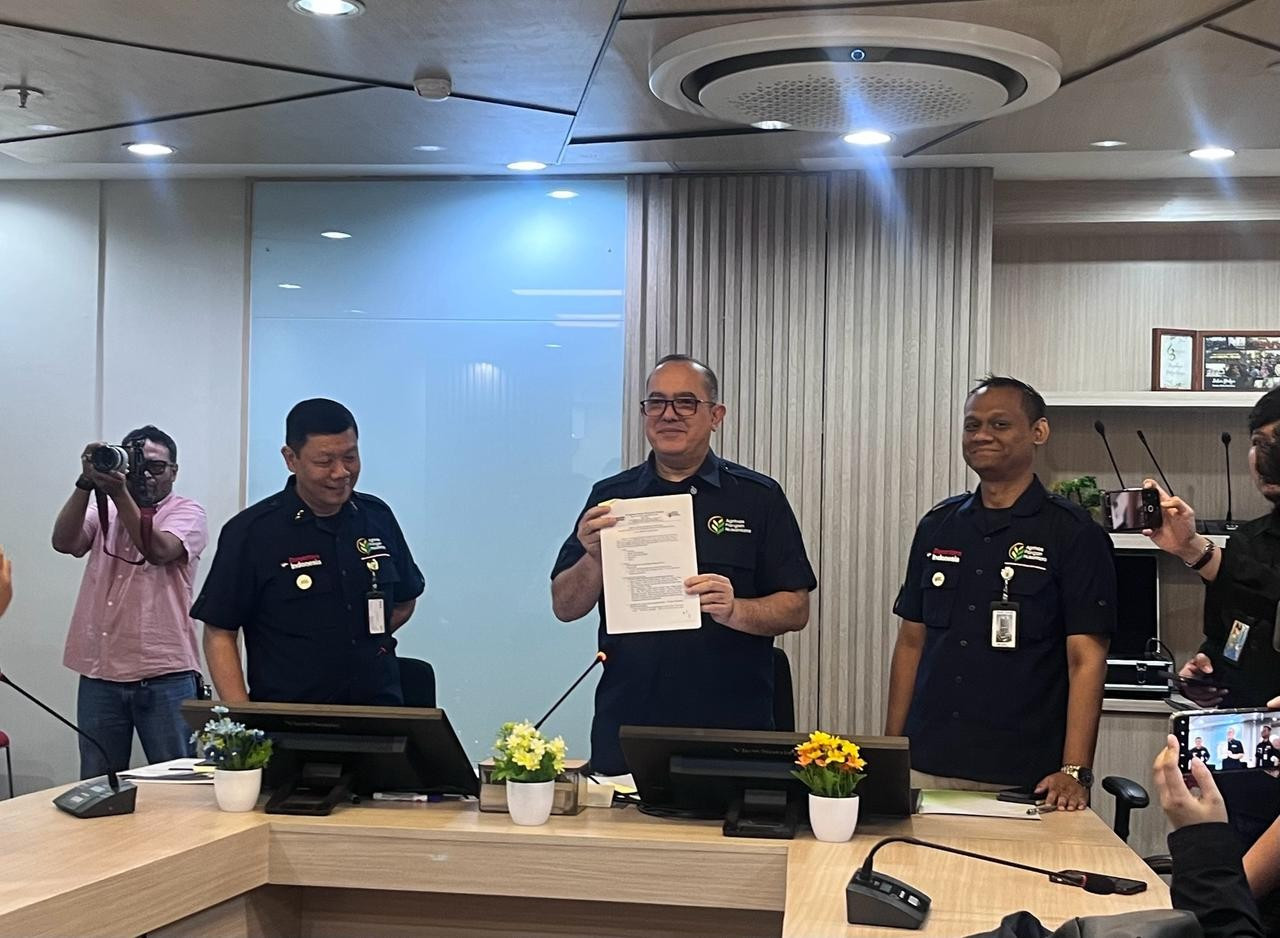 State-owned agriculture firm PT Agrinas Pangan Nusantara president director Joao Angelo De Sousa Mota (center) poses for a picture in a press conference on Feb. 24 while showing a document related to the decision to import 105,000 vehicles from Indian firms Tata Motors and Mahindra. (The Jakarta Post/Ni Made Tasyarani)
S
tate-owned PT Agrinas Pangan Nusantara’s plan to import 105,000 pickup trucks from India has triggered strong criticism from domestic industry players, labor unions, and lawmakers who argue that the move undermines Indonesia’s automotive sector and contradicts national industrialization goals. The state-owned company, which is tasked with operating the Red and White Cooperatives (KMP) program, has defended the plan on the grounds of cost efficiency. Agrinas chief executive officer Joao Angelo De Sousa Mota stated that price considerations were the primary driver behind the procurement decision.
The procurement plan consists of 35,000 Mahindra 4x4 pickups, 35,000 Tata Motors 4x4 pickups and 35,000 light trucks, with a total estimated cost of Rp 24.66 trillion (US$1.47 billion). Business associations such as Kadin Indonesia, the Indonesian Automotive Industry Association (GAIKINDO) and the Association of Automotive and Motorcycle Parts Industries (GIAMM) have strongly opposed the plan. They argue that domestic manufacturers have sufficient, and in many cases underutilized, production capacity to meet the demand. Large-scale imports of completely built-up vehicles, they warn, could erode local market share, threaten employment and create significant economic leakage abroad, potentially reducing gross domestic product contributions by tens of trillions of rupiah.
Labor organizations, including KSPSI and unions representing workers at major automakers such as Suzuki, have described the policy as dismissive of national industrial capabilities. They caution that the move could accelerate layoffs at a time when the sector is already under pressure. Several economists have also characterized the plan as disruptive to Indonesia’s long-standing industrialization strategy. Meanwhile, DPR Vice Speaker Sufmi Dasco Ahmad has called for a postponement pending President Prabowo Subianto’s review, stressing that government procurement should prioritize domestic production in line with the administration’s commitment to economic self-reliance.
Although reports indicate that around 200 Mahindra units have already arrived, with additional shipments on the way, public pressure continues to mount. Many stakeholders are urging the government to cancel or at least thoroughly reassess the procurement in order to safeguard domestic industry and employment.
The controversy surrounding the KMP program, however, extends well beyond the automotive procurement issue. Launched under Presidential Instruction No. 17 of 2025 as a flagship initiative to strengthen rural self-reliance, the program has faced increasing scrutiny since its implementation. Much of the criticism centers on the mandatory reallocation of village budgets. For 2026, approximately Rp 34.57 trillion, or 58.03 percent of the total Rp 60.57 trillion village fund allocation, is earmarked for the program. Village leaders, particularly in remote areas, argue that the reallocation significantly reduces fiscal space for essential infrastructure and social assistance, thereby constraining local economic activity.
Conceptually, the program is a flagship initiative to empower rural economies, making villages more productive through self-reliant cooperatives that handle downstream processing of local commodities. The initiative understandably drew grassroots support from the public, as it promises to aggregate and add value to rural businesses.

However, critics argue there had not been a sufficiently strong preexisting demand or ecosystem to justify rolling out village cooperatives on such a massive scale. The argument could be made for villages in proximity to urban epicenters, but in remote and underdeveloped regions, weak infrastructure, poor market access and significant logistical challenges make successful operations highly uncertain, potentially leading to underutilized facilities and financial strain from maintenance or debt, or outright failure, echoing the recent issue last year about state banks being forced to maintain the liquidity of village cooperatives.