The Jakarta Post
Please Update your browser
Your browser is out of date, and may not be compatible with our website. A list of the most popular web browsers can be found below.
Just click on the icons to get to the download page.


Popular Reads
Top Results
No results found. Please check your search term and try again
Can't find what you're looking for?
View all search results
Popular Reads
Top Results
No results found. Please check your search term and try again
Can't find what you're looking for?
View all search resultsIndonesia’s strategic autonomy in a fragmented global order
In an era of intensifying great-power rivalry and economic decoupling, Indonesia must move beyond passive non-alignment toward a doctrine of disciplined strategic autonomy. By integrating balance-of-power logic with sophisticated economic statecraft, Jakarta can transform global uncertainty into a source of national leverage.
Change text size
Gift Premium Articles
to Anyone
Share the best of The Jakarta Post with friends, family, or colleagues. As a subscriber, you can gift 3 to 5 articles each month that anyone can read—no subscription needed!
 Set as preferred source
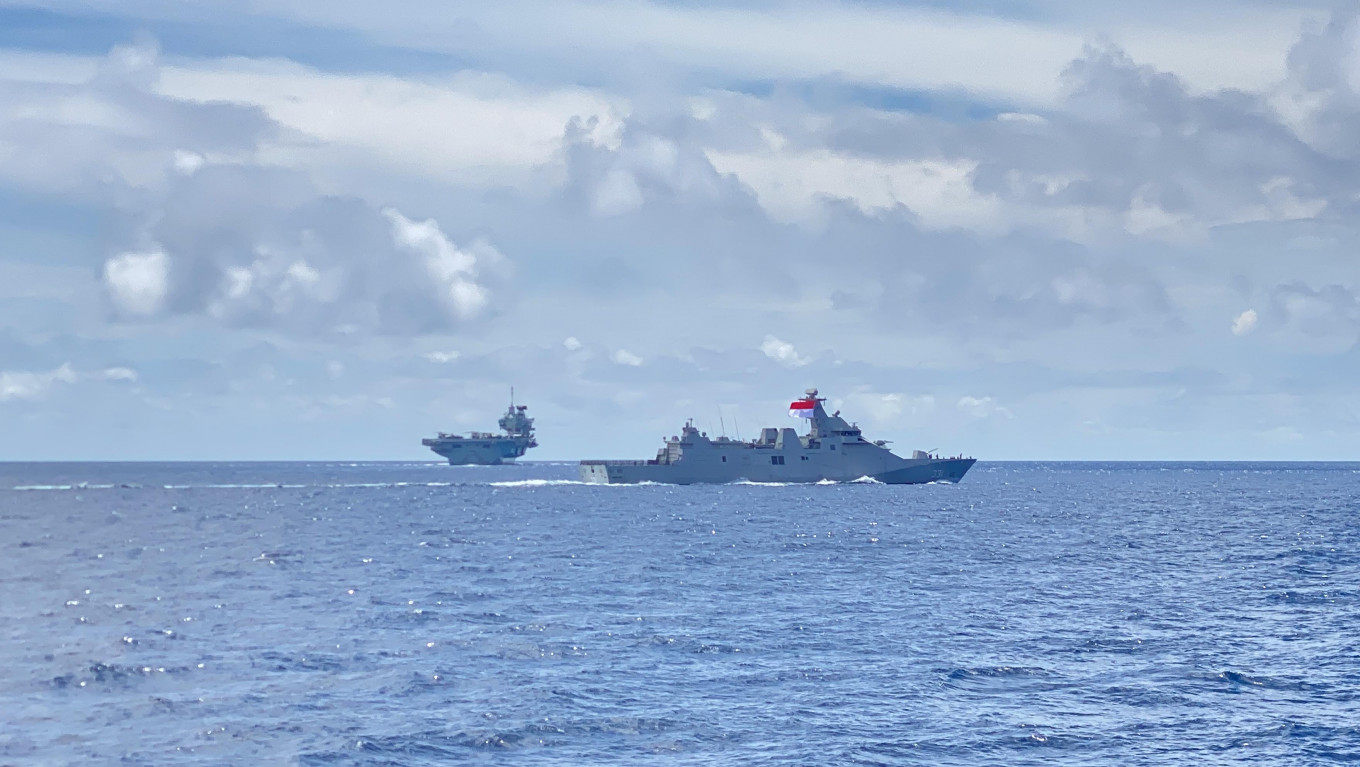 The Navy's KRI Raden Eddy Martadinata (foreground) passes the Royal Navy's aircraft carrier HMS Prince of Wales during a passing exercise (Passex) along the Indonesian Sea Lane of Communications (ALKI) III on Banda Sea, southwest of Buru Island, on July 31. (Courtesy of Indonesian Navy/-)
T
he world is no longer a scene of comforting predictability. The unipolar moment that followed the Cold War has dissipated, replaced by a fractured, multipolar environment characterized by intensifying strategic rivalries, economic decoupling and normative contestation.
In this complex configuration, states are increasingly pressed to make unsettling choices, often between autonomy and alignment, or between short-term economic opportunity and long-term strategic vulnerability.
For Indonesia, the world’s third-largest democracy and the preeminent economy in Southeast Asia, navigating this tumultuous era demands a recalibration of foreign policy that is neither naïve nor narrowly transactional. It calls for a disciplined strategic autonomy that synthesizes balance-of-power considerations, economic statecraft and principled diplomacy, particularly in the pursuit of global peace.
Any serious discussion of strategic autonomy must begin with the structure of power itself. Balance of power is often framed as an outmoded relic of realist geopolitics, yet this misreads its enduring structural logic.
As articulated by scholars such as Kenneth Waltz and Hedley Bull, balance of power is not an ideological preference but a systemic inevitability when great powers contest influence within an anarchic international system. Waltz’s structural realism reminds us that in the absence of a central global authority, states must act to prevent domination by any single hegemon. Bull, in The Anarchical Society, further underscores that equilibrium, not permanent hierarchy, is what sustains international order.
Today, the Indo-Pacific epitomizes such systemic uncertainty. The rivalry between the United States and China extends across military postures, technological ecosystems and supply chains. In this environment, strict non-alignment, once a proud declaration, risks irrelevance if it is not matched by cold strategic calculation.

Indonesia’s geostrategic position is a material reality, not an abstract advantage. Straddling the waterways connecting the Indian and Pacific Oceans, Indonesia is the custodian of sea lanes through which nearly a third of global maritime trade flows. As major powers vie for access, Jakarta’s posture cannot be merely reactive. A calibrated engagement with balance-of-power logic enables Indonesia to shape equilibrium without surrendering its sovereignty.