The Jakarta Post
Please Update your browser
Your browser is out of date, and may not be compatible with our website. A list of the most popular web browsers can be found below.
Just click on the icons to get to the download page.


Popular Reads
Top Results
No results found. Please check your search term and try again
Can't find what you're looking for?
View all search results
Popular Reads
Top Results
No results found. Please check your search term and try again
Can't find what you're looking for?
View all search resultsSelective multilateralism and the drift from law to power
As military force bypasses diplomatic channels, the international order faces a perilous transition from a system governed by the predictability of law to one dictated by the selective whims of power.
Change text size
Gift Premium Articles
to Anyone
Share the best of The Jakarta Post with friends, family, or colleagues. As a subscriber, you can gift 3 to 5 articles each month that anyone can read—no subscription needed!
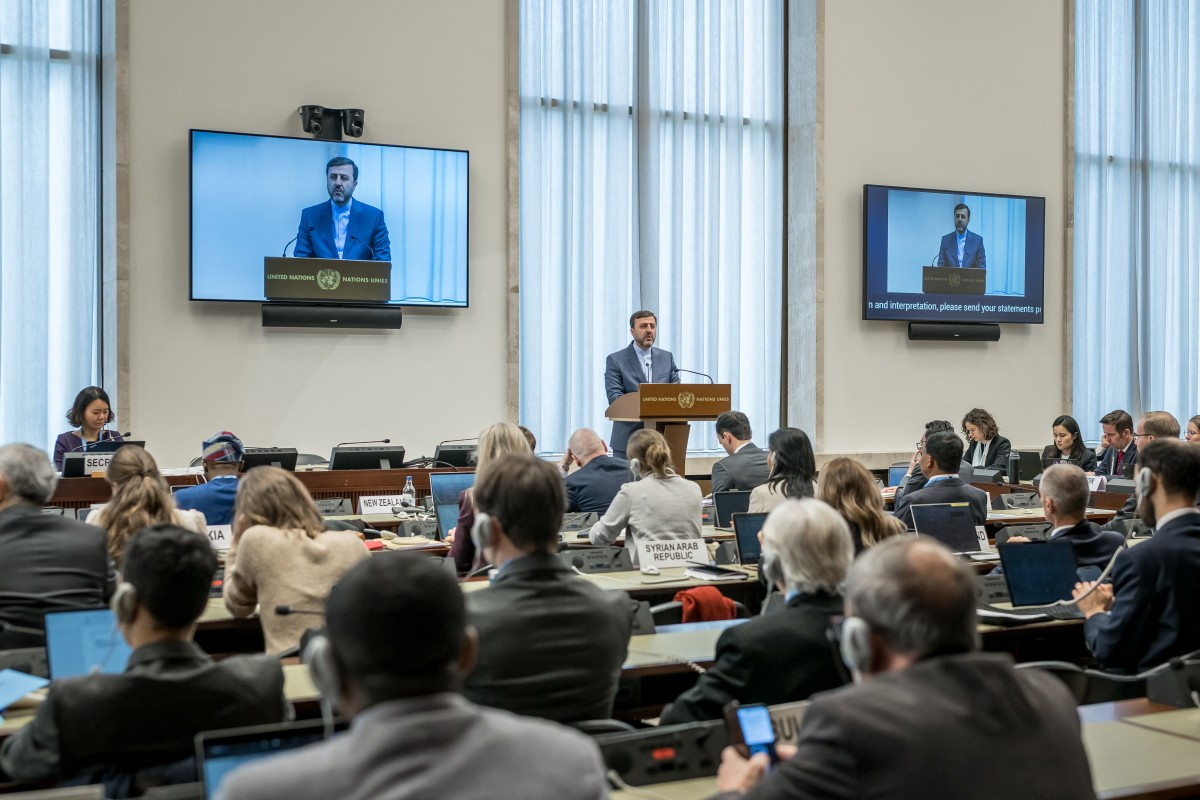 Iran's Deputy Foreign Minister Kazeem Gharibabadi addresses the audience on Saturday during the annual high-level debate of the United Nations Conference on Disarmament in Geneva, Switzerland. (AFP/Fabrice Coffrini)
T
he international order rarely unravels in a single dramatic rupture. More often, it frays quietly - rule by rule, exception by exception - until what once felt firm begins to seem negotiable.
The coordinated strikes by the United States and Israel against Iranian targets on Feb. 28 may prove to be one such moment. Beyond their immediate regional implications, they raise deeper questions about the health of multilateralism, the authority of international law and whether rules still effectively constrain power in a moment of crisis.
At the heart of this episode lies a tension between legality and power, between collective restraint and unilateral action. While diplomatic negotiations were reportedly still underway, military force was deployed. This sequence compels a fundamental question: Did such action conform not only to the text but also to the spirit of the United Nations Charter?
For decades, states have reaffirmed their commitment to the Charter as the constitutional foundation of the post-1945 order. Article 2 enshrines three interlocking principles: sovereign equality, the peaceful settlement of disputes and the prohibition of the use of force. These provisions were designed to replace a world governed by might with one restrained by law - a system in which predictability tempers volatility.
The legal threshold for the use of force is intentionally high. Under Article 2(4), force is prohibited except in two narrowly defined circumstances: authorization by the UN Security Council under Chapter VII, or the inherent right of self-defense in response to an armed attack under Article 51. In the case of the Feb. 28 attacks, there was no Security Council authorization. Nor was there publicly verifiable evidence of an ongoing armed attack that would clearly trigger the right of self-defense. Absent these conditions, the legal justification becomes, at best, contestable.
When broad security concerns or speculative future risks are invoked as sufficient grounds for military action, the prohibition on the use of force risks becoming conditional rather than binding. Once conditional, it ceases to restrain power. The legal firewall weakens, and with it the predictability that underpins international stability. What is framed as exceptional today may become a normalized precedent tomorrow.

Equally troubling is the steady sidelining of diplomacy. Article 2(3) obliges states to settle disputes by peaceful means. This is not a ceremonial prelude to force; it is a binding legal duty. Negotiation, mediation and dialogue are not signs of weakness, but mechanisms intended to prevent escalation and preserve legitimacy. When they are bypassed, expediency overtakes process - and when process is sidelined, trust dissolves.