TheJakartaPost
Please Update your browser
Your browser is out of date, and may not be compatible with our website. A list of the most popular web browsers can be found below.
Just click on the icons to get to the download page.


Popular Reads
Top Results
No results found. Please check your search term and try again
Can't find what you're looking for?
View all search results
Popular Reads
Top Results
No results found. Please check your search term and try again
Can't find what you're looking for?
View all search resultsAs disasters increase, climate adaptation funding lags behind
As disasters become more frequent, contingency funds prove insufficient, forcing local administrations to seek support from the central government, which seems to focus on its own priority programs.
Change text size
Gift Premium Articles
to Anyone
Share the best of The Jakarta Post with friends, family, or colleagues. As a subscriber, you can gift 3 to 5 articles each month that anyone can read—no subscription needed!
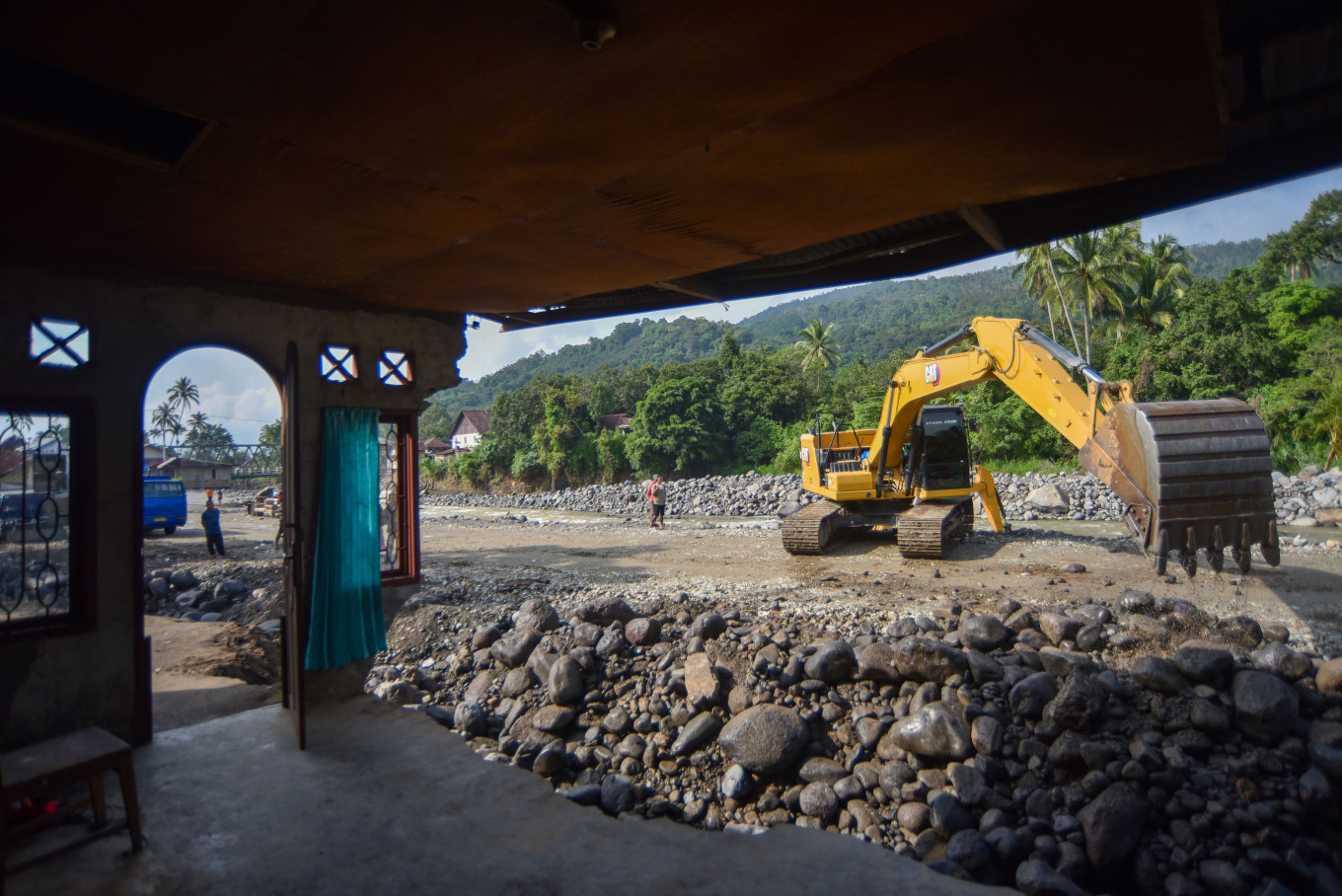 An operator runs heavy equipment on Saturday, Jan. 10, 2026, to normalize a river in Nagari Sumpu, Tanah Datar, West Sumatra. The Tanah Datar administration has proposed about Rp 1.4 trillion (US$82.79 billion) in post-disaster recovery funding to the central government, including more than Rp 1.3 trillion for infrastructure, around Rp 92.9 billion for housing, Rp 49 billion for the economy, over Rp 6.7 billion for social programs and more than Rp 10 billion for cross-sector needs. (Antara/Iggoy el Fitra)
R
ecent hydrometeorological disasters faced by the people of northern Sumatra demonstrate the escalating impacts of climate change in Indonesia. Floods, landslides and extreme weather are increasing frequently and severely across regions.
Months after the disaster, communities in Aceh are still struggling to recover, revealing not only exposure to risk but also low post-disaster resilience. What once felt distant now directly affects daily life in cities and villages alike.
While rising temperatures due to the climate crisis may have intensified the rainfall, land-use change has amplified the risks. Data from the Forestry Ministry show that deforestation across Sumatra reached 78,000 hectares in 2024, accounting for 44 percent of the national rate, reducing soil water absorption and accelerating floods and landslides across the region.
Climate factors alone do not explain the severity of destruction. In many local governments, disaster risk reduction (DRR) has yet to be recognized as a development priority. When treated merely as a sectoral issue, institutional readiness becomes a blind spot in reducing disaster risks. The existing gap in mitigation measures, such as disaster preparedness, risk assessments and early warning systems result in governments responding only after damage has occurred.
The gap is rooted in how DRR is financed in Indonesia. Local administrations rely heavily on contingency reserves, which are designed for short-term emergencies rather than recurring climate risks. As disasters become more frequent, these funds quickly prove insufficient, forcing local administrations to seek support from the central government.
Meanwhile, the national disaster response from central government remains tied to rigid annual state budget cycles that prioritize rehabilitation and reconstruction after losses occur, offering limited space for preventive, ex-ante investments.

This rigid mechanism leaves little room for local administrations to maneuver due to limited fiscal autonomy, where provinces and districts depend heavily on national transfers and struggle to mobilize their own revenue. The regions facing the highest climate risks are often the least equipped with stable and flexible funding to invest in long-term DRR beyond annual budgets or transfers.