TheJakartaPost
Please Update your browser
Your browser is out of date, and may not be compatible with our website. A list of the most popular web browsers can be found below.
Just click on the icons to get to the download page.


Popular Reads
Top Results
No results found. Please check your search term and try again
Can't find what you're looking for?
View all search results
Popular Reads
Top Results
No results found. Please check your search term and try again
Can't find what you're looking for?
View all search resultsLPDP furor and the narrow definition of national service
Behind the viral outrage of a "disloyal" scholarship recipient lies a rigid bureaucratic formula that values physical presence over global impact. It is time to ask why Indonesia treats its brightest minds like office furniture rather than strategic national assets.
Change text size
Gift Premium Articles
to Anyone
Share the best of The Jakarta Post with friends, family, or colleagues. As a subscriber, you can gift 3 to 5 articles each month that anyone can read—no subscription needed!
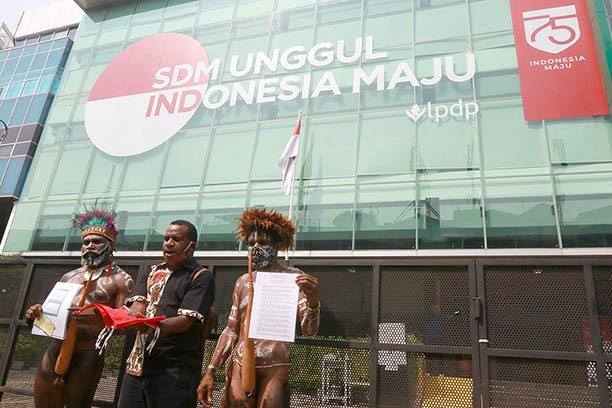 Solidarity: Wearing traditional Papuan dress, members of the Ebamukai Solidarity Team for Indonesian human rights lawyer Veronica Koman show documents in front of the Endowment Fund for Education (LPDP) office in Jakarta, on Sept. 9, 2020, as they sought to reimburse scholarship money totaling Rp 773.8
million (US$51,900). The lawyer was asked to return the funding, which she received from the LPDP, as it said that she had failed to return home to Indonesia after her studies. Security officers prevented them from entering the office, saying that the office was closed because of the large-scale social restrictions. (JP/Dhoni Setiawan)
Solidarity: Wearing traditional Papuan dress, members of the Ebamukai Solidarity Team for Indonesian human rights lawyer Veronica Koman show documents in front of the Endowment Fund for Education (LPDP) office in Jakarta, on Sept. 9, 2020, as they sought to reimburse scholarship money totaling Rp 773.8
million (US$51,900). The lawyer was asked to return the funding, which she received from the LPDP, as it said that she had failed to return home to Indonesia after her studies. Security officers prevented them from entering the office, saying that the office was closed because of the large-scale social restrictions. (JP/Dhoni Setiawan)
R
ecently, an LPDP scholarship recipient went viral on social media after posting about her child's foreign citizenship by birth and disparaging the Indonesian passport as an "unfortunate" one. While the controversy quickly devolved into moral outrage over nationalism and gratitude, the episode raises a deeper, more uncomfortable question: why does Indonesia's scholarship define loyalty and contribution in such narrow, bureaucratic terms?
Let us talk about 2n+1, a formula that appears to have emerged not from impact-based policy reasoning, but from bureaucratic revelation. The formula is treated as sacrosanct, immune to questioning and accepted as an unquestionable truth.
Yet the question is logically simple: why must it be 2n+1? Why not 4n+1, or even n², so scholarship recipients can truly age and grow moss in government offices before being deemed to have "served" the nation?
Within LPDP's logic, service is not measured by what one produces, but by how long one's body remains physically present inside the country. The longer one sits in a government office, the more nationalist one becomes. The longer one fills out forms and reports, the more patriotic one appears. Impact, innovation and real influence are relegated to secondary considerations—if they are considered at all.
Imagine two hypothetical figures. The first is a PhD graduate from the United Kingdom who returns to Indonesia and spends nine years trapped in the university's administrative maze. His life is filled with accreditation paperwork, meetings, performance reports and endless signatures. In the eyes of the system, he is the ideal servant: present, compliant and physically loyal.
The second is a diaspora scientist in London working on cancer treatments, climate technology or artificial intelligence. Her work is cited in international journals, global industries adopt her patents and her research networks span continents. Her contribution is tangible, measurable and globally impactful. Yet under certain policy lenses, such contributions are deemed insufficient. Why? Because she does not "show her face" domestically.

This logic resembles an absurd comparison: a local amateur footballer who plays for 20 years versus a World Cup player who competes for a single season. In terms of duration, the amateur wins decisively. But in terms of impact, prestige and influence, the answer is obvious even before the question is asked.