The Jakarta Post
Please Update your browser
Your browser is out of date, and may not be compatible with our website. A list of the most popular web browsers can be found below.
Just click on the icons to get to the download page.


Popular Reads
Top Results
No results found. Please check your search term and try again
Can't find what you're looking for?
View all search results
Popular Reads
Top Results
No results found. Please check your search term and try again
Can't find what you're looking for?
View all search resultsAnalysis: US trade deal could compel Indonesia to pick sides
Change text size
Gift Premium Articles
to Anyone
Share the best of The Jakarta Post with friends, family, or colleagues. As a subscriber, you can gift 3 to 5 articles each month that anyone can read—no subscription needed!
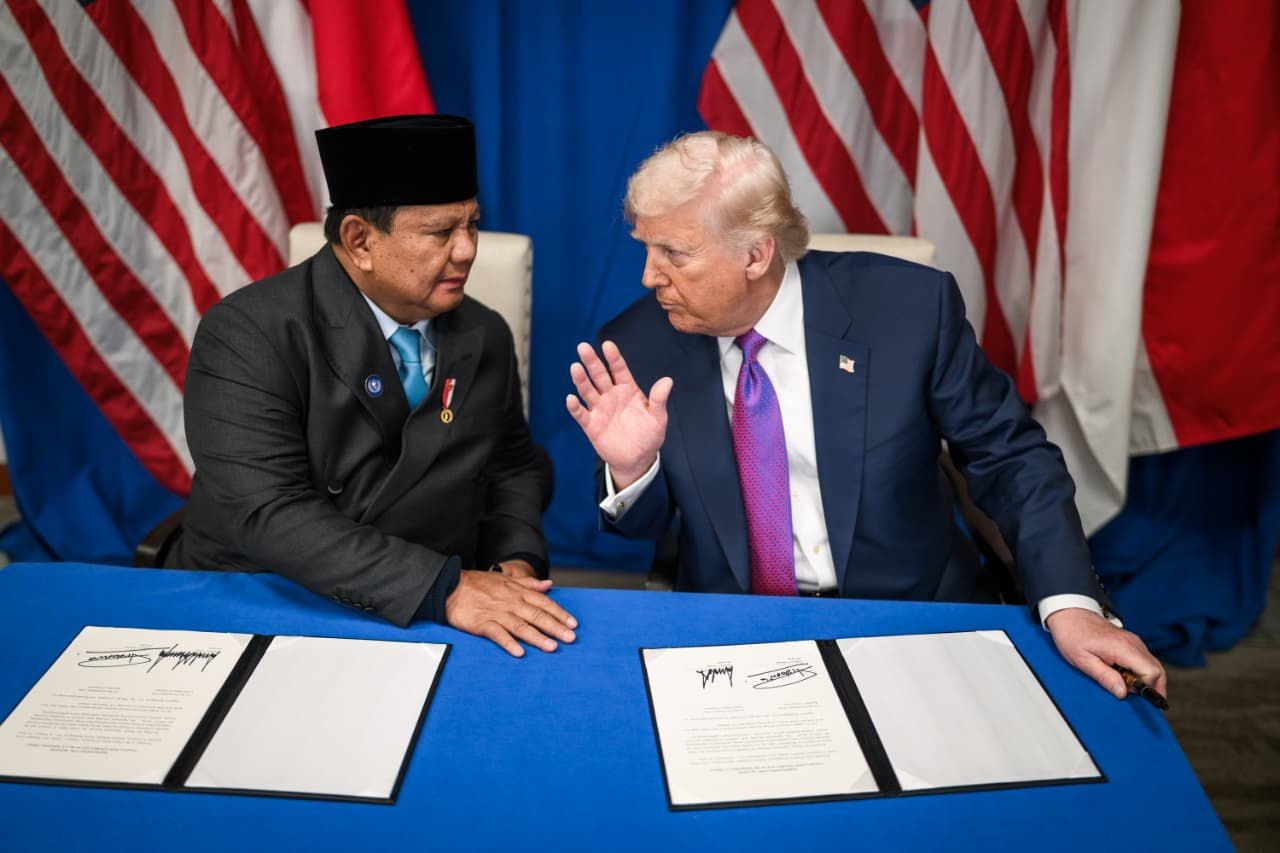 President Prabowo Subianto (left) speaks to United States President Donald Trump on Feb. 19 during the signing of the US-Indonesia Agreement on Reciprocal Tariffs (ART) in Washington, DC. (Courtesy of Presidential Secretariat/White House)
T
he Indonesia–United States Agreement on Reciprocal Trade (ART) reaches far beyond conventional tariff negotiations. While public debate has focused on potential export gains, the deal also includes provisions on investment, subsidy transparency and alignment with US regulatory standards that, over time, could narrow Indonesia’s room for maneuver in shaping its own industrial policy and development strategy.
While the ART agreement sets a 19 percent tariff for Indonesia, it grants preferential access for 1,819 Indonesian tariff lines, including major exports such as crude palm oil, coffee, cocoa, spices, rubber, electronic components, semiconductors and aircraft parts. However, it is difficult to conclude that Indonesia can walk away from the deal entirely satisfied. The arrangement reflects less a partnership of equals than a transactional alignment shaped by US President Donald Trump’s evolving trade strategy.
Indonesia has long positioned itself as a neutral, nonaligned country that pursues an independent foreign policy and prioritizes its own national interests. However, Indonesia’s decision to sign the ART could potentially test this long-standing principle.
Several provisions in the agreement appear to place constraints on Indonesia’s economic and trade autonomy. Notably, Articles 5 and 6 contain clauses that suggest a degree of policy alignment with the US. Article 5.1.1, for instance, states that “If the United States imposes a customs duty, quota, prohibition, fee, charge, or other import restriction on a good or service of a third country […] Indonesia shall adopt or maintain a measure with equivalent restrictive effect as the measure adopted by the US.” Put simply, when the US moves against a third country, Indonesia may be expected to align.
Beyond this, other provisions in the agreement raise further concerns about Indonesia’s policy flexibility. Article 3.3 requires Indonesia to communicate with the US before entering into any new digital trade agreement that could affect US interests. Similarly, Article 6.1.5 requires Indonesia to restrict excess production from foreign-owned processing facilities in line with national mining quotas, covering critical minerals.
These provisions carry clear downside risks, potentially reducing investment and trade flows from key partners such as China, especially in strategic sectors like critical minerals and technology. They suggest that Indonesia’s ability to pursue trade and digital partnerships with other countries, particularly those viewed by the US as strategic rivals, may be subject to US scrutiny and potential economic retaliation through the reimposition of tariffs.

The alignment does not stop there, extending into broader economic policy. Article 5.2.2 requires Indonesia to establish a mechanism to review inbound investment for national security risks and to cooperate with the US on investment security matters. Indonesia may therefore need to screen foreign investors more carefully, especially if the US considers them a security risk. This provision could effectively constrain Indonesia’s ability to attract investment from countries viewed by the US as strategic competitors.