The Jakarta Post
Please Update your browser
Your browser is out of date, and may not be compatible with our website. A list of the most popular web browsers can be found below.
Just click on the icons to get to the download page.


Popular Reads
Top Results
No results found. Please check your search term and try again
Can't find what you're looking for?
View all search results
Popular Reads
Top Results
No results found. Please check your search term and try again
Can't find what you're looking for?
View all search resultsA stronger work ethic won't fix advanced economies
What Merz witnessed in Hangzhou was not the product of longer working hours. It was the result of massive, directed investment.
Change text size
Gift Premium Articles
to Anyone
Share the best of The Jakarta Post with friends, family, or colleagues. As a subscriber, you can gift 3 to 5 articles each month that anyone can read—no subscription needed!
 Set as preferred source
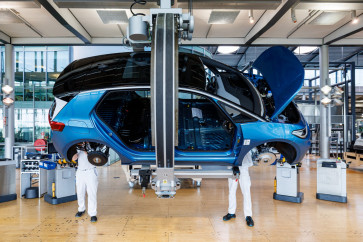
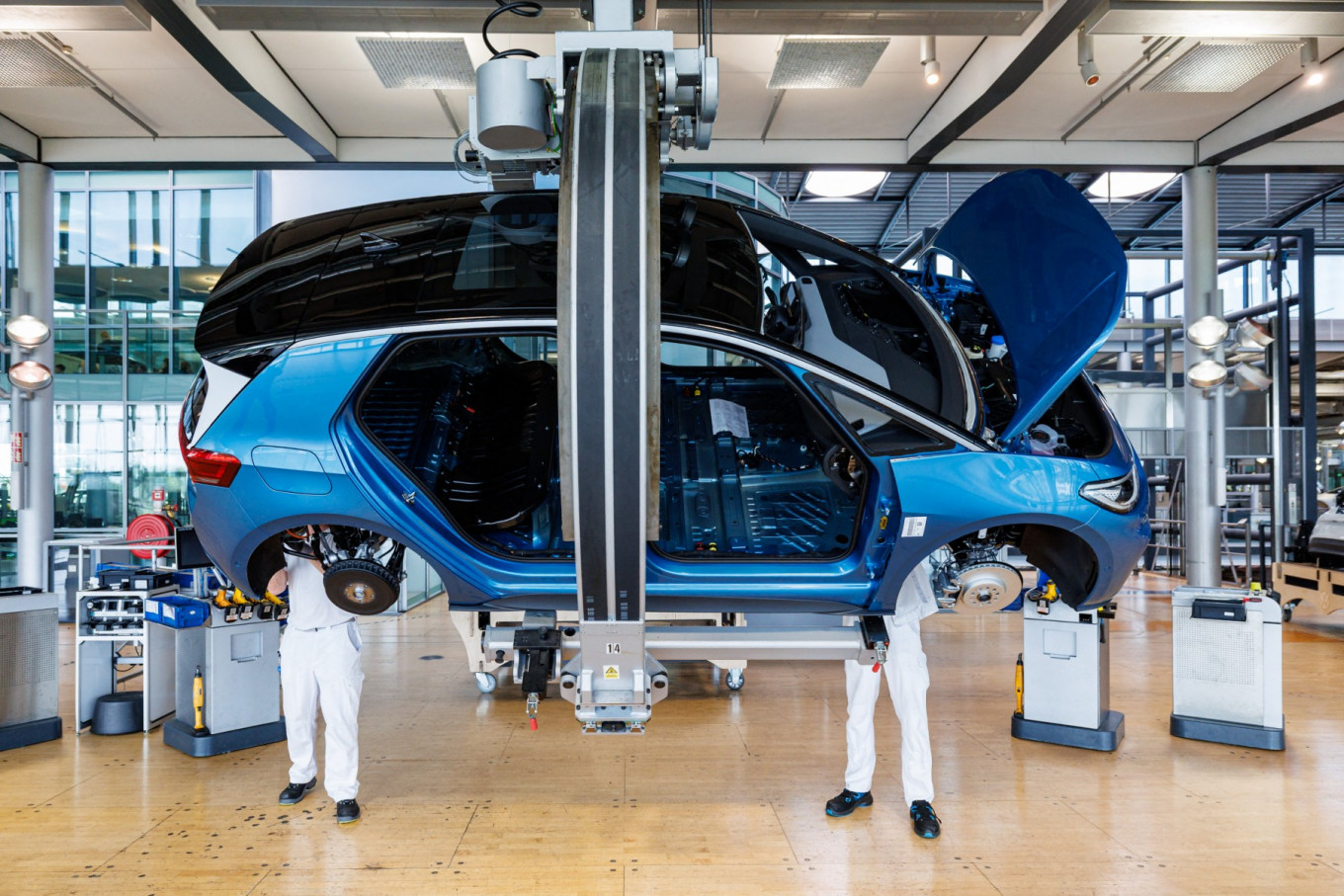 Employees work on the assembly line for the ID.3 electric car of German carmaker Volkswagen, at the 'Glaeserne Manufaktur ( Transparent Factory) production site in Dresden, eastern Germany, on May 14, 2025. (AFP/Jens Schlueter)
G
erman Chancellor Friedrich Merz returned from his recent visit to China visibly rattled. After touring Unitree Robotics in Hangzhou, where quadruped robots performed martial arts, he conceded that Germany is “simply no longer productive enough,” and warned that prosperity cannot be maintained with “work-life balance and a four-day week.” Germans, he declared, “will simply have to do a little more.”
Merz is right to sound the alarm. Germany’s economy contracted for two consecutive years in 2023 and 2024, and its industrial output has fallen sharply. The Federation of German Industries estimates that 1.4 trillion euros (US$1.6 trillion) in additional investment is needed by 2030 just to keep the country globally competitive. Worse, over one-third of German industrial firms are considering relocating production abroad. No one can deny that Europe’s largest economy is in deep structural trouble.
But Merz’s prescription, to work harder reflects a misdiagnosis of the problem. Though his remarks may partly reflect an internal coalition battle over welfare and labor market policies, where work-ethic rhetoric serves a political purpose, conflating working hours with productivity misses the point. Germany has among the fewest annual working hours in the OECD, yet its output per hour remains among the highest in the world, around three to four times that of China. Ever since the late Nobel laureate economist Robert Solow articulated his foundational growth theory in the 1950s, economists have understood that advanced economies grow not through additional labor inputs but through capital deepening (an increase in capital per worker), technological progress and total factor productivity growth.
What Merz witnessed in Hangzhou was not the product of longer working hours. It was the result of massive, directed investment. China did not become a technological powerhouse because its people burned the midnight oil. Rather, the state invested strategically in productive capacity, deliberately cultivating industrial ecosystems the likes of which Europe has struggled even to comprehend. China’s R&D spending grew nearly twice as fast as America’s over the past five years, reaching 2.8 percent of GDP in 2025, exceeding the OECD average for the first time.
But aggregates tell only part of the story. What explains Western visitors’ “cognitive shock” is the nature of China’s production ecosystems at the micro level. In keeping with the economist Michael Porter’s cluster theory, China has cultivated geographic concentrations of interconnected firms generating productivity gains through knowledge spillovers and intense competition.
Shenzhen’s Huaqiangbei district, for example, packs more than 100 printed-circuit-board fabricators, mold shops, component distributors and firmware freelancers into 1.45 square kilometers. One European tech entrepreneur, “Mehdi,” recently claimed on X that he had completed four prototype iterations in Huaqiangbei in a week for under $1,000, whereas a colleague in Europe spent $12,000 on a single revision and waited two months. Such anecdotes are common, and they all point to the same thing: a deep pattern of distributed intelligence, with knowledge flowing horizontally across a global network and compounding daily, in Chinese production hubs, through thousands of simultaneous interactions.

The results speak for themselves. The Chinese firm BYD rose from obscurity to sell 4.6 million vehicles globally in 2025. Even under strict sanctions, Huawei managed to produce a 7-nanometer chip. And now, cities like Hefei, Chengdu and Wuhan are replicating the Shenzhen model at scale.