The Jakarta Post
Please Update your browser
Your browser is out of date, and may not be compatible with our website. A list of the most popular web browsers can be found below.
Just click on the icons to get to the download page.


Popular Reads
Top Results
No results found. Please check your search term and try again
Can't find what you're looking for?
View all search results
Popular Reads
Top Results
No results found. Please check your search term and try again
Can't find what you're looking for?
View all search resultsAnalysis: Indonesia-US trade deal undermines halal certification
Change text size
Gift Premium Articles
to Anyone
Share the best of The Jakarta Post with friends, family, or colleagues. As a subscriber, you can gift 3 to 5 articles each month that anyone can read—no subscription needed!
 Set as preferred source
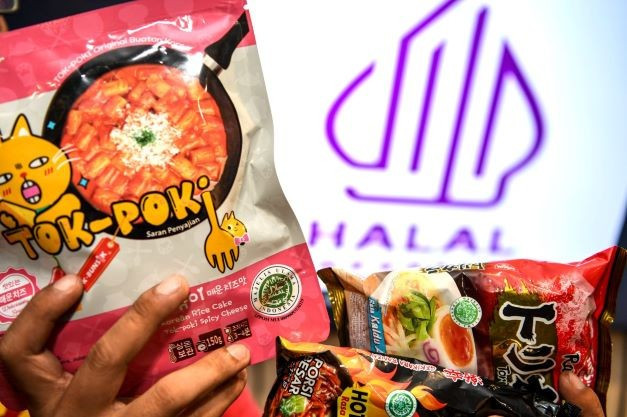 A person holds up imported food products with halal certification against the halal logo in this illustration created on March 14, 2022. (Antara)
T
he provisions in the Indonesia-United States Agreement on Reciprocal Trade (ART) have once again drawn public scrutiny. This time, the debate extends beyond tariff reductions to a more sensitive issue: the possible easing of halal certification requirements for US products entering the Indonesian market.
As stipulated in the ART, several US products such as cosmetics and medical devices are recorded as receiving certain facilities related to halal certification. The agreement also mentions recognition of US slaughtering standards and food safety supervision systems for food and agricultural products.
Specifically, the ART stipulates that Indonesia will allow any US halal certifier recognized by Indonesia’s halal authority, such as the Halal Transactions of Omaha (HTO) and the Islamic Food and Nutrition Council of America (IFANCA), to certify products for importation without additional requirements or restrictions. In addition, Indonesia will streamline and accelerate recognition of US halal certifiers.
For the world’s largest Muslim-majority country, however, halal certification is not merely an administrative requirement but a central pillar of consumer protection. Under Law No. 33/2014 on halal product assurance, goods entering and distributed in Indonesia must be halal certified unless they are explicitly declared non-halal. In theory, imported US products could simply be labeled and sold as non-halal.
However, the more pressing concern is the lack of clarity on how the policy would be implemented. Without detailed guidelines from the government, the uncertainty surrounding this issue has fueled speculation about whether this would amount to a limited administrative adjustment or a broader relaxation of the national halal assurance framework.
At present, domestically distributed products are generally expected to be halal certified. Retail outlets specializing in non-halal goods remain the exception rather than the norm. In practice, businesses seeking broad market access must obtain halal certification through the Halal Certification Agency (BPJPH), meaning that this is not just a formal requirement but effectively a gateway for mass-market domestic distribution.

In essence, the debate now centers on two fundamental concerns. The first is consumer protection. From the perspective of foreign exporters, mandatory halal certification is often framed as a nontariff barrier that discriminates against imported goods. Yet in the domestic context, halal assurance is less about trade restrictions and more about safeguarding the religious freedoms of Indonesia’s Muslim majority.