TheJakartaPost
Please Update your browser
Your browser is out of date, and may not be compatible with our website. A list of the most popular web browsers can be found below.
Just click on the icons to get to the download page.


Popular Reads
Top Results
No results found. Please check your search term and try again
Can't find what you're looking for?
View all search results
Popular Reads
Top Results
No results found. Please check your search term and try again
Can't find what you're looking for?
View all search resultsReforming LPG subsidy scheme in uncertain times
As Middle East conflicts drive global price volatility, Indonesia must replace its outdated, "one-size-fits-all" LPG subsidy with a targeted direct-transfer system to protect both the poor and the state budget.
Change text size
Gift Premium Articles
to Anyone
Share the best of The Jakarta Post with friends, family, or colleagues. As a subscriber, you can gift 3 to 5 articles each month that anyone can read—no subscription needed!
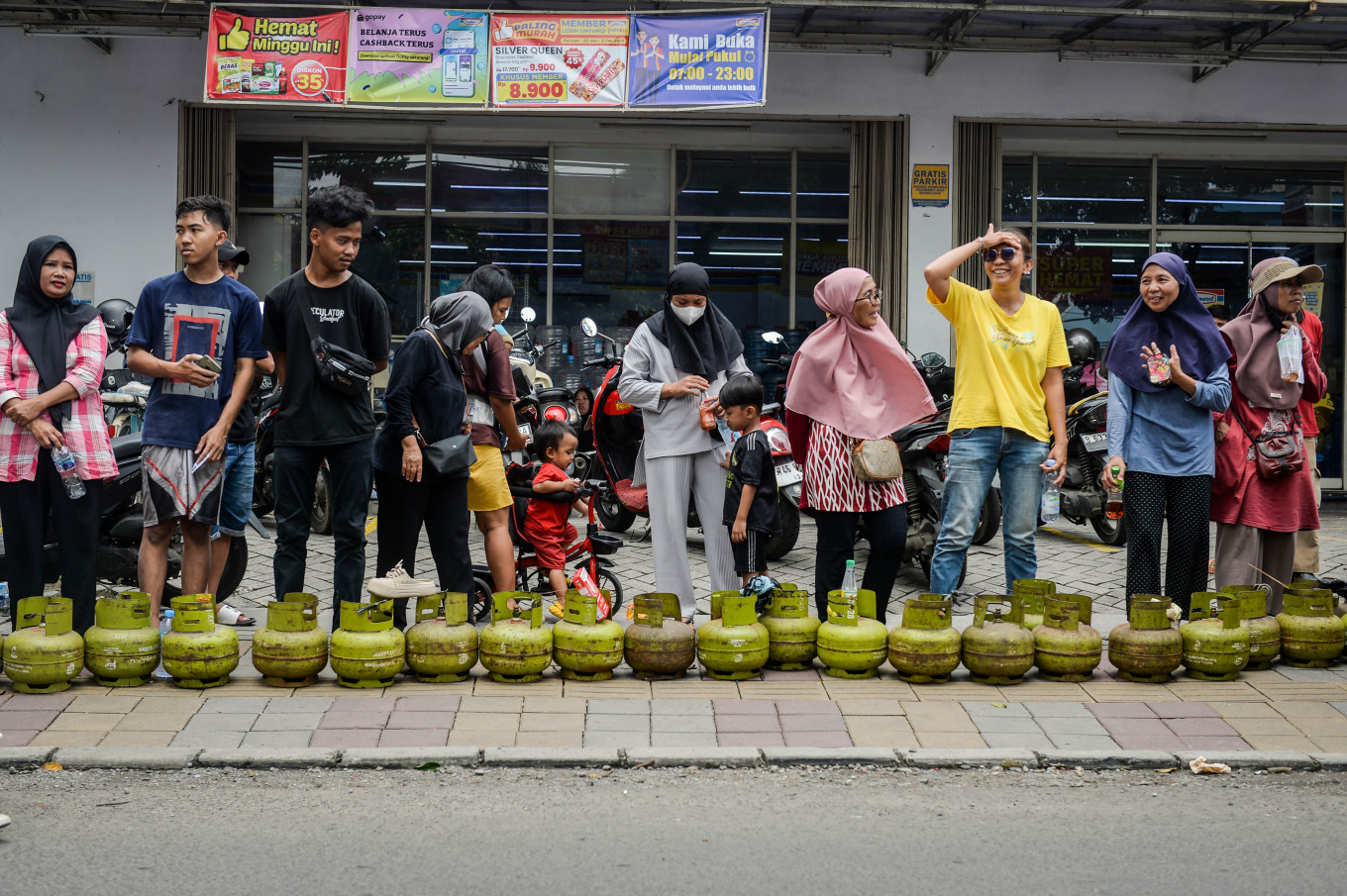 Residents line up on Feb. 3, 2025, to exchange 3-kilogram liquefied petroleum gas (LPG) canisters in Cibodas, Tangerang, Banten. Residents in Tangerang city said that it had been difficult for them to receive the gas canisters following the government’s new policy prohibiting their sale at the retailer level and requiring people to buy them from official distribution centers. (Antara Foto/Putra M. Akbar)
T
he liquefied petroleum gas (LPG) subsidy policy began in 2007 as part of a national kerosene conversion program. This transition was initially implemented to reduce the spiraling costs of the fuel subsidy budget. Ironically, a policy designed to save state funds has eventually become a significant burden on national finances.
The volume of subsidized LPG continues to climb. By 2025, the distribution of 3-kilogram LPG canisters reached 8.5 million tonnes, exceeding the previous year’s 8.2 million tonnes and marking a sharp increase from the 7.69 million tonnes recorded in 2020.
To manage this, the government has allocated Rp 87 trillion (US$5.1 billion) for LPG subsidies in 2025. While this is lower than the 2022 peak of Rp 100.4 trillion, it remains drastically higher than the 2020 budget of Rp 32.8 trillion.
This massive expenditure has prompted the government to seek ways to curb consumption, such as requiring consumers to register their national identification numbers (NIK). However, other proposed solutions, such as converting LPG use to coal-based dimethyl ether, remain logistically and economically tenuous.
The urgency for reform is now compounded by the ongoing conflict in the Middle East. As a region that serves as a primary source for global LPG supply, any instability there poses a direct threat to Indonesia’s energy security. As a net importer, Indonesia is highly vulnerable to supply chain disruptions and price volatility driven by war premiums.
Under the current price-gap model, the government commits to keeping the retail price of 3-kg canisters fixed. Consequently, every spike in global market prices caused by geopolitical tension translates directly into an unbudgeted expansion of the state’s fiscal deficit. Relying on an indirect subsidy during such uncertain times is effectively signing a blank check for global market fluctuations.

The issues surrounding LPG subsidies extend beyond the budget; the system is fundamentally poorly targeted. According to the Energy Law, energy subsidies should be reserved for the poor. In practice, however, the bulk of these benefits flow to economically well-off households.