TheJakartaPost
Please Update your browser
Your browser is out of date, and may not be compatible with our website. A list of the most popular web browsers can be found below.
Just click on the icons to get to the download page.


Popular Reads
Top Results
No results found. Please check your search term and try again
Can't find what you're looking for?
View all search results
Popular Reads
Top Results
No results found. Please check your search term and try again
Can't find what you're looking for?
View all search resultsWhat gold’s relentless rise is telling us about the dollar
As gold surges past $5,200, the "exorbitant privilege" of the US dollar is facing a reckoning driven by policy overreach and a global trust deficit.
Change text size
Gift Premium Articles
to Anyone
Share the best of The Jakarta Post with friends, family, or colleagues. As a subscriber, you can gift 3 to 5 articles each month that anyone can read—no subscription needed!
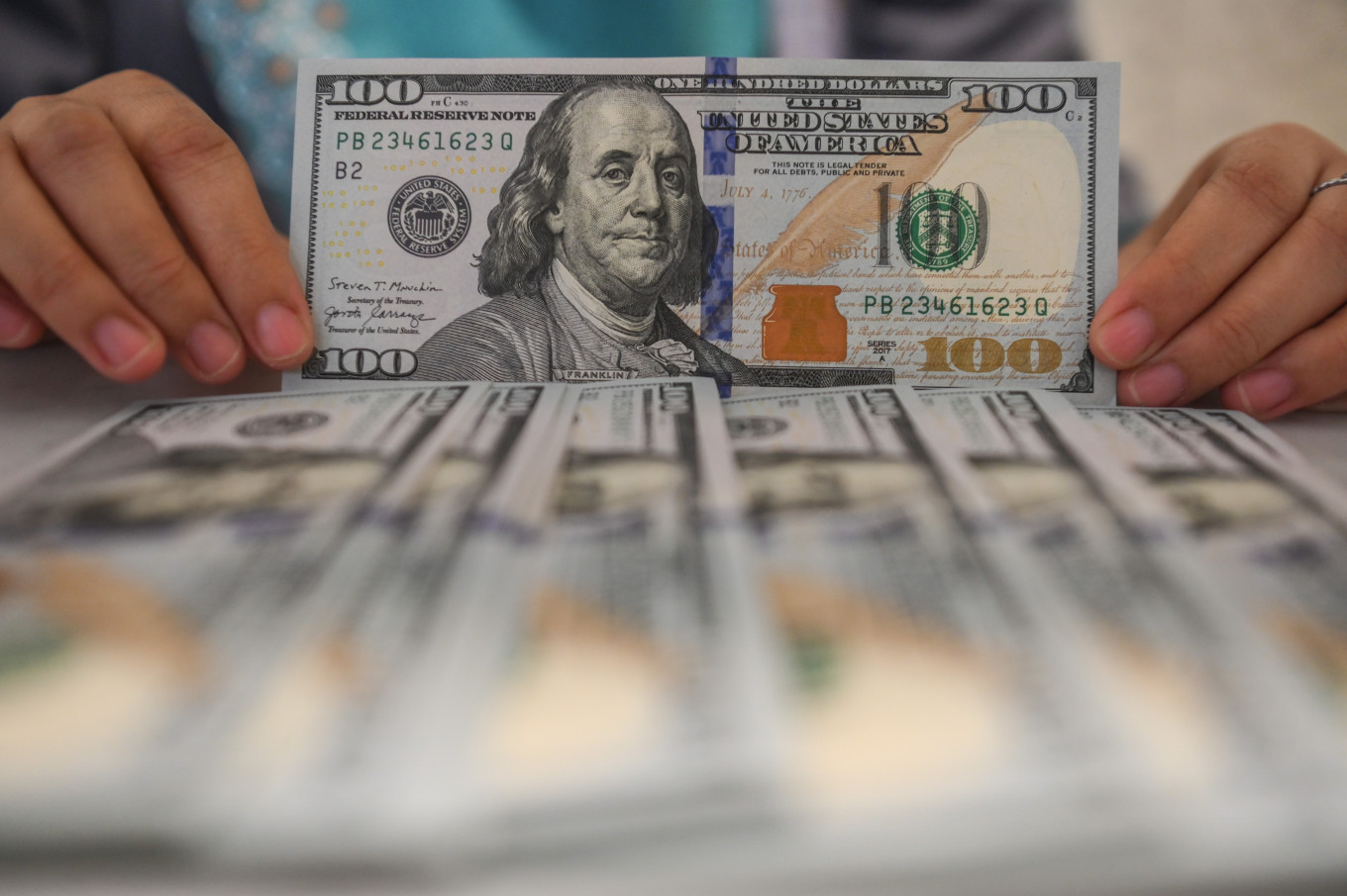 An employee displays U.S. dollar banknotes at Bank Syariah Indonesia in South Tangerang, Banten, on Jan. 21, 2026. (Antara/Hafidz Mubarak A)
F
ormer French president Valéry Giscard d’Estaing famously described the United States’ ability to issue the world’s reserve currency as an “exorbitant privilege.” For decades, this privilege sustained US hegemony, allowing Washington to borrow cheaply, run persistent deficits and finance wars and consumption simultaneously.
But what happens when the issuer begins to systematically erode the very confidence upon which that privilege depends? Through tariff escalation, sanctions overreach, military adventurism and the deliberate reshoring of manufacturing, the US is reducing dollar liquidity in the global system and planting the seeds of a multipolar reserve currency transition. Gold, surging past US$5,200 per ounce in early March 2026 after more than doubling in two years, is the canary in the coal mine.
Eichengreen, Mehl and Chitu identified three critical determinants of reserve currency status: inertia, network effects and policy credibility. The dollar’s post-1945 dominance was built on all three. The Despres, Kindleberger and Salant “minority view” framed the US as the world’s banker, viewing the deficit as a functional feature rather than a structural weakness.
Even after the Bretton Woods system collapsed in 1971, the dollar survived because no alternative could match its network effects. However, Eichengreen et al. found a crucial asymmetry: while supportive policies have limited effect in building reserve status, restrictive and hostile policies are devastatingly effective at destroying it. Historically, a single devaluation has been associated with a 24-percentage-point long-run decline in a currency’s reserve share.
The US is currently undermining its own currency through multiple channels. The administration’s tariff escalation against both rivals and allies represents a fundamental departure from the postwar commitment to open markets. While the US Supreme Court struck down the sweeping tariffs in February, the damage to global confidence was already done. When you impose tariffs on allies, you signal that access to the US market is conditional and unpredictable.
As Charles Kindleberger argued in The World in Depression, the interwar catastrophe occurred because no hegemon was willing to maintain open markets. Current "reshoring" efforts compound this by constricting the circulatory system of the dollar standard; fewer imports mean fewer dollars flowing overseas and, consequently, fewer dollars recycled into Treasury securities.

The weaponization of the dollar-based financial system has escalated for years, but the freezing of Russian central bank reserves in 2022 was a watershed moment. Dollar-denominated reserves are not truly sovereign assets if the US can unilaterally confiscate them.