TheJakartaPost
Please Update your browser
Your browser is out of date, and may not be compatible with our website. A list of the most popular web browsers can be found below.
Just click on the icons to get to the download page.


Popular Reads
Top Results
No results found. Please check your search term and try again
Can't find what you're looking for?
View all search results
Popular Reads
Top Results
No results found. Please check your search term and try again
Can't find what you're looking for?
View all search resultsDistorted development fuels long-lasting violence in Papua
Economic development in Papua has become a "ticking time bomb," where exclusionary policies and resource exploitation have not only failed to bring peace but are actively fueling a new cycle of violence.
Change text size
Gift Premium Articles
to Anyone
Share the best of The Jakarta Post with friends, family, or colleagues. As a subscriber, you can gift 3 to 5 articles each month that anyone can read—no subscription needed!
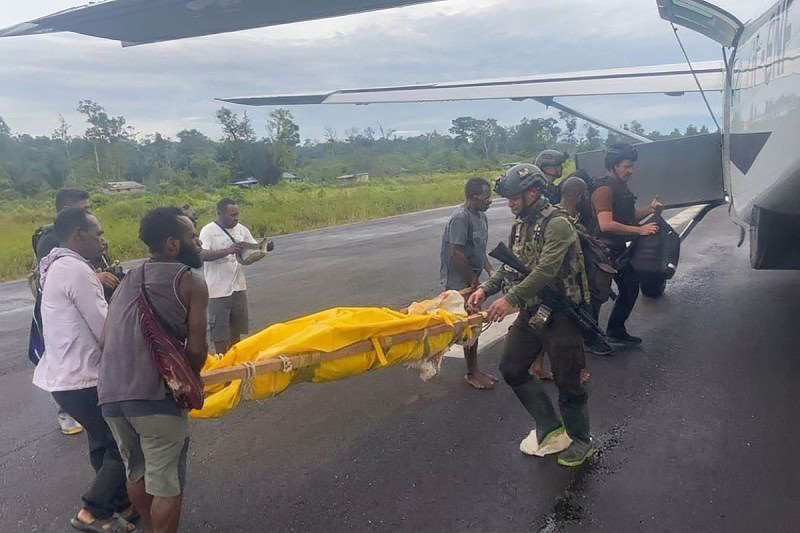 Personnel from a joint military and police team remove the bodies of a Smart Air pilot and copilot on Feb. 12 at Korowai airfield in Boven Digoel regency, South Papua. (Antara/Handout/Damai Cartenz Task Force)
E
ven as global attention is fixed on the recent United States and Israeli strikes on Iran, we must not allow ourselves to be distracted from a critical domestic issue that demands equal urgency and reflection: the escalation of conflict and violence in Papua. Casualties keep mounting among the Indonesian Military (TNI) and National Police (Polri), the Free Papua Movement (OPM) and civilians alike.
This relentless cycle demands a re-evaluation of both conflict-resolution strategies and development policies in Papua. The prevailing assumption holds that violence stems from poverty, leading to a development policy that is heavily economic in orientation.
Yet, research by the Centre for Strategic and International Studies (CSIS) reveals a far more nuanced relationship. This piece examines the controversies surrounding that developmental logic and the new threats now shrouding Papua’s future.
The government’s assumption that violence is primarily a product of underdevelopment is an oversimplification. In reality, three competing paradigms are at play: first, that violence is caused by economic backwardness (the framework most commonly relied upon by the government); second, that violence itself obstructs economic development; and third, that economic development actually generates violence.
The case of Boven Digoel regency illustrates how violence threatens economic progress. After a Smart Air aircraft carrying basic supplies was allegedly shot down by the OPM on Feb. 11, killing two pilots, pilot associations staged protests over safety concerns, and several airlines suspended their routes. Ultimately, ordinary people suffer. The provision of essential goods and public services has been further disrupted by the evacuation of teachers and medical workers from conflict zones.
Conversely, the frequent violence in the Freeport operational area in Mimika regency exemplifies the third paradigm: conflict generated by economic development itself. The distribution of benefits from the mining sector reveals a glaring imbalance among corporations, the state and local communities. This contested relationship is supported by CSIS research in the Jayawijaya and Mimika regencies.

The findings reveal a stark paradox. Despite significant economic interventions through Special Autonomy (Otsus) and the formation of new autonomous regions, these policies have failed to effectively address the root causes of violence or substantially improve the welfare of indigenous Papuans. In some cases, development policy has deepened existing inequalities and contributed directly to emerging conflicts.