The Jakarta Post
Please Update your browser
Your browser is out of date, and may not be compatible with our website. A list of the most popular web browsers can be found below.
Just click on the icons to get to the download page.


Popular Reads
Top Results
No results found. Please check your search term and try again
Can't find what you're looking for?
View all search results
Popular Reads
Top Results
No results found. Please check your search term and try again
Can't find what you're looking for?
View all search resultsGaruda’s 50 Boeing planes deal: Between ambition and survival
Garuda’s multi-billion dollar bet on 50 new Boeing jets will either modernize Indonesia's skies or ground the carrier in debt, depending entirely on whether the deal prioritizes operational logic over political optics.
Change text size
Gift Premium Articles
to Anyone
Share the best of The Jakarta Post with friends, family, or colleagues. As a subscriber, you can gift 3 to 5 articles each month that anyone can read—no subscription needed!
 Set as preferred source
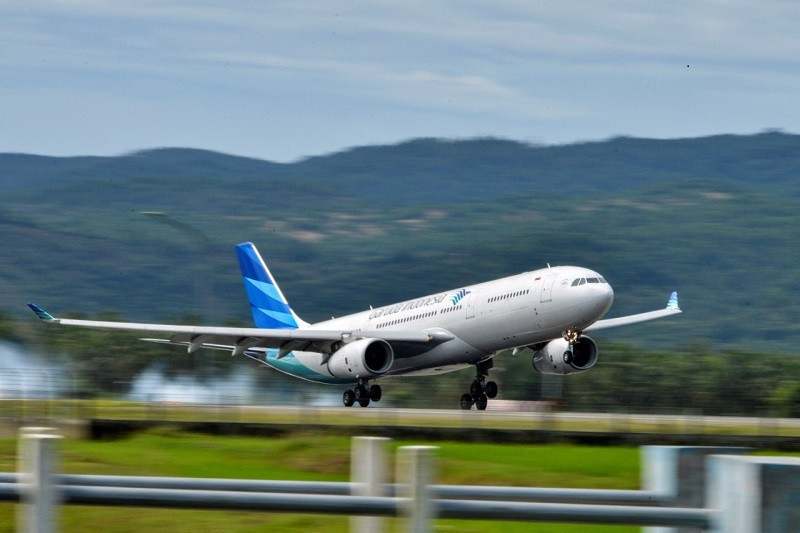 A Garuda Indonesia Airbus A330 lands on July 13, 2021, at Sultan Iskandar Muda International Airport in Blang Bintang, Aceh. (AFP/Chaideer Mahyuddin)
A
n ongoing polemic surrounds the recent Indonesia-United States Agreement on Reciprocal Trade. A highlight of this deal is Indonesia’s commitment to acquire 50 Boeing aircraft, valued at approximately US$13.5 billion. It marks one of the most significant aviation-related undertakings in the region.
These 50 aircraft are intended to reinforce the Garuda Indonesia fleet. The flag carrier has been seeking additional aircraft to increase connectivity in recent years. Faced with an aging fleet and limited seat capacity, Garuda needs these assets to rejuvenate its operations and gain market share on profitable routes. The most recent delivery to the airline was a Boeing 737 MAX on lease in 2025.
So far, there is no indication of the specific aircraft types included in this massive order. The flag carrier must remain firm in negotiating based on operational needs rather than political optics, specifically, whether the fleet requires narrow-body or wide-body aircraft.
If the Boeing deal proceeds, it represents a multi-decade commitment involving financing structures, maintenance ecosystems and production timelines. There are currently three funding options on the table: A capital injection from Danantara state asset fund, self-funding through company profits or manufacturer credit through deferred payments or installments.
In the aviation industry, aircraft are typically acquired through purchase or lease. While purchasing allows Garuda to own the asset, it requires enormous capital and exposes the carrier to asset depreciation and residual value uncertainty over the aircraft's 20-to-25-year lifespan. Leasing, by contrast, reduces capital intensity. Through an operating lease, the risk of depreciation shifts to the lessor, who re-markets the aircraft once the airline phases it out.
A hybrid path often used by major airlines is the sale-and-leaseback (SLB) scheme. Under this model, the airline purchases the aircraft from the manufacturer, benefiting from bulk-order discounts, and simultaneously sells them to lessors to lease them back. This provides immediate liquidity and potential margins on the sale.

Industry practice shows that manufacturers often operate on modest margins when selling the airframe. The long-term revenue lies in maintenance programs, spare parts and technical services. Fifty aircraft represent hundreds of engines, landing gears and avionics components, each with its own maintenance cycle. Over decades, airlines spend billions on heavy checks and engine overhauls.