TheJakartaPost
Please Update your browser
Your browser is out of date, and may not be compatible with our website. A list of the most popular web browsers can be found below.
Just click on the icons to get to the download page.


Popular Reads
Top Results
No results found. Please check your search term and try again
Can't find what you're looking for?
View all search results
Popular Reads
Top Results
No results found. Please check your search term and try again
Can't find what you're looking for?
View all search resultsMiddle powers and the struggle in a US–China world
Can “middle powers” bolster existing multinational institutions like the United Nations? Can they cooperate where their interests align to safeguard shared goods?
Change text size
Gift Premium Articles
to Anyone
Share the best of The Jakarta Post with friends, family, or colleagues. As a subscriber, you can gift 3 to 5 articles each month that anyone can read—no subscription needed!
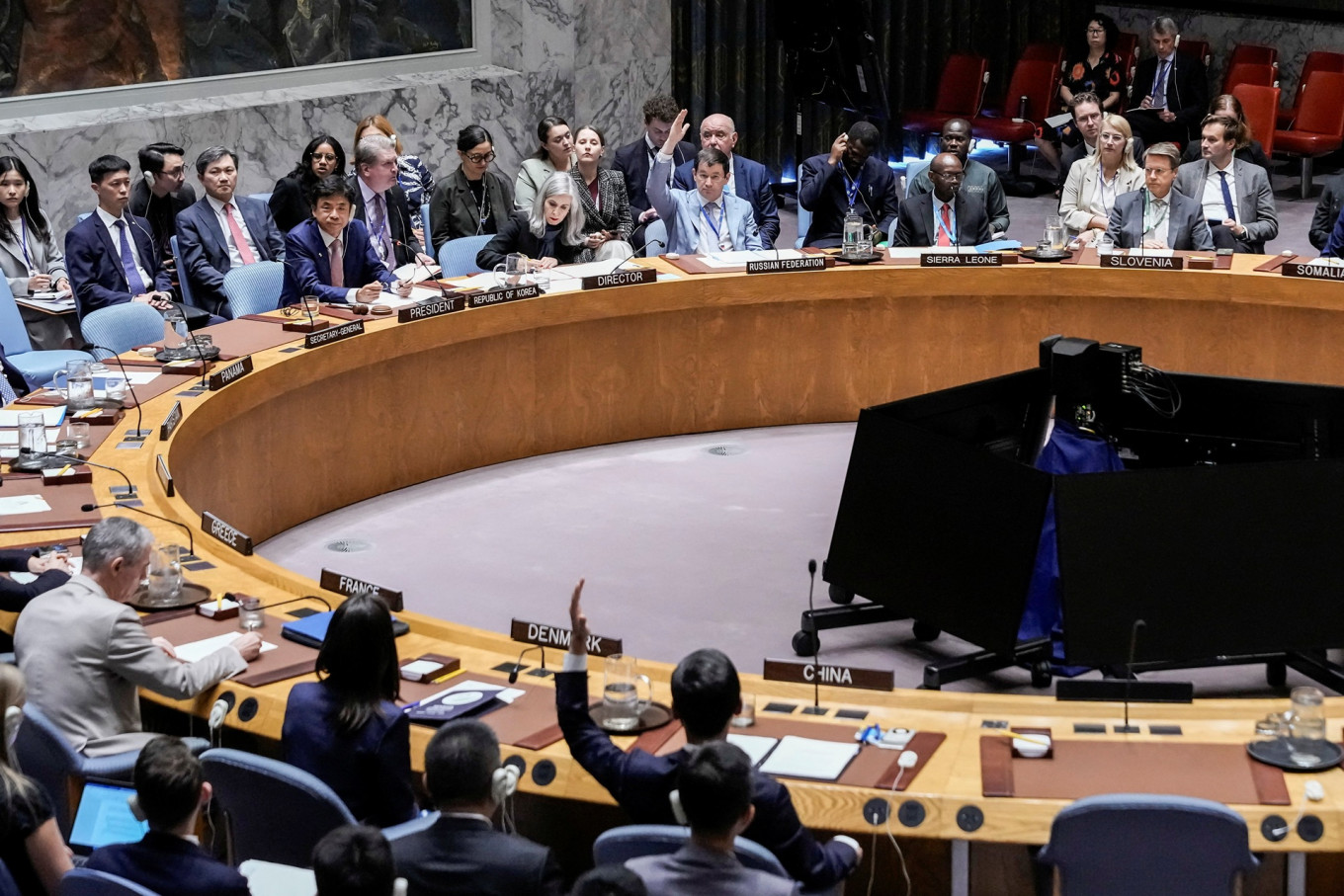 Members of the United Nations Security Council vote on a resolution by Russia and China on Sept. 26, 2025, to delay by six months the reimposition of sanctions on Iran during the 80th UN General Assembly in New York City, the United States. (Reuters/Eduardo Munoz)
T
he United States' allies no longer view it as a champion of collective security, free trade and the rule of law. At the same time, China’s growing economic power and political influence concerns many whose prosperity has become increasingly dependent on maintaining constructive relations with the People’s Republic.
In this fraught new environment, with the US and China dominating the international system, and with Russia committed to upending it, Canadian Prime Minister Mark Carney warned in January that “the middle powers must act together.”
But what does this mean, exactly? Can “middle powers” bolster existing multinational institutions like the United Nations? Can they cooperate where their interests align to safeguard shared goods? There are plenty of reasons for skepticism. But if they cannot find ways to assert themselves now, they will suffer what they must in a future of US–Chinese domination.
Fortunately, the current geopolitical landscape does offer opportunities for middle powers. Coalitions of willing parties like the European Union, India, Japan, Brazil, Canada and others could work together to boost financial and political support for institutions like the UN, the World Bank, the International Monetary Fund and the World Trade Organization.
It will be easier to shore up existing institutions than to build new ones: the US and China could undermine anything that other powers try to construct, and the US, China and Russia still have considerable power to resist deeper reforms at the UN Security Council. But that is why the goal would be to preserve the institutions that are most vulnerable to US abandonment and Chinese domination.
On security, the US and China’s material and military advantages still leave most middle powers dependent on a basic alignment with the US for troop coordination, weapons development and intelligence-sharing. But exceptions are emerging. Owing to Russia’s war on Ukraine, there has been greater defense coordination within Europe, though this process will still take considerable time, money, and political will to see through.

Similarly, India has forged closer security and trade ties with Europe, owing to its longstanding rivalry with China, the poor quality of Russian defense products and doubts about the US' long-term reliability. Europe and Canada have deepened their defense cooperation, reflecting shared fears about America’s trajectory; and Japan, South Korea, Saudi Arabia and Turkey could all potentially develop their own nuclear deterrents.