TheJakartaPost
Please Update your browser
Your browser is out of date, and may not be compatible with our website. A list of the most popular web browsers can be found below.
Just click on the icons to get to the download page.


Popular Reads
Top Results
No results found. Please check your search term and try again
Can't find what you're looking for?
View all search results
Popular Reads
Top Results
No results found. Please check your search term and try again
Can't find what you're looking for?
View all search resultsIndonesia’s civil–military boundaries under new pressure
The plan to train thousands of civil servants as military reservists raise risks of militarizing the bureaucracy.
Change text size
Gift Premium Articles
to Anyone
Share the best of The Jakarta Post with friends, family, or colleagues. As a subscriber, you can gift 3 to 5 articles each month that anyone can read—no subscription needed!
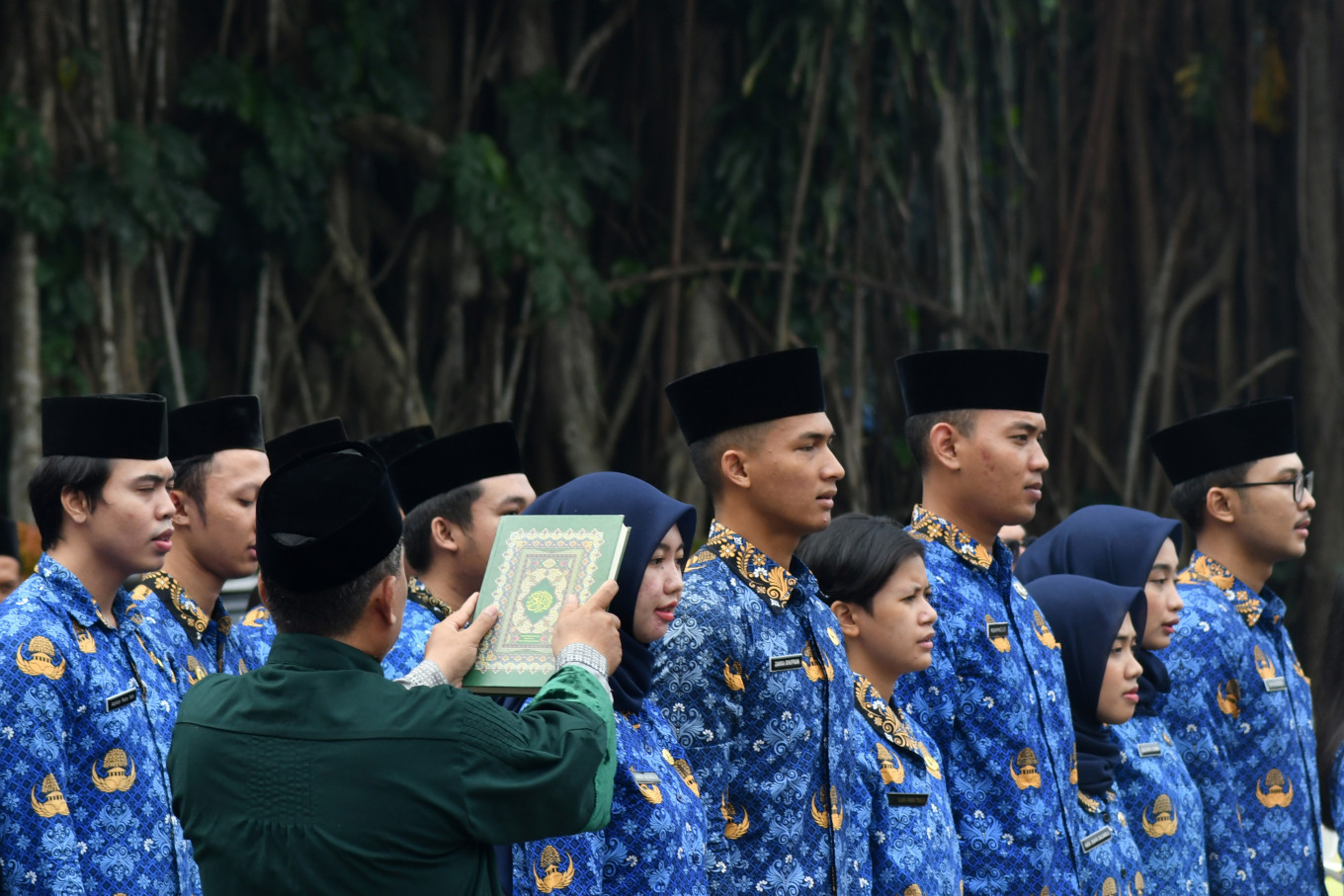 New civil servants take their oath on March 22, 2024, during an induction ceremony at Bogor City Hall in Bogor, West Java. (Antara/Arif Firmansyah)
T
he government’s proposal to train 4,000 civil servants as military reservists has triggered renewed debate about the boundaries between civil and military roles in government.
The Defense Ministry has also floated the possibility of designating all civil servants, a total of around 5 million, as part of the reserves. Critics have warned that such a move risks shifting the country’s civilian bureaucracy toward a more militarized posture.
The plan sits at the intersection of national defense policy, civil–military relations and bureaucratic reform. It also raises questions about how the state interprets the constitutional obligation of citizens to participate in national defense, and whether the Law No. 23/2019 on Management of National Resources for State Defense (PSDN) is being applied as originally intended.
The PSDN Law outlines five mechanisms for managing national resources for defense: bela negara or a civic‑education program that builds citizens’ awareness, resilience and willingness to contribute to national defense without requiring military training, structuring of supporting components, formation of the national reserve, strengthening of the main component and mobilization and demobilization.
The law places bela negara at the forefront, emphasizing civic awareness and national resilience for Indonesia’s overall strength and readiness as a nation. It aspires to a cohesive society that stays calm, cooperative and united during crises because people trust institutions and know how to respond responsibly.
Crucially, the law classifies civil servants as Supporting Components, not reserve troops. PSDN Law places civil servants under “other citizens as elements of the citizenry.” In the explanation of the stipulation, “citizens other than citizens” are citizens who are not included in the Main Component, Reserve Component, trained citizens and experts but who meet the physical and psychological requirements to become Supporting Components alongside veterans and individual citizens.

Supporting Components are developed through “socialization, technical guidance and/or simulations,” not military-style training. As the original document notes, Supporting Components “are not subjected to military-style training as is the case with the Reserve Component.” As such, the Supporting Component is a non-military national resource that can be used to increase the strength and capabilities of the Main Component and Reserve Component.
While the law allows citizens, including civil servants, to volunteer as military reservists, it does not envision blanket designation of all civil servants as reserve troops. Participation must occur through voluntary registration.
The military reservist was introduced as a compromise after Indonesia chose not to adopt mandatory military service. Article 30 of the Constitution states that every citizen has both the right and the obligation to participate in national defense and security.
The PSDN Law organizes national defense resources into a three‑part structure in which the Main Component consists of the Indonesian Military (TNI), the military reservists are made up of civilians who volunteer for military training and the Supporting Components include institutions, resources and citizens who contribute through non‑military roles such as veteran members of the Republic of Indonesia, state civil apparatus and individuals.
The obligation for citizens to participate becomes binding only during emergencies or when mobilization is declared. Outside of such conditions, participation is voluntary.
This structure was designed to balance Indonesia’s defense needs with its commitment to civilian supremacy and democratic governance. Expanding the National Reserve to include all civil servants would represent a significant reinterpretation of this balance.
Civil society organizations, legal experts and some lawmakers have expressed concern that involving civil servants as military reservists could blur the line between civilian and military spheres. They emphasized that civil servant involvement must not be coercive and must not disrupt public services.
Military training is built on hierarchy, command structures and obedience, values that differ from the principles of civilian governance, which emphasize accountability, transparency and public service.
The document notes that the military reservist doctrine prepares individuals to confront threats, while the job of civil servants is to improve “humane and accountable public service governance.”
Military‑style training could reshape the culture of Indonesia’s civil service, reinforcing rigidity and weakening the momentum for reform. Military indoctrination for civil servants through the reserve component seems to repeat the indoctrination program of the New Order era, which “ultimately failed to improve the quality of civil services” and instead deepened bureaucratic rigidity and corruption.
The debate over the military reservist comes amid broader concerns about the increasing presence of military personnel in civilian institutions.
Analysts note that such presence will strengthen the Soeharto era’s military dual-function doctrine regime. This doctrine allowed the military to engage in both civilian and military affairs. Even more than that, apart from the placement of military officers in the civilian positions, the reserve component is actually a form of militarization of civilians, including civil servants.
Indonesia’s post‑reform era sought to dismantle the dual-function doctrine and restore clear boundaries between civilian and military domains. The deviations in the past must not be repeated, where the military was not only active in the realm of national defense but was also involved in socio-political activities.
Any proposal to mandate the civil servant’s participation as military reservists must be carefully reconsidered. At present, the public expects civil servants to work professionally, uphold integrity and honesty and refrain from corruption, collusion and nepotism.
The government should continue advancing bureaucratic reform, an agenda that still faces many challenges. For the civil servants, working professionally and upholding good governance principles is itself the foremost expression of state defense, as mandated by PSDN Law.
---
The writer is an associate professor of law and the director of the Center for Constitutional Studies (PUSaKO) at Andalas University.