The Jakarta Post
Please Update your browser
Your browser is out of date, and may not be compatible with our website. A list of the most popular web browsers can be found below.
Just click on the icons to get to the download page.


Popular Reads
Top Results
No results found. Please check your search term and try again
Can't find what you're looking for?
View all search results
Popular Reads
Top Results
No results found. Please check your search term and try again
Can't find what you're looking for?
View all search resultsBetween Persian culture and Islamic theocracy: The politics of Iran’s Nowruz
Official warnings ahead of Nowruz in Iran have been explicit: Dissent will be treated not as protest but as insurrection.
Change text size
Gift Premium Articles
to Anyone
Share the best of The Jakarta Post with friends, family, or colleagues. As a subscriber, you can gift 3 to 5 articles each month that anyone can read—no subscription needed!
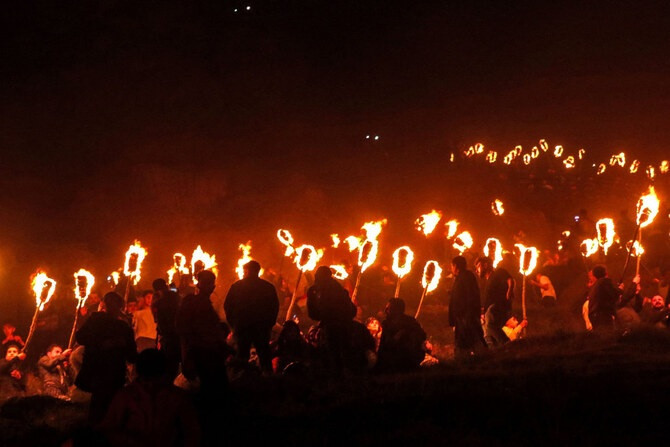 Iraqi Kurdish people celebrate the Nowruz New Year festival in the town of Akre,in Iraq’s northern autonomous Kurdish region, on March 20, 2025. (AFP)
A
s Iran welcomes the Persian New Year this week, an ancient festival has become the stage for a current political contest. On the eve of Chaharshanbe Suri—the fire festival that heralds Nowruz—Reza Pahlavi’s call on the Iranian people to celebrate with vigour was as much a political intervention in a fraught moment as it was a cultural invocation.
Reza Pahlavi, the son of Mohammad Reza Shah who was ousted by the Islamic Revolution of 1979, cast the flames of Chaharshanbe Suri as a force that could dispel the darkness of what he called an “un-Iranian” regime. For nationalist critics, the Islamic Republic marks a break from Iranian civilization and culture.
Nowruz is best understood as a fusion between Diwali, Holi and Ugadi (or Gudi Padwa, Vishu, Puthandu)—marking renewal, light, and the arrival of spring. Celebrated on the vernal equinox, Nowruz predates Islam by centuries and reflects the Zoroastrian worldview of ancient Persia, where fire symbolized truth, purity and cosmic order.
Chaharshanbe Suri, observed on the last Wednesday before Nowruz, is its most evocative prelude. Across Iran, people light bonfires in courtyards and streets, jumping over them in the belief that the fire absorbs sickness and misfortune and returns vitality. Like Holi, it is exuberant and public; like Diwali, it invokes light against darkness.
The Islamic Republic was never at ease with Nowruz. The 1979 revolution, like the Taliban’s later project in Afghanistan, sought to subordinate inherited cultural traditions to a universalist Islamic ideology. Ayatollah Khomeini dismissed pre-Islamic practices as relics of “fire-worshipping”, and the early years of the revolution saw attempts to curtail Nowruz, including the abolition of its customary holiday period. These moves provoked resistance, forcing the regime into a more gradual strategy—restricting public celebrations, discouraging participation, and reinterpreting festivals within acceptable ideological frames.
Chaharshanbe Suri drew particular hostility. A fatwa against it, administrative curbs, and attempts to rename it in neutral terms all reflected the regime’s discomfort with a ritual it could neither control nor erase. Yet, like many ancient festivals in India that have survived waves of political and religious contestation, Nowruz endured.

Over time, it has acquired a sharper political edge. For many Iranians—especially those born after the revolution—the act of celebrating Nowruz has become an assertion of identity distinct from the state’s ideological project. The flames of Chaharshanbe Suri now carry not just the symbolism of renewal, but also political defiance.
This year, Nowruz comes amid great turbulence in Iran. The anti-regime protests that erupted three months ago marked one of the most serious challenges to the Islamic Republic since its founding. The scale of repression that followed was unprecedented even by the Islamic Republic’s standards. At the same time, sustained American and Israeli strikes and the decapitation of Iran’s leadership have left the regime under extraordinary pressure.
It is into this moment of vulnerability that Reza Pahlavi has inserted his appeal. His calls for strikes and civil resistance, framed in the language of Persian civilizational revival, are part of a broader effort to position himself as the leader of a potential transition in Iran.
The choice of Chaharshanbe Suri is deliberate. Festivals bring people into the streets; they offer both symbolic legitimacy and practical cover for collective action. By linking protest to ritual, Pahlavi seeks to turn cultural participation into political mobilization.
Whether symbolism can overcome structural constraints, however, remains uncertain. Official warnings ahead of Nowruz have been explicit: Dissent will be treated not as protest but as insurrection. Nor is it easy for people to gather in public when American and Israeli bombs are raining down.
Yet the deeper significance of the moment can’t be missed. Nearly five decades after the revolution, the contest between competing identities in Iran has sharpened. The Islamic Republic was founded in part on a rejection of nationalism and rejection of traditional culture. But in practice, the Iranian state has never escaped the gravitational pull of Persian identity. It has been compelled, repeatedly, to accommodate elements of national culture even as it seeks to subordinate them.
Even within the system, attempts have been made to leverage this civilizational heritage. Mahmoud Ahmadinejad, president from 2005 to 2013, sought to revive pre-Islamic symbols, invoking Cyrus the Great and presenting ancient Iran as compatible with the Islamic Republic.
This effort to transcend the Islamic revolution’s ideology alarmed the clerical establishment. Then Supreme Leader Ali Khamenei pushed back, denouncing the so-called “Iranian School” and curbing state endorsement of such symbolism. The episode underscored the regime’s unease with any narrative that might privilege Persian identity over Islamic ideology.
This tension—between an ancient civilizational inheritance and a more recent ideological state—is not unfamiliar to the Subcontinent. In Pakistan’s Punjab, the spring festival of Basant has survived periodic bans. In India, cultural diversity endures despite serious attempts at homogenization from empowered quarters. The persistence of Nowruz in Iran reflects a similar dynamic: the resilience of inherited tradition against the pressures of transient political authority.
For those advocating regime change, this tension offers a potential lever. The invocation of pre-Islamic identity aligns with broader efforts at regime change in Iran.
But history counsels caution. Civilizational identities are powerful, but they are also layered and contested. Their political mobilization rarely produces predictable outcomes, and the Islamic Republic retains significant institutional support.
As Iranians gather around bonfires this week, Chaharshanbe Suri illuminates an important question: will Iran’s future be shaped more by its enduring civilizational heritage or by the repressive theocracy?
***
The writer is a contributing editor on international affairs for The Indian Express. He is also associated with the Jindal Global University and the Council on Strategic and Defense Studies, Delhi.