TheJakartaPost
Please Update your browser
Your browser is out of date, and may not be compatible with our website. A list of the most popular web browsers can be found below.
Just click on the icons to get to the download page.


Popular Reads
Top Results
No results found. Please check your search term and try again
Can't find what you're looking for?
View all search results
Popular Reads
Top Results
No results found. Please check your search term and try again
Can't find what you're looking for?
View all search resultsHow intellectual diplomacy bridges East and West
The meeting of the best of the East and the West is more than a symbolic gesture; it is a substantive step toward reimagining the future of global intellectual engagement.
Change text size
Gift Premium Articles
to Anyone
Share the best of The Jakarta Post with friends, family, or colleagues. As a subscriber, you can gift 3 to 5 articles each month that anyone can read—no subscription needed!
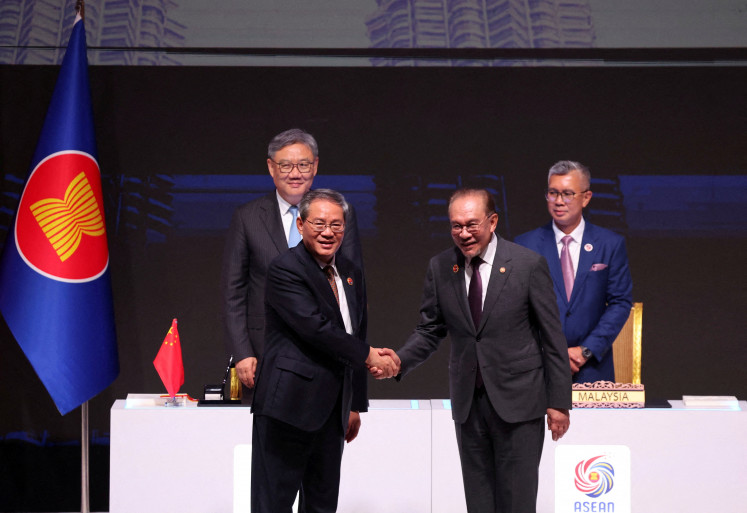
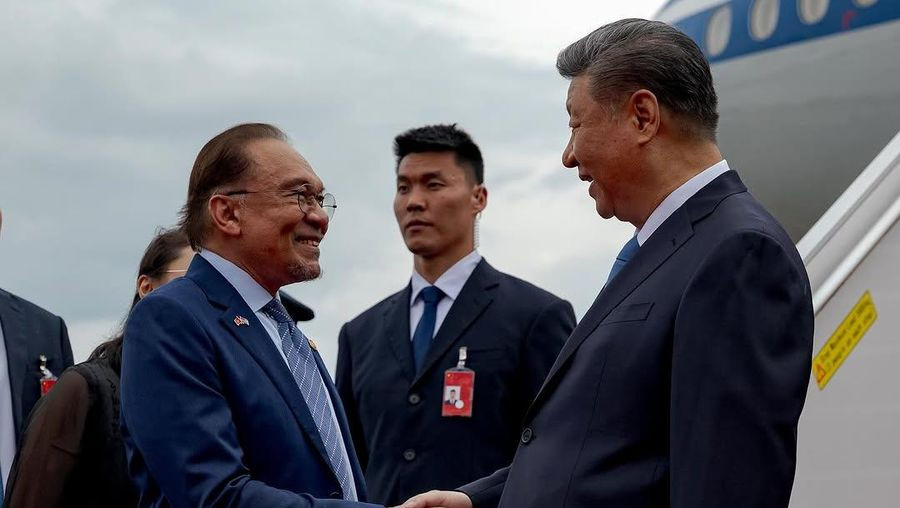 Malaysian Prime Minister Anwar Ibrahim (left) greets Chinese President Xi Jinping (right) as the latter arrives in Kuala Lumpur on April 15, 2025 for a three-day visit to the Southeast Asian country. (Instagram/anwaribrahim_my)
I
n an age marked by fragmentation, suspicion, and the steady erosion of shared norms, moments of genuine intellectual convergence are rare. Prime Minister Anwar Ibrahim, however, has given his fullest endorsement to such efforts.
On April 1–2 April, the International Islamic University Malaysia (IIUM) will host one such moment of consequence: the Inter-Civilizational Academic Conference 2026: IIUM–Oxford–Peking University Dialogues.
This is not merely another academic gathering; it is, in essence, a deliberate act of civilizational bridge-building. The event brings together some of the most distinguished scholars from the University of Oxford, Peking University, Fudan University, and IIUM itself. At a time when geopolitical rivalries threaten to harden into civilizational divides, this conference offers a vital counter-narrative: that dialogue, not discord, remains the most enduring pathway forward.
The significance of this conference lies not only in the stature of its participants but also in the intellectual traditions they represent. To convene these traditions under one roof is no small feat. It is a recognition that no single civilization holds a monopoly over truth, wisdom, or the future.
While the world today is often framed through the prism of great power rivalry—most notably between the United States and China—universities are unfortunately not immune to these tensions.
Academic exchanges are increasingly scrutinized, and intellectual cooperation is sometimes viewed through the lens of strategic competition. It is as if universities are expected to attack one another; yet, the truth is more subtle: universities can also trigger peaceful discourse.

Against this backdrop, the dialogues stand as a quiet but firm rebuttal to the notion that knowledge must be subordinated to power. The initiative stands against Islamophobia and, for that matter, Sinophobia. Evidently, it is also a platform that privileges the importance of ASEAN centrality. Thus, this conference reaffirms a different principle: that civilizations can meet not as adversaries, but as interlocutors.
At the heart of this conference lies a deeper philosophical ambition: the integration of Tawhidic epistemology with global academic discourse. Tawhid, or the oneness of God, is not merely a theological concept; it is an epistemological framework that emphasizes unity in knowledge, coherence in ethics, and balance in human affairs.
In a fragmented world, such a framework offers a compelling alternative to reductionist modes of thinking. By placing Tawhidic epistemology in conversation with Western and East Asian intellectual traditions, IIUM is advancing a bold proposition: that the future of knowledge must be integrative rather than divisive.
This is particularly relevant in addressing contemporary challenges—climate change, technological disruption, inequality, and cultural polarization—all of which defy simplistic, single-disciplinary solutions.
Malaysia’s role as host is neither accidental nor incidental. As a country situated at the crossroads of the Malay world, the Islamic ummah, and the broader Asian region, Malaysia has long embodied a form of lived pluralism.
By hosting this conference at IIUM, Malaysia reaffirms its capacity to serve as a bridge between civilizations amidst a time of acute conflict in the Middle East and Eastern Europe. It serves as a reminder that middle powers like Malaysia, often overlooked in grand strategic narratives, can play a pivotal role in fostering dialogue and understanding.
In many ways, this conference is a form of intellectual diplomacy—a "Track II" engagement that complements, and at times compensates for, the limitations of formal statecraft. While governments may struggle to find common ground, scholars can often engage in more candid and constructive exchanges. Ideas, after all, are less constrained by the rigidities of national interest.
The upcoming conference thus represents an investment in the long-term architecture of peace. By fostering mutual understanding at the level of ideas, it lays the groundwork for more stable and cooperative international relations. For students, academics, and policymakers alike, the significance of this event cannot be overstated. It offers a rare opportunity to witness—and participate in—a dialogue that transcends borders, disciplines, and ideologies.
To engage with such a gathering is to be part of a larger intellectual journey—one that seeks not only to understand the world but to shape it. The meeting of the best of the East and the West is more than a symbolic gesture; it is a substantive step toward reimagining the future of global intellectual engagement.
In a time of uncertainty, such efforts matter. They remind us that civilizations need not clash; they can converse. They remind us that knowledge need not divide; it can unite. And they prove that the pursuit of truth, when undertaken collectively, can illuminate pathways that no single tradition could discover alone.
The conference is, therefore, not just an event. It is a statement of intent—a declaration that dialogue remains humanity’s most powerful tool in navigating an increasingly complex world. In that dialogue lies the promise of a more harmonious global order.
***
The writer is a professor of ASEAN Studies and director of the Institute of International and ASEAN Studies (IINTAS), International Islamic University Malaysia (IIUM).