TheJakartaPost
Please Update your browser
Your browser is out of date, and may not be compatible with our website. A list of the most popular web browsers can be found below.
Just click on the icons to get to the download page.


Popular Reads
Top Results
No results found. Please check your search term and try again
Can't find what you're looking for?
View all search results
Popular Reads
Top Results
No results found. Please check your search term and try again
Can't find what you're looking for?
View all search resultsBeyond the ritual, the power of Indonesia’s 'Lebaranomics' is real
In an economy still heavily skewed toward urban concentration, where capital accumulates disproportionately in Jakarta and major cities, the annual Idul Fitri migration serves as a release valve, channeling economic “lifeblood” back into rural capillaries.
Change text size
Gift Premium Articles
to Anyone
Share the best of The Jakarta Post with friends, family, or colleagues. As a subscriber, you can gift 3 to 5 articles each month that anyone can read—no subscription needed!
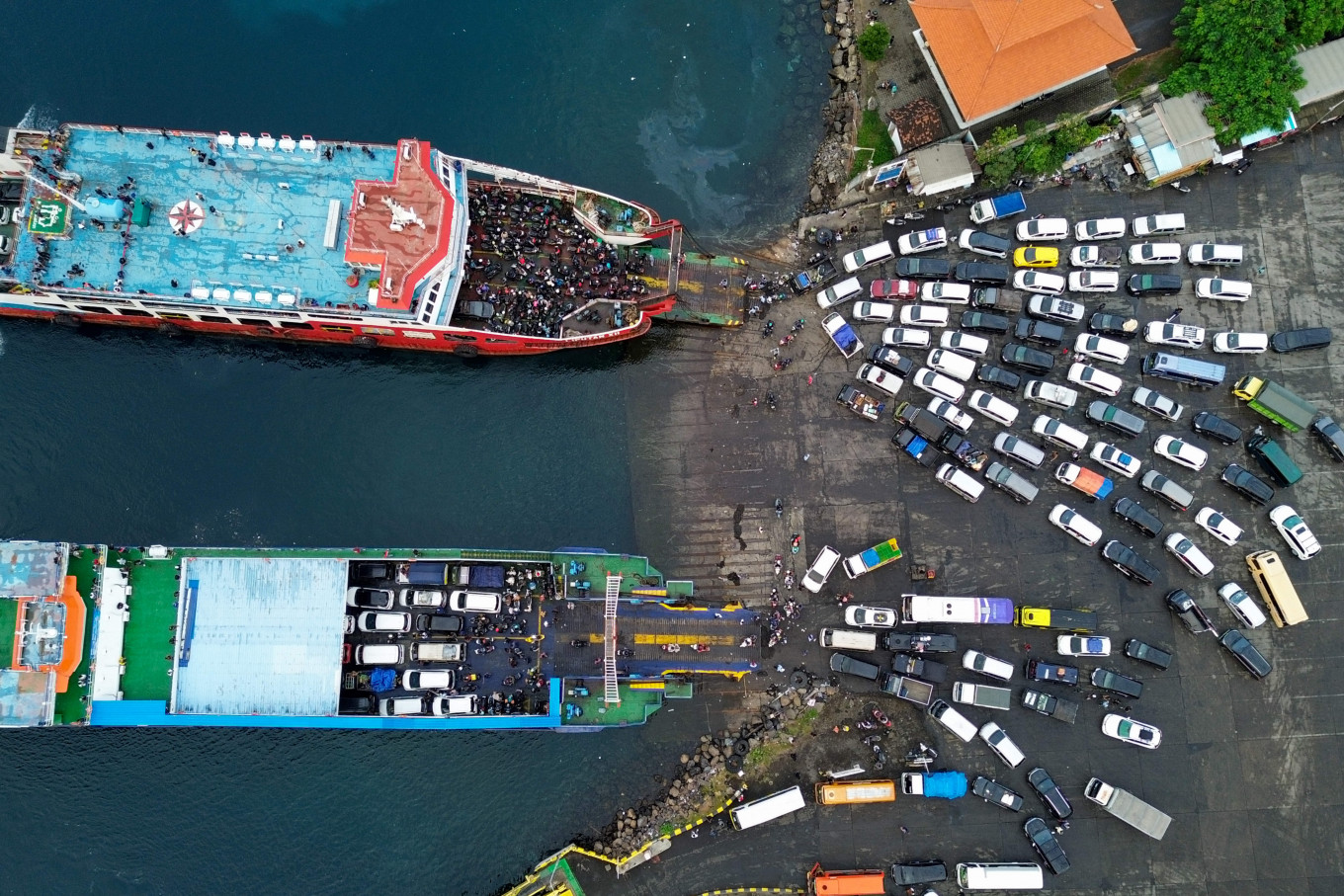 An aerial view shows vehicles of homebound travelers lining up to board ferries at Gilimanuk Port in Jembrana, Bali, on March 15, 2026. Six days before Idul Fitri, traffic heading from Bali to Java surged as thousands of people began the annual mudik (exodus) to celebrate the holiday with family. (Antara/Budi Candra Setya)
E
ach year, Indonesia stages a sociological spectacle unmatched anywhere in the world, the mass homecoming known as mudik (exodus). More than a ritual of reunion or nostalgia, of returning to childhood homes and familiar village rhythms, mudik functions as one of the most organic and large-scale mechanisms of wealth redistribution in existence.
In an economy still heavily skewed toward urban concentration, where capital accumulates disproportionately in Jakarta and major cities, this annual migration serves as a release valve, channeling economic “lifeblood” back into rural capillaries.
In 2026, this phenomenon, often dubbed “Lebaranomics”, arrives at a particularly consequential moment. For the first time in several years, the entire Ramadan-Idul Fitri economic cycle falls squarely within the first quarter (Q1), a period traditionally marked by sluggish economic activity. This calendar alignment alone elevates the strategic importance of this year’s festive economy.
The scale is formidable. The Transportation Ministry projects that 143.91 million people, more than half the population, will travel during the Idul Fitri period, which started on March 16 and is expected to end on March 27. This level of mobility underscores remarkable social resilience, especially against a backdrop of persistent global uncertainty.
Financially, the implications are equally significant. The Indonesian Chamber of Commerce and Industry (Kadin) estimates money circulation between Rp 148 trillion (US$8.7 billion) and Rp 162 trillion. Yet deeper analytical models suggest the figure could surge as high as Rp 417 trillion, contingent on sustained middle-class purchasing power.
The economic spillover from this vast movement of people permeates nearly every layer of the real economy. The transportation, retail and tourism sectors are the most immediate beneficiaries, with consumer spending projected to rise by 10 to 15 percent above typical monthly levels.

What distinguishes 2026 is the accelerating digitization of spending patterns. Electronic wallets are expected to account for roughly 54 percent of retail transactions, signaling a notable deepening of financial inclusion, even in rural destinations.