The Jakarta Post
Please Update your browser
Your browser is out of date, and may not be compatible with our website. A list of the most popular web browsers can be found below.
Just click on the icons to get to the download page.


Popular Reads
Top Results
No results found. Please check your search term and try again
Can't find what you're looking for?
View all search results
Popular Reads
Top Results
No results found. Please check your search term and try again
Can't find what you're looking for?
View all search resultsEUDR delay: A chance for fairer supply chains
The EUDR holds immense potential to benefit global sustainability, but only if it evolves beyond rigid rules and overly simple measurements.
Change text size
Gift Premium Articles
to Anyone
Share the best of The Jakarta Post with friends, family, or colleagues. As a subscriber, you can gift 3 to 5 articles each month that anyone can read—no subscription needed!
 Set as preferred source
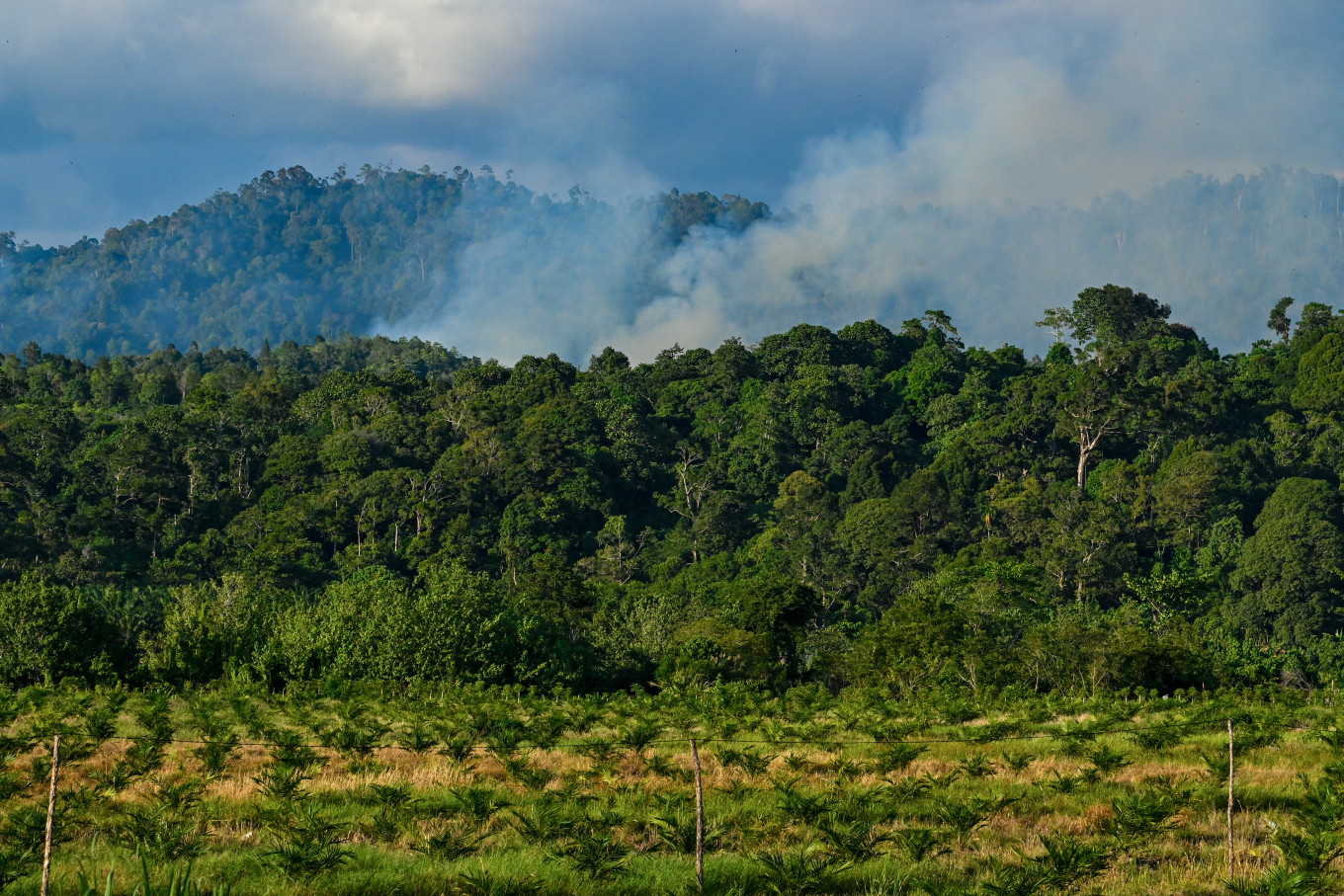 Smoke rises on Jan. 18 during the deforestation of a new planting area for oil palm plantations in Lamno, Aceh. (AFP/Chaideer Mahyuddin )
W
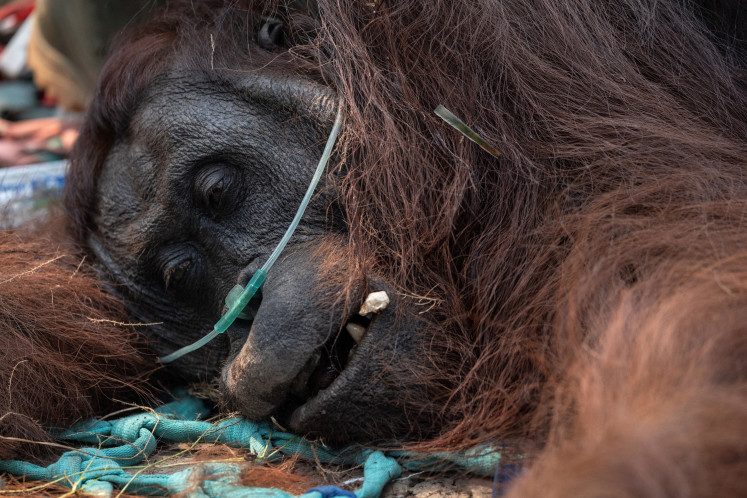
hen you reach for a “palm-oil-free” label at the supermarket, you likely feel you’re doing your part to save orangutans and protect biodiversity. However, the reality behind that label is more complex than it appears.
Our work with the IUCN Oil Crop Task Force reveals that replacing palm oil with alternatives actually increases the demand for land. Recent studies from both the IUCN and industry leaders like Musim Mas confirm that palm oil is exceptionally efficient, producing four to 10 times more oil per hectare than soy or sunflower.
Consequently, a blind boycott of palm oil risks a “displaced” environmental catastrophe, potentially triggering the clearing of millions of hectares elsewhere.
As a conservation biologist with years spent on the forest frontier alongside local communities, I’ve learnt first-hand that the line between “good” and “bad” agriculture rarely lies in the crop itself.
The European Union Deforestation Regulation (EUDR) attempts to address this complexity, yet it currently lacks the precision needed to avoid significant unintentional harm.
Our 2025 analysis of three major Western supermarket chains, selected for the transparency of their online ingredient lists, suggests that the often repeated “palm oil lurks in 50 percent of consumer items” claim may be an overstatement, at least according to our data.

While palm oil appeared in just 8 percent of the products we analyzed, significant uncertainty remains; as much as 40 percent of items may contain hidden palm oil disguised as derivatives (processed ingredients) or listed under vague labels like “emulsifiers”.
This labeling fog prevents consumers from tracing product origins, allowing myths to eclipse the realities of supply chain management.
The EUDR offers a critical solution. By requiring that key commodities, including beef, cocoa, coffee, palm oil, rubber, soy and wood, entering the EU are both deforestation-free and legally produced, the regulation sets a high bar for global trade. However, the path to successful implementation faces significant hurdles.
With the European Parliament voting to delay enforcement for a second time, the law’s good intentions appear stuck in a political deadlock. While the core text remains intact, proposed simplifications for early 2026 include streamlining reporting obligations and refining the product list to include items like palm oil-based soaps and instant coffee.
The EUDR’s impact deeply affects tropical exporters and their trading partners, including the UK. British companies exporting goods containing these commodities must align with EUDR standards to maintain access to the EU market.
However, the UK’s own deforestation rules are notably less strict. This regulatory divergence threatens UK firms with higher compliance costs and risks turning the country into a “dumping ground” for deforestation-linked goods rejected by the EU. This delay offers a vital window of opportunity for the UK to align with the EUDR, mitigate trade risks and reclaim its leadership in ethical supply chains.
For exporting countries like Indonesia, the core issue remains fairness. The EUDR relies on satellite-derived “base maps” to verify forest loss, yet these maps are deeply flawed. Research shows that Indonesian agroforestry systems face a 63 percent risk of being misclassified as “deforested”. As a result, a single erroneous pixel in Brussels could effectively bar an honest smallholder in Sumatra from European markets.
Recent analysis from Mongabay warns that the extremely high costs of tracing and mapping farm locations threaten to marginalize these smallholders. This financial burden risks driving them toward less regulated markets, a phenomenon known as “leakage” that could dilute the EUDR’s environmental impact.
To date, nations like Indonesia, Malaysia and Brazil have condemned the regulation as “green protectionism”. The resentment is clear: many view it as hypocrisy from a Europe that cleared its own forests to build wealth, only to now lecture others without offering adequate support. By positioning Brussels as the only judge of what is legal, the law is seen as undermining national sovereignty.
For the EUDR to succeed, this delay must serve as a catalyst for practical reform.
First, the EU must engage producer nations as partners. This requires investing in collaborative, high-resolution mapping that accurately distinguishes sustainable agroforestry from industrial clear-cutting. Transparency should be treated as a funded public good rather than a financial burden pushed onto vulnerable producers.
Second, transparency must be enforced universally. The EUDR must apply rules equitably across all agricultural products that affect land use, and this accountability must extend to retailers and supermarkets. EUDR data could finally mandate clear labelling that reflects both origin and practice.
Crucially, to truly preserve global biodiversity, the EU must ensure its regulatory system rewards conforming smallholders and traditional guardians rather than favouring large corporations.
Finally, we must confront the trade-offs head-on. The EU accounts for only 10 percent to 15 percent of global trade in deforestation-linked commodities. If Brussels restricts imports without addressing the underlying drivers of deforestation, production will simply shift to less regulated markets. Forests will fall elsewhere, and prices will rise at home. We must ask ourselves: are we simply paying a premium to ease our consciences without actually solving the problem?
We have to start somewhere, and transparency is the right focus. The upcoming 2026 simplification package and review must prioritize these fundamental changes. The EUDR holds immense potential to benefit global sustainability, but only if it evolves beyond rigid rules and overly simple measurements.
---
The writer is a professor at Faculty of Environmental Sciences and Natural Resource Management, Wageningen University. This article is republished under a Creative Commons license.