The Jakarta Post
Please Update your browser
Your browser is out of date, and may not be compatible with our website. A list of the most popular web browsers can be found below.
Just click on the icons to get to the download page.


Popular Reads
Top Results
No results found. Please check your search term and try again
Can't find what you're looking for?
View all search results
Popular Reads
Top Results
No results found. Please check your search term and try again
Can't find what you're looking for?
View all search resultsA riskier Middle East will drive Big Oil toward new frontiers
The reputational damage to the Middle East due to the Iran war may spur oil majors and the industry as a whole to realign their investment focus, though a shift to potentially higher-risk regions will lead to an inevitable rise in energy prices.
Change text size
Gift Premium Articles
to Anyone
Share the best of The Jakarta Post with friends, family, or colleagues. As a subscriber, you can gift 3 to 5 articles each month that anyone can read—no subscription needed!
 Set as preferred source
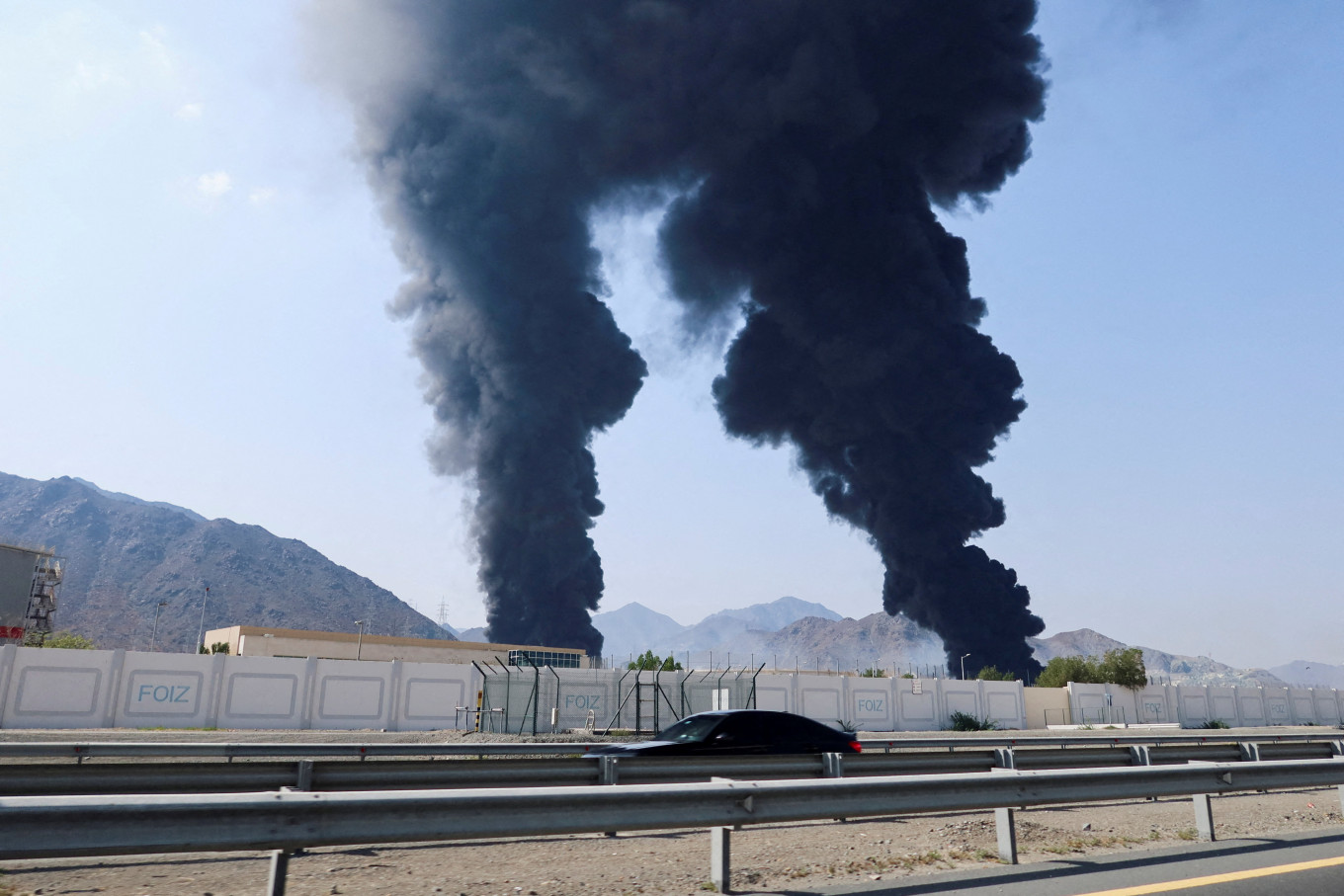 Smoke rises from the Fujairah oil industry zone in the United Arab Emirates on March 14, 2026, reportedly from burning debris after air defenses intercepted a drone during the United States-Israel attacks on Iran. (Reuters/Staff)
O
il companies will have to look farther afield for new fossil fuel resources now that the Iran war has dented the investment allure of the energy-rich Middle East. Higher oil prices will give them that chance.
Major international oil companies, including ExxonMobil, Chevron, TotalEnergies, Shell and BP, have long been drawn to the Middle East by its vast resources, stable fiscal terms and, until recently, relative political stability. The region accounts for roughly a fifth of global oil and liquefied natural gas (LNG) production.
That reputation, built painstakingly over decades even as wars raged in Iraq and Yemen, has now been shattered by the United States-Israeli war with Iran.
Now in its fifth week, the conflict has put energy infrastructure squarely in the crosshairs. Dozens of facilities across the Gulf have been damaged, including Qatar’s giant LNG hub and several major oil refineries.
The closure of the Strait of Hormuz, through which roughly 20 percent of the world's oil and gas normally flows, has forced producers to shut oil fields, costing the region an estimated US$1 billion a day in lost export revenues, according to Reuters calculations based on prewar prices.
The longer-term costs will be far higher. Restarting operations and repairing damaged facilities will likely run into the tens of billions of dollars, if not far more

QatarEnergy said an Iranian missile strike on Feb. 18 could cost it around $20 billion a year in lost revenue and take up to five years to repair.
But no amount of money may be able to repair the region’s reputational damage, at least not in the short term, and that is likely to rapidly reshape Western energy majors’ upstream strategies.
The Middle East will clearly remain a major source of oil and gas for decades. It holds around half of the world’s proven oil reserves and 40 percent of gas reserves. Western companies are thus unlikely to abandon it altogether.
It currently makes up a substantial portion of many majors’ portfolios, including 41 percent of Exxon’s reserves, 42 percent of TotalEnergies’ and a quarter of Shell’s, according to consultancy Welligence. The region attracted around $130 billion in oil and gas investment in 2025, roughly 15 percent of the global total, according to the International Energy Agency.
But unless the Iran war ends with a new, nonbelligerent government sitting in Tehran, an outcome that currently appears remote, the conflict will leave deep scars.
Uncertainty over the safety of transit through Hormuz and the higher risk of conflagration is apt to sharply boost the cost of deploying staff, equipment, insurance and capital in the Middle East, making the region a lot less attractive for exploration.
This rising risk premium in the world’s largest energy-producing region is already being reflected in long-term oil prices.
Since the eve of the conflict, the average Brent Crude price expected in 2030 has jumped around 10 percent to roughly $72 a barrel. Once the full extent of the damage from the war is known, that could rise even further.
A structurally higher oil price would change the upstream calculus for the world’s energy giants.
This shift comes as the industry’s appetite for new oil and gas investment has been strengthening. Over the past year, oil companies have significantly increased spending on exploration worldwide, from West Africa and the eastern Mediterranean to Brazil and Southeast Asia.
That was a sharp break from the prior decade, when shareholder pressure and fears of a rapid demand decline, driven by the energy transition, reduced upstream investment. Today, companies are increasingly confident that more supply will be needed through the end of the decade, spurred by new outlooks suggesting that fossil fuel demand won’t peak until the next decade.
Of course, exploration remains a high-risk, high-reward business requiring heavy upfront investment. Projects can also often take more than a decade to progress from the first drilling campaign to production.
Still, higher long-term prices would expand the pool of economically viable reserves worldwide. And importantly, the spiking risk premium in the Middle East is likely to push more capital toward regions previously deemed more risky or marginal.
Venezuela offers a case in point. Its oil industry reopened to Western companies after the US deposed president Nicolas Maduro in January, yet investment in the country has remained tepid, given political uncertainty and concerns over the sector’s dilapidated infrastructure.
In a more bullish price environment, however, Venezuela’s vast resources could suddenly appear more appealing, particularly if the relative geopolitical risk gap between Venezuela and the Gulf shrinks.
The energy industry has been through such a geographic reshuffle before. After 2022, the Middle East gained importance when Western companies were forced to exit Russia following Moscow’s full-scale invasion of Ukraine.
The Iran war now threatens to trigger another realignment, pushing companies to cast their investment nets wider than they have in years. But if the response this time around is to move into riskier or costlier areas, the floor on energy prices is likely going up.
---
The writer is a columnist for Reuters. The views expressed are personal.