TheJakartaPost
Please Update your browser
Your browser is out of date, and may not be compatible with our website. A list of the most popular web browsers can be found below.
Just click on the icons to get to the download page.


Popular Reads
Top Results
No results found. Please check your search term and try again
Can't find what you're looking for?
View all search results
Popular Reads
Top Results
No results found. Please check your search term and try again
Can't find what you're looking for?
View all search resultsOpposition critique is the oxygen of a flourishing democracy
Rather than a threat to stability, opposition is the very condition necessary for stability and the key ingredient of a thriving democracy.
Change text size
Gift Premium Articles
to Anyone
Share the best of The Jakarta Post with friends, family, or colleagues. As a subscriber, you can gift 3 to 5 articles each month that anyone can read—no subscription needed!
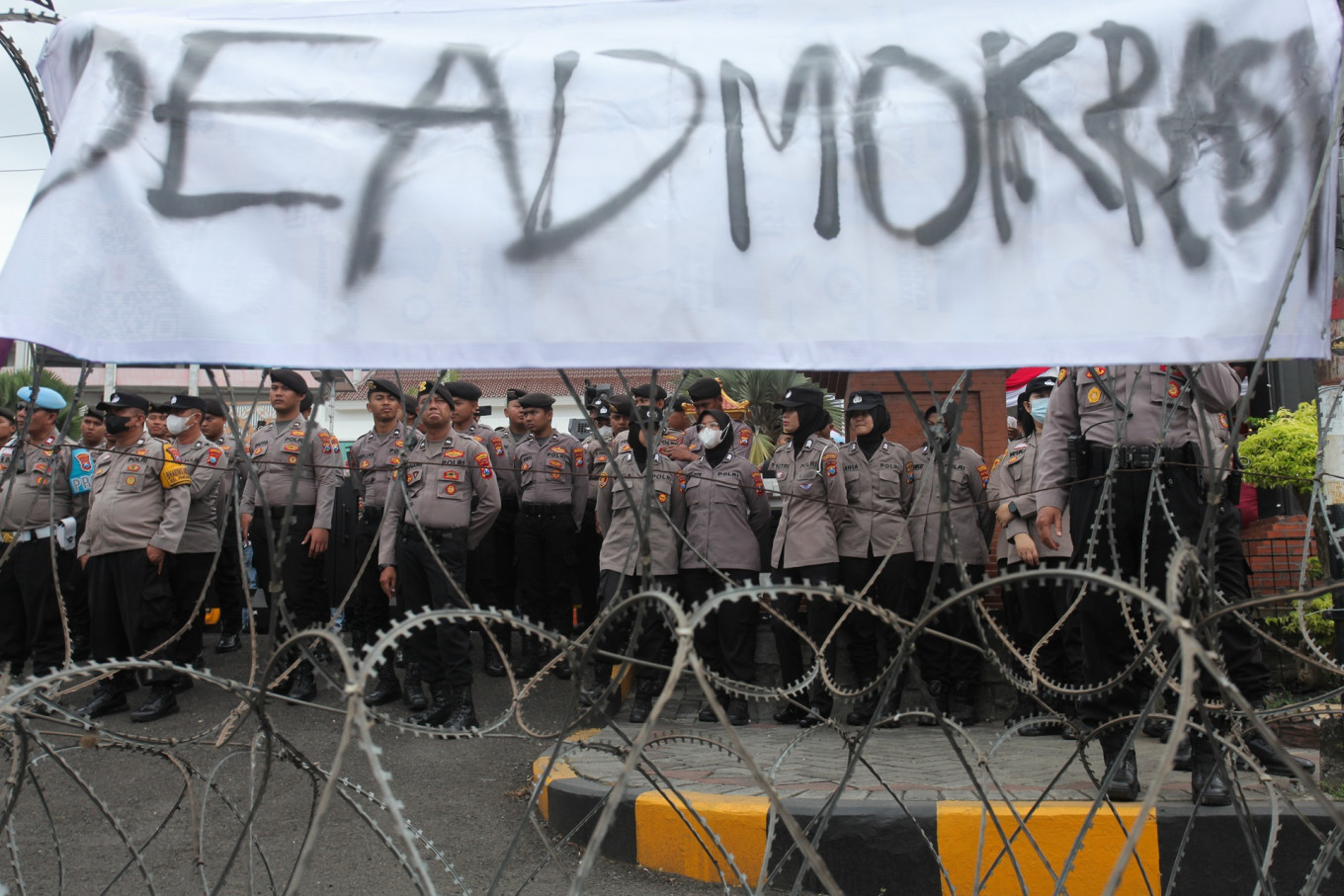 Police officers stand guard behind a razor wire barrier at the East Java Legislative Council (DPRD) in the provincial capital Surabaya on Aug. 19, 2025, during a student-led rally to push for protection of free speech and demand that the government scrap its controversial national history textbook project. (Antara/Didik Suhartono)
A
dangerous illusion is taking root across many democracies in the developing world, perhaps including Indonesia: the belief that unity is always preferable to a contest of ideas, and that a government stripped of opposition will be more efficient, stable and decisive.
History proves, however, that this notion is more than a mere mistake. It is a fatal error. A democracy without opposition and public criticism is not a democracy at all; it is simply power without a correction mechanism.
As Robert A. Dahl reminds us, the essence of democracy lays not just in the act of voting but in the dual pillars of contestation and participation. Without a genuine opposition, contestation vanishes and democracy loses its soul.
The fundamental difference between established and developing democracies can be captured through a simple metaphor: Changing a national leader is like changing a chef.
In developed nations, a change in leadership poses no existential threat. This is not because their leaders are invariably exceptional, but because the kitchen in which they operate is inherently robust. Core institutions, such as the courts, the military, the bureaucracy and the private sector, are stable, independent and governed by rules that bind every actor.
Because the system possesses its own memory and discipline, when the chef is replaced, the menu remains the same, the ingredients remain the same, the recipe is followed and the kitchen layout stays intact.

Consider the United Kingdom, where power alternates frequently between Labour and Conservative governments without rattling the foundations of the state. The system absorbs change without the risk of collapse because ultimately, the kitchen is stronger than the chef.