The Jakarta Post
Please Update your browser
Your browser is out of date, and may not be compatible with our website. A list of the most popular web browsers can be found below.
Just click on the icons to get to the download page.


Popular Reads
Top Results
No results found. Please check your search term and try again
Can't find what you're looking for?
View all search results
Popular Reads
Top Results
No results found. Please check your search term and try again
Can't find what you're looking for?
View all search resultsWar tests BRICS and reveals its limits
Despite calls for mediation, the grouping of so-called Global South nations has remained fragmented, highlighting its role as a "club" akin to the G7 rather than a forum for collective action.
Change text size
Gift Premium Articles
to Anyone
Share the best of The Jakarta Post with friends, family, or colleagues. As a subscriber, you can gift 3 to 5 articles each month that anyone can read—no subscription needed!
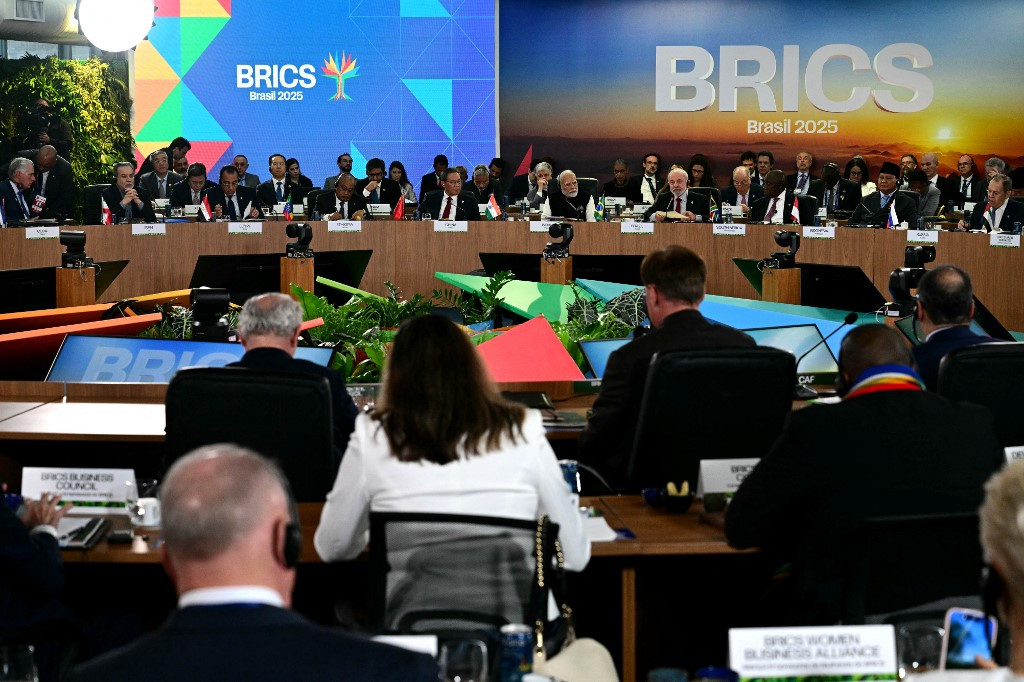 Heads of state and high-level delegates attend the second plenary session on July 6 during the BRICS Summit 2025 in Rio de Janeiro, Brazil. (AFP/Pablo Porciuncula)
M
ore than two months after the United States and Israel launched their military attacks on Iran, the conflict is poised on the edge of a fragile ceasefire. The cost in human suffering for Iran and Lebanon has been high. Israel has also suffered civilian casualties from Iranian missile attacks. However, the economic pain caused by the closure of the Strait of Hormuz and the destruction of energy infrastructure on both sides of the Persian Gulf is already being felt around the world.
Fuel prices in the Philippines have more than doubled since the start of the conflict, affecting households across the country. In India, a rise in the prices of liquefied petroleum gas (LPG) cylinders on the black market has forced migrant workers to leave cities.
The odds of a US recession in the next 12 months have risen to nearly 50 percent. Food prices in Gulf countries, which import 70-80 percent of their food, have surged. Global food availability is also at risk, as fertilizer supplies that transit through the Strait remain disrupted.
Amid all this, one influential grouping of countries, called upon by Iranian leaders including President Masoud Pezeshkian and Foreign Minister Abbas Araghchi to help end the conflict, has been notably silent: the BRICS grouping, comprising Brazil, Russia, India, China and South Africa.
Iran joined the expanded grouping BRICS Plus in 2024. The United Arab Emirates and Saudi Arabia, which have faced Iranian attacks for hosting US bases involved in the war, are also members of BRICS+.
Both Pezeshkian and Araghchi called on India to play a role as the current BRICS chair, but it was Pakistan that eventually took on a mediating role.

Under the fog of war, BRICS has been seen as hesitant, fragmented and even irrelevant. Similar concerns emerged during the 12-day war between Israel and Iran in 2025.
To the extent that BRICS has remained silent on the war, its major members have been able to secure selective benefits, even when belligerents were not satisfied. India, for instance, managed to secure safe passage through the Strait of Hormuz for some of its ships via direct talks with Iran.
In a rare demonstration of their veto powers on the United Nations Security Council, China and Russia jointly undermined a Bahraini resolution, supported by the Gulf states and the US, that would authorize the use of force for “defensive purposes” in Hormuz. Afterward, Trump backed off from his very aggressive rhetoric and announced a ceasefire with Iran.
The lack of collective response on the part of BRICS is not new.
In 2014, the Russian annexation of Crimea drew only a muted response from BRICS, in contrast to its repeated criticisms of international financial institutions and its joint condemnation of NATO’s intervention in Libya during the Arab Spring.
BRICS also remained largely silent in 2022 without seriously engaging the second Russian invasion of Ukraine, despite separate mediation efforts by China’s Xi Jinping and Brazil’s Lula da Silva. In 2025, conflict in East Asia overshadowed the BRICS summit in Brazil, which focused on environmental issues ahead of the COP30 climate summit.
Discomfort with BRICS’ ambivalence may arise less from its member states and more from a broader demand in global politics for new institutional frameworks with stronger input from Global South powers.
There is a sense that the post-1945 liberal international order is both inefficient in a fragmented globalized world and biased toward the West. Over time, the United Nations has faced a prolonged period of institutional decline against the backdrop of crises, such as the war on terror, the 2008 financial crisis and COVID-19.
Meanwhile, expectations from BRICS have risen. Its members remain devoted to their individual interests, however, and function like an informal grouping such as the Group of Seven (G7) rather than a structured multilateral organization like the UN or regional bodies such as ASEAN, the African Union or the European Union.
While the group offers a platform for diverse powers and has expanded significantly in recent years, its loose, leader-driven format limits collective action, as each member retains room to pursue national interests.
This is not unique to BRICS. Similar criticisms are directed at other groupings, including the G7 and the Group of 20 (G20).
India, which is a member of the Quad security alliance along with Australia, the US and Japan, also declined Washington’s calls for “friendly nations” to reopen Hormuz by force.
With the next meeting of BRICS leaders set to take place in September or October in India, a major Global South economy with strong post-pandemic growth, the group’s focus may shift from the immediate energy crisis in West Asia to broader concerns about global economic stagnation.
The world’s attention will again turn to the Global South, although expectations are likely to remain tempered.
---
The writer is an assistant professor of international relations and governance studies at Shiv Nadar University. This article is republished under a Creative Commons license.