The Jakarta Post
Please Update your browser
Your browser is out of date, and may not be compatible with our website. A list of the most popular web browsers can be found below.
Just click on the icons to get to the download page.


Popular Reads
Top Results
No results found. Please check your search term and try again
Can't find what you're looking for?
View all search results
Popular Reads
Top Results
No results found. Please check your search term and try again
Can't find what you're looking for?
View all search resultsIndonesia’s airspace torn between sovereignty and partnership
If Indonesia approves new military overflight arrangements with the United States, it will face a high-stakes balancing act between strategic partnership and national autonomy. In an era of shifting global power, control of Indonesia’s skies must remain a matter of substance, not just symbolism.
Change text size
Gift Premium Articles
to Anyone
Share the best of The Jakarta Post with friends, family, or colleagues. As a subscriber, you can gift 3 to 5 articles each month that anyone can read—no subscription needed!
 Set as preferred source
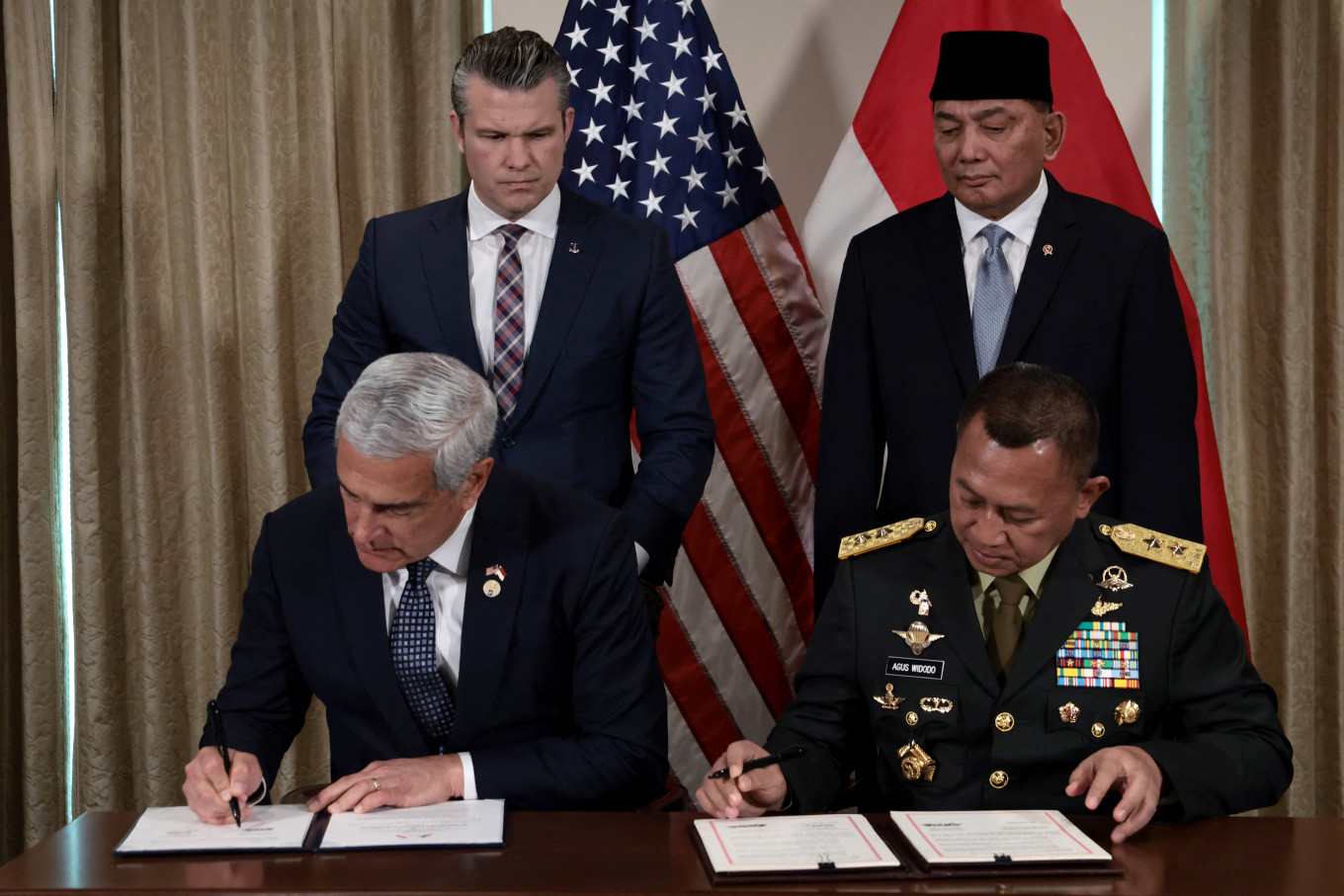 United States Secretary of Defense Pete Hegseth (left, rear) and Indonesian Defense Minister Sjafrie Sjamsoeddin (right, rear) serve as witnesses on April 13, 2026, during a signing ceremony at the Pentagon in Arlington, Virginia, just outside of Washington, D.C. (Reuters/Evelyn Hockstein)
A
mid the rekindled flames of conflict in the Middle East, the world has been reminded once again that airspace is a decisive domain in modern military operations. Rising tensions between the United States and Iran, coupled with the ever-present risk of regional escalation, illustrate that contemporary warfare is no longer confined to land and sea. Instead, it is increasingly defined by access to and control over the skies across national boundaries.
In an interconnected world, the air corridors of states far removed from an immediate theater of conflict can assume immense strategic value as pathways for military movement. Within this broader geopolitical context, any policy concerning overflight access becomes profoundly sensitive, as national decisions are inevitably entangled with global power dynamics.
Against this backdrop, the proposed understanding between Indonesia and the US on the operationalization of military overflight raises fundamental questions regarding the direction of Indonesia’s sovereignty policy. Indonesian Defense Minister Sjafrie Sjamsoeddin is visiting Washington, D.C. for talks with his US counterpart, Secretary of Defense Pete Hegseth, regarding a major defense partnership between the two nations.
Regarding the overflight proposal, the Defense Ministry has stated it will not compromise Indonesia’s sovereignty. Nevertheless, what appears on the surface as a technical arrangement governing military aviation actually touches the very core of statehood: the extent to which Indonesia exercises full control over its sovereign airspace.
When access is granted under the framework of contingency operations, crisis response and joint exercises, the implications of such permission extend far beyond routine clearance and enter the realm of strategic consequence.
Within the international aviation regime articulated by the International Civil Aviation Organization (ICAO), state sovereignty over airspace is both complete and exclusive. This principle is not merely declaratory. It forms the legal and operational foundation on which a state governs all activities in its skies.

Sovereignty entails the authority to determine who may enter, for what purpose, along which routes and under what conditions. When a state begins to extend access through standing or semipermanent mechanisms, what is at stake is not simply permission but the integrity of control itself.