TheJakartaPost
Please Update your browser
Your browser is out of date, and may not be compatible with our website. A list of the most popular web browsers can be found below.
Just click on the icons to get to the download page.


Popular Reads
Top Results
No results found. Please check your search term and try again
Can't find what you're looking for?
View all search results
Popular Reads
Top Results
No results found. Please check your search term and try again
Can't find what you're looking for?
View all search resultsAnalysis: Meikarta to Tanah Abang: Public housing in private hands
Change text size
Gift Premium Articles
to Anyone
Share the best of The Jakarta Post with friends, family, or colleagues. As a subscriber, you can gift 3 to 5 articles each month that anyone can read—no subscription needed!
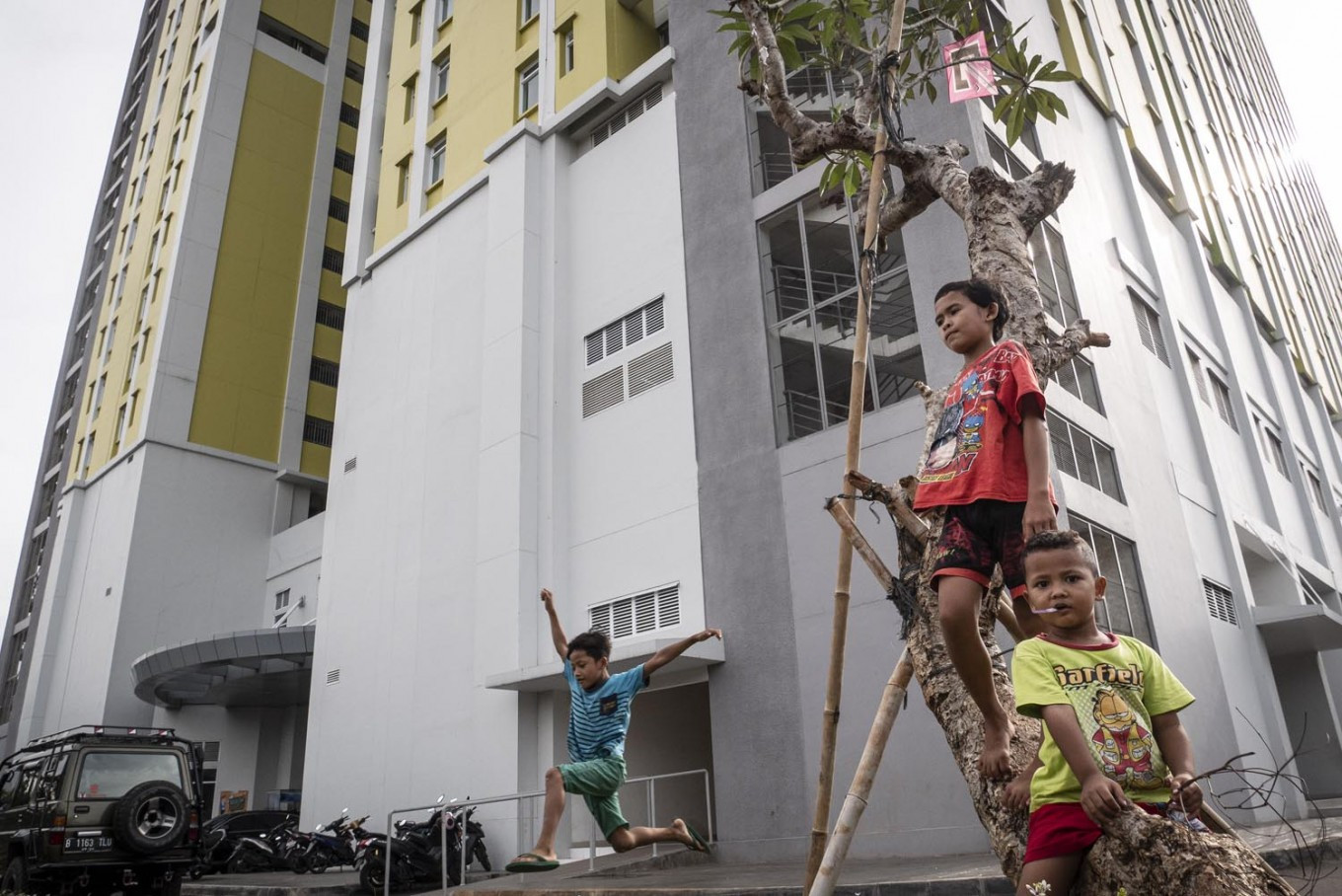 Children play on May 4, 2020, in the yard of the Pasar Rumput Simple low-cost apartment (rusun) in South Jakarta. (Antara/Dhemas Reviyanto)
o
f its plan to deliver 3 million homes, the government is partnering with state-owned PT Kereta Api Indonesia (KAI) and PT Astra International to build 1,000 low-cost flats on KAI-owned land in Tanah Abang, Central Jakarta, financed through Astra’s corporate social responsibility (CSR) scheme. While the model appears efficient, it raises a key question: Is this a sustainable solution to Indonesia’s housing shortage, or merely a stopgap that masks deeper structural gaps and potential quid pro quo dynamics?
The 3-million housing program is one of President Prabowo’s flagship initiatives to expand access to affordable housing and reduce regional disparities. Achieving this target requires substantial financing, pushing the government to move beyond the state budget and increasingly rely on private sector participation.
Astra International’s involvement reflects this broader shift toward public–private collaboration. The company plans to develop affordable apartment units on PT KAI’s land in Tanah Abang, a strategically located site with strong long-term residential potential. Each unit will be around 35 square meters with two bedrooms, targeting lower-income households.
Under the arrangement, the government provides the land while Astra handles construction, with the completed units to be handed back to the state. While this project illustrates how private participation can help accelerate housing supply, it also highlights a growing dependence on corporate actors in delivering what is fundamentally a public good.
Housing and Settlements Minister Maruarar “Ara” Sirait has outlined various schemes to accelerate the construction of subsidized flats, with land sourced from state assets, state-owned enterprises (SOEs), ministries and local governments. Development may involve a mix of actors, including SOEs, government institutions and private firms, while financing extends beyond the state budget to include CSR and other alternative mechanisms.
However, the increasing reliance on CSR as a financing instrument raises a more fundamental concern. Public housing is inherently a core state responsibility, and its provision through corporate philanthropy reflects a growing dependence on private actors to deliver what has traditionally been a public mandate. This blurring of roles not only represents a pragmatic response to fiscal constraints but also signals a gradual redefinition of the state’s responsibility in delivering social welfare.

A similar pattern can be seen in the planned repurposing of the Meikarta project in Cikarang, Bekasi, owned by the Lippo Group. Once a high-profile development stalled by regulatory and legal controversies, the site is now being repositioned as part of the government’s subsidized housing strategy.