The Jakarta Post
Please Update your browser
Your browser is out of date, and may not be compatible with our website. A list of the most popular web browsers can be found below.
Just click on the icons to get to the download page.


Popular Reads
Top Results
No results found. Please check your search term and try again
Can't find what you're looking for?
View all search results
Popular Reads
Top Results
No results found. Please check your search term and try again
Can't find what you're looking for?
View all search resultsFinding legal certainty for Indonesia's ambitious spaceport program
To claim its rightful place in the global space race, Indonesia must bridge the gap between its unparalleled equatorial advantage and the legal vacuum stalling its national spaceport.
Change text size
Gift Premium Articles
to Anyone
Share the best of The Jakarta Post with friends, family, or colleagues. As a subscriber, you can gift 3 to 5 articles each month that anyone can read—no subscription needed!
 Set as preferred source
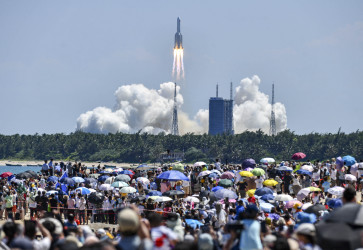
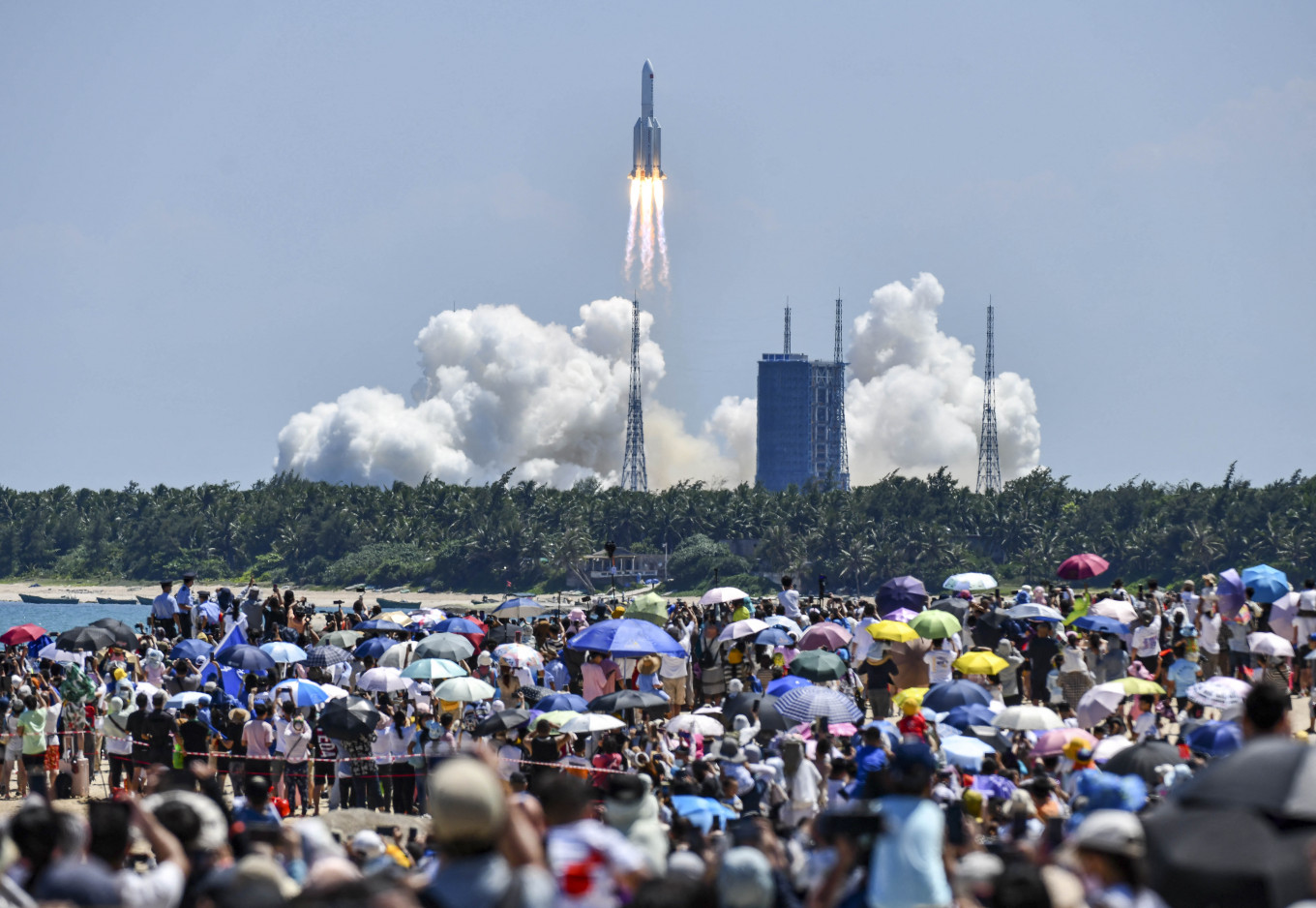 Onlookers watch the launch of a rocket transporting China’s second module for its Tiangong space station from the Wenchang spaceport in southern China on July 24, 2022. (AFP/CNS)
T
he recent Artemis II Moon mission serves as yet another reminder that a spaceport is a strategic piece of infrastructure that signifies technological advancement. It paves the way for the building of a space economy and fostering national pride. However, only a few states possess the geographic advantage and natural opportunity to host a spaceport.
Sitting in the equator offers Indonesia significant technological advantages for launch services. Because the Earth rotates faster at the equator, it provides rockets with natural thrust, minimizing both fuel consumption and the need for additional boosters. In short, an equatorial launch significantly reduces costs.
Several nations are currently vying to become space hubs. The Guiana Space Center in Kourou, operated by the European Space Agency, is a prime example of a near-equatorial spaceport. In Asia, equatorial spaceports include the Satish Dhawan Space Centre in India and the Wenchang Space Launch Site in China.
No such facility exists in Southeast Asia, even though the region is crossed by the equator through Indonesia. Aware of this market and the prestigious opportunity it presents, ASEAN member states, specifically Indonesia, Malaysia and Thailand, are eyeing the establishment of their own spaceports. While competitors can only achieve "near-equatorial" status, Indonesia possesses a crystal-clear distinction and a natural competitive advantage.
Building and operating a national spaceport has been a pillar of Indonesia’s vision for decades; it represents a vital milestone in the nation's mastery of space technology. This vision is the result of long-standing studies considering several locations.
In discussions concluded around 2020, the two primary candidates were Morotai in Sulawesi and Biak in Papua. Today, it is widely reported that Biak is set to host the national spaceport, aiming to provide launch services primarily for Low Earth Orbit (LEO) missions.

To understand Indonesia’s complicated policy on this matter, one must trace its legal history. The National Research and Innovation Agency (BRIN) has owned 100 hectares of land in Biak since the 1980s. Discussions regarding spaceport construction with local communities began in parallel during that period. In the 1990s, the Indonesian Space Agency (LAPAN) began conducting social and technical studies on the Indonesian spaceport dream. Therefore, this is not a sudden development for the local population.