TheJakartaPost
Please Update your browser
Your browser is out of date, and may not be compatible with our website. A list of the most popular web browsers can be found below.
Just click on the icons to get to the download page.


Popular Reads
Top Results
No results found. Please check your search term and try again
Can't find what you're looking for?
View all search results
Popular Reads
Top Results
No results found. Please check your search term and try again
Can't find what you're looking for?
View all search resultsIndia marks milestone in peaceful nuclear energy program
India has officially entered the second stage of its three-stage nuclear power program.
Change text size
Gift Premium Articles
to Anyone
Share the best of The Jakarta Post with friends, family, or colleagues. As a subscriber, you can gift 3 to 5 articles each month that anyone can read—no subscription needed!
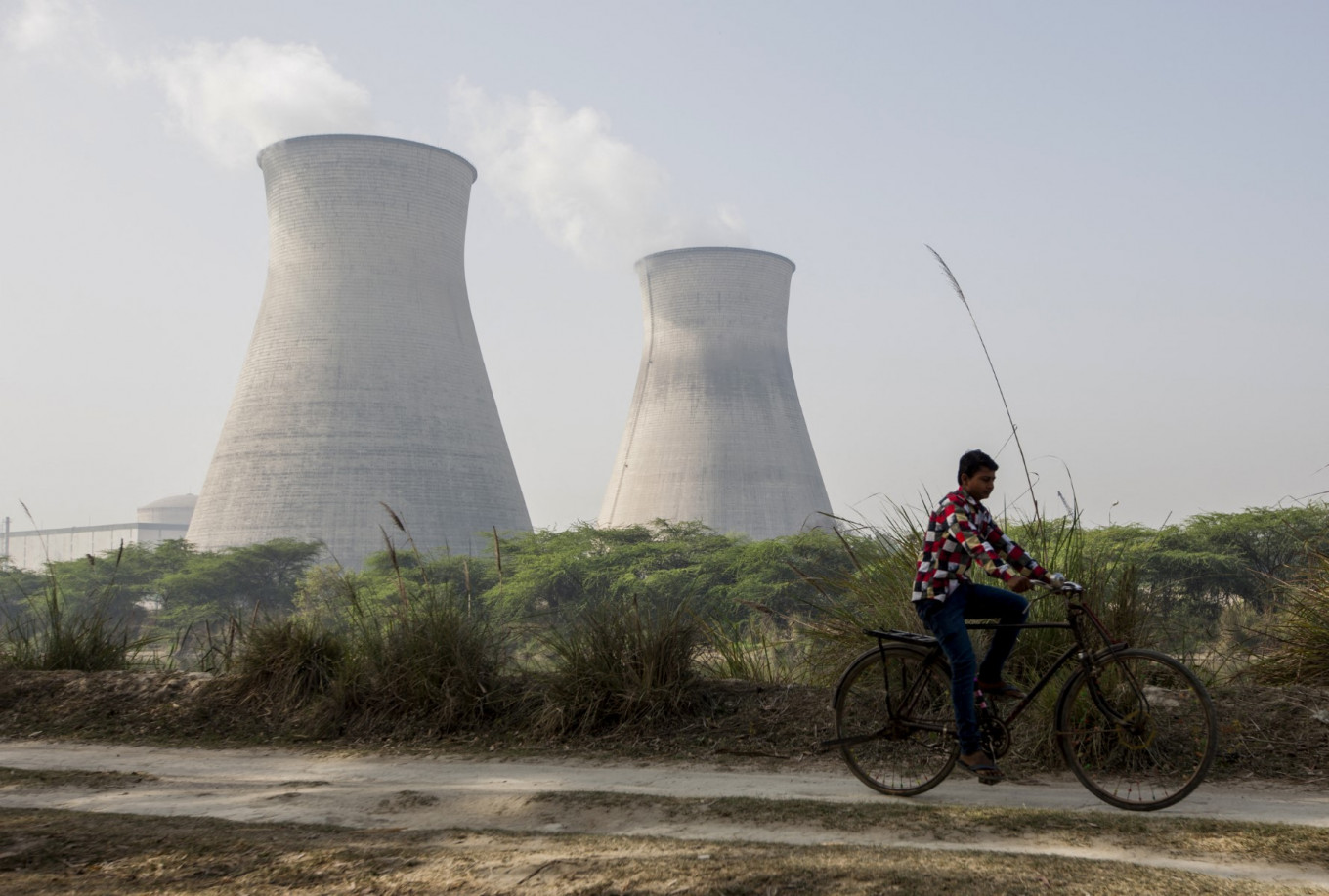 An Indian man cycles on March 27, 2018, along a dirt road next to the Norora Atomic Power Station near Norora in Uttar Pradesh state. (AFP/Xavier Galiana)
I
ndia has marked a major milestone in its peaceful nuclear energy program. The indigenously designed and built Prototype Fast Breeder Reactor (PFBR) at Kalpakkam in the Southern Indian state of Tamil Nadu successfully attained its first criticality on April 6, marking the initiation of a sustained nuclear chain reaction. This PFBR is a 500 MWe (MegaWatt electrical) reactor. India has achieved what some of the world's biggest nuclear powers, the United States and France, could not.
With this achievement, India has officially entered the second stage of its three-stage nuclear power program, a vision first conceived by Homi Jehangir Bhabha, the architect of India's nuclear program. The milestone carries substantial global significance. Once fully operational, India will become only the second country in the world after Russia to operate a commercial fast breeder reactor.
This achievement is a testament to the decades of scientific effort led by India’s Department of Atomic Energy. It also marks a significant step in India's clean energy journey, reinforcing the country's commitment to reliable, low-carbon power. Additionally, it brings India closer to its goal of achieving net zero emissions by 2070, as announced by Indian Prime Minister Narendra Modi.
India holds limited uranium reserves but one of the largest thorium reserves in the world. Thorium is considered a practically vast energy source and this stage holds the key to India's long-term energy security. To make the most of these resources, India’s Department of Atomic Energy designed a three-stage nuclear power program built on a closed nuclear fuel cycle. The goal is to progressively multiply domestic fissile resources and secure long-term energy independence.
Fast Breeder Reactors are a cornerstone of India’s long-term nuclear strategy. Unlike conventional thermal reactors, the PFBR uses Uranium-Plutonium Mixed Oxide (MOX) fuel. The core of PFBR is surrounded by a blanket of Uranium-238. Fast neutrons convert fertile Uranium-238 into fissile Plutonium-239, enabling the reactor to produce more fuel than it consumes. The reactor is designed to eventually use Thorium-232 in the blanket. Through transmutation, Thorium-232 will be converted into Uranium-233, which will fuel the third stage of India’s nuclear power program.
India's nuclear energy program has maintained a steady presence in the country's electricity mix. It now stands at a pivotal moment, with significant expansion planned over the coming years. India's current nuclear capacity is 8.78 Gigawatt (GW). Nuclear power has consistently accounted for around 3 percent of India's total electricity generation. In 2024–2025, its share stood at 3.1 percent. There are 25 nuclear power reactors in India.

India's nuclear capacity is set to grow nearly three time in the coming years. With indigenous 700 Megawatt (MW) reactors and 1,000 MW reactors being developed through international cooperation, the installed capacity is projected to reach 22.38 GW by 2031–2032. India has signed Inter-Governmental Agreements (IGAs) on Civil Nuclear Cooperation for peaceful purposes with 18 countries, reflecting the growing global confidence in India's nuclear program.