The Jakarta Post
Please Update your browser
Your browser is out of date, and may not be compatible with our website. A list of the most popular web browsers can be found below.
Just click on the icons to get to the download page.


Popular Reads
Top Results
No results found. Please check your search term and try again
Can't find what you're looking for?
View all search results
Popular Reads
Top Results
No results found. Please check your search term and try again
Can't find what you're looking for?
View all search resultsAnalysis: Mounting losses put construction SOE consolidation to the test
Change text size
Gift Premium Articles
to Anyone
Share the best of The Jakarta Post with friends, family, or colleagues. As a subscriber, you can gift 3 to 5 articles each month that anyone can read—no subscription needed!
 Set as preferred source
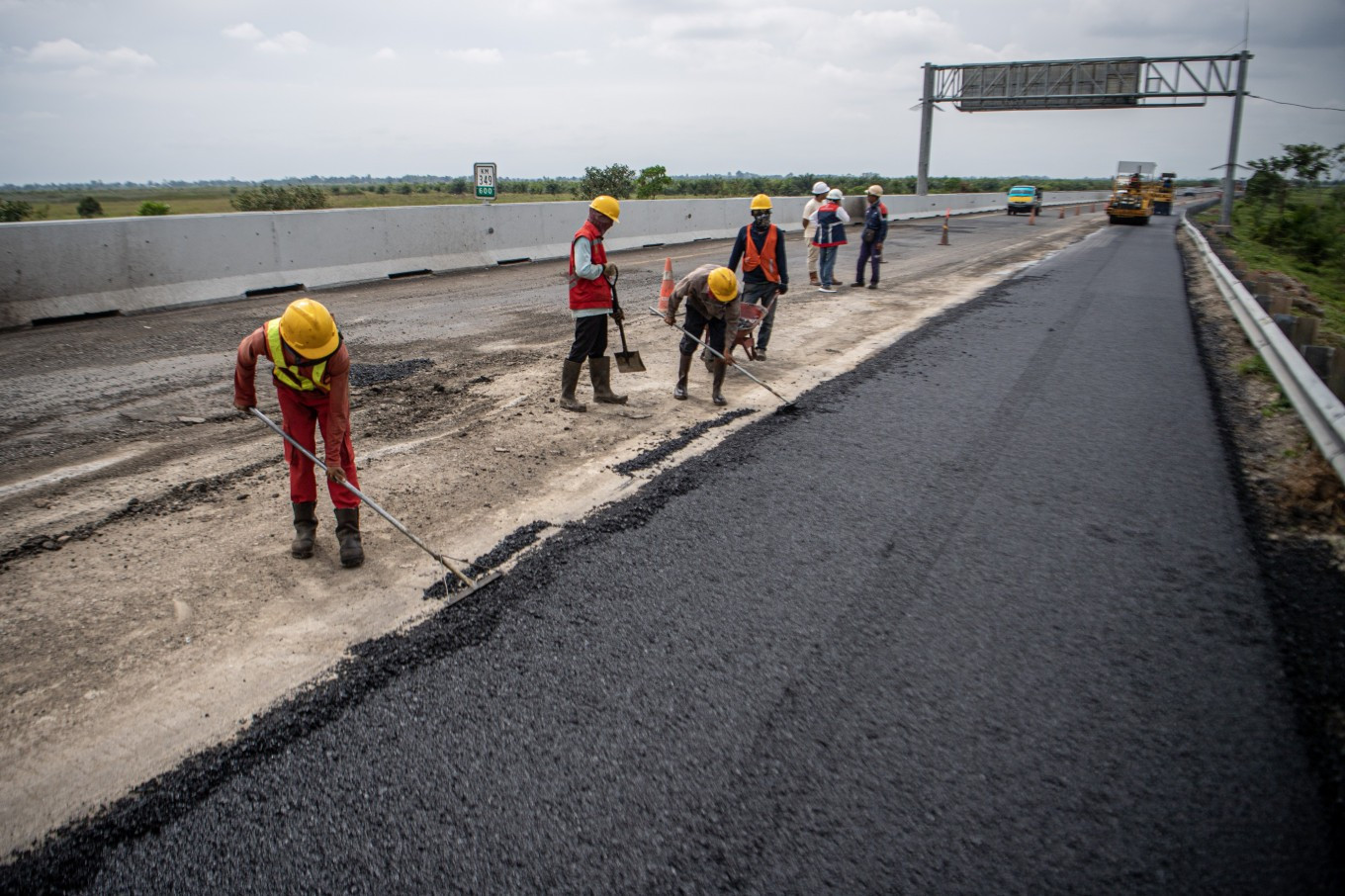 Workers from PT Waskita Sriwijaya, a subsidiary of state-owned construction firm Waskita Karya, use rakes on April 3, 2023 to spread asphalt along a section of the Trans-Sumatra Toll Road in Ogan Komering Ilir regency, South Sumatra. (Antara/Nova Wahyudi)
I
ndonesia’s largest state-owned construction firms – Wijaya Karya (Wika), Pembangunan Perumahan (PP), Adhi Karya (Adhi) and Waskita Karya (Waskita) – have sunk deeper into financial distress, posting a combined loss of around Rp 28 trillion (US$1.7 billion) in 2025. Far from incidental, these losses reflect years of aggressive and often unprofitable investments tied to the infrastructure push under former president Joko “Jokowi” Widodo, turning what was once a growth engine into a mounting financial burden.
Against this backdrop, the long-delayed consolidation plan for construction state-owned enterprises (SOEs) is once again under scrutiny. Initially proposed during SOEs Minister Erick Thohir’s tenure, the plan has been repeatedly postponed and is now expected to materialize no earlier than the second half of 2026 under the coordination of the Danantara sovereign wealth fund.
The consolidation aims to merge seven construction SOEs — including Wika, Waskita, PP, Adhi, Nindya Karya and Brantas Abipraya — into three entities organized by business lines: buildings, infrastructure, engineering, procurement and construction (EPC). In theory, this restructuring is intended to improve efficiency, reduce overlap and strengthen financial resilience.
In practice, however, the delay reflects a deeper concern: These companies are not yet financially ready to consolidate. Danantara has prioritized financial recovery before integration, focusing on improving cash flow, restructuring debt and optimizing nonproductive assets. Yet this approach faces a fundamental challenge. The financial condition of these firms continues to deteriorate, creating a vicious cycle in which losses weaken balance sheets, limit financing capacity and further constrain recovery efforts.
The scale of the losses is striking. In 2025 alone, Wika recorded the largest deficit at Rp 10.14 trillion, followed by PP at Rp 8 trillion, Adhi at Rp 5.4 trillion and Waskita at Rp 4.48 trillion. Rather than stabilizing, losses have deepened compared with previous years.
Part of the deterioration is linked to impairment charges. For instance, PP’s impairment losses surged from Rp 1.89 trillion in 2024 to Rp 7.35 trillion in 2025, largely driven by its property segment. As a result, the property segment accounts for 99 percent of the company’s losses, highlighting the failure of its diversification strategy.

Wika, meanwhile, presents a different but equally concerning picture. While it faced decreasing fair value on inventories and property investment, more than half of its losses originated from infrastructure and building construction activities. A significant portion is tied to its involvement in the Whoosh Jakarta-Bandung high-speed rail project through its stake in PT Pilar Sinergi BUMN Indonesia, a consortium of Indonesian SOEs for the project.